
Key takeaways
- Best overall for most households: ARRIS SURFboard S34, with DOCSIS 3.1 and a 2.5Gbps Ethernet port.
- Best for multi-gig service: NETGEAR CM3000, which combines DOCSIS 3.1 with a 2.5Gbps Ethernet port and broad high-speed positioning.
- Best alternative for a 1Gbps plan: Motorola MB8611, a DOCSIS 3.1 modem with a 2.5Gbps Ethernet port.
- Best lower-cost choice for slower plans: Motorola MB7621, a DOCSIS 3.0 24×8 modem for compatible plans up to roughly 600Mbps, depending on the ISP.
- Best future-facing category: a DOCSIS 4.0 modem such as the Hitron CODA56 where the ISP specifically supports that model and technology.
The best cable modems in 2026 are DOCSIS 3.1 models with at least a 2.5Gbps Ethernet port, but the right choice still depends on your ISP, subscribed speed, and whether you plan to upgrade soon.
Our top picks
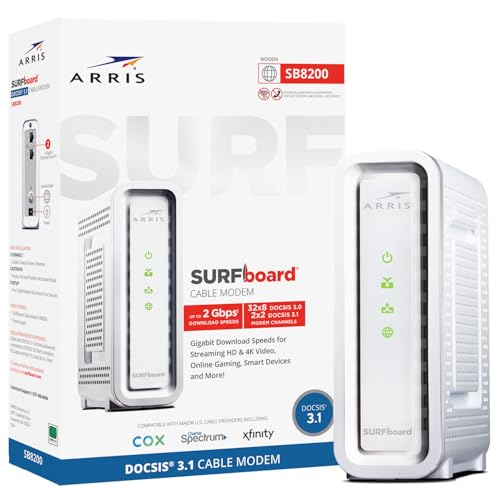


As an Amazon Associate we earn from qualifying purchases at no extra cost to you. Ratings are shown as listed on Amazon.
Quick picks for different home internet plans
- Best overall for most households: ARRIS SURFboard S34, with DOCSIS 3.1 and a 2.5Gbps Ethernet port.
- Best for multi-gig service: NETGEAR CM3000, which combines DOCSIS 3.1 with a 2.5Gbps Ethernet port and broad high-speed positioning.
- Best alternative for a 1Gbps plan: Motorola MB8611, a DOCSIS 3.1 modem with a 2.5Gbps Ethernet port.
- Best lower-cost choice for slower plans: Motorola MB7621, a DOCSIS 3.0 24×8 modem for compatible plans up to roughly 600Mbps, depending on the ISP.
- Best future-facing category: a DOCSIS 4.0 modem such as the Hitron CODA56 where the ISP specifically supports that model and technology.
What to compare before buying a cable modem
DOCSIS version
DOCSIS is the standard that controls how a cable modem communicates with your provider. DOCSIS 3.0 remains usable for many basic and midrange plans, but channel bonding limits its maximum capacity. DOCSIS 3.1 is the practical default for new purchases because it supports gigabit-class service, improved network efficiency, and better upgrade headroom.
DOCSIS 4.0 is newer and designed for substantially higher downstream and upstream capacity. However, buying a DOCSIS 4.0 modem only makes sense when your cable provider supports both the technology and the exact modem model. A newer standard does not override ISP certification requirements.
Downstream and upstream channels
DOCSIS 3.0 modems are described with channel counts such as 8×4, 16×4, or 24×8. The first number refers to downstream channels and the second to upstream channels. More channels can improve the modem’s theoretical capacity and resilience, but the actual speed is determined by your plan and network.
DOCSIS 3.1 uses OFDM and OFDMA profiles rather than relying only on the older channel-count format. Manufacturers may still list legacy channel support, but shoppers should prioritize DOCSIS 3.1 compatibility and the ISP’s approved speed tier over a simple channel-count comparison.
Ethernet port speed
The Ethernet port is the modem’s connection to your router. A modem with only a 1Gbps port can become a bottleneck on a plan above 1Gbps, even if its DOCSIS hardware is capable of more. For a gigabit plan, a 1Gbps port is usually sufficient, although real-world wired speeds will be below the advertised line rate. For plans above 1Gbps, choose a 2.5Gbps port and make sure your router, switch, and computer also support multi-gig Ethernet.
ISP compatibility
Compatibility is not universal. Cable providers approve specific modem models and firmware versions, sometimes limiting which speed tiers each model can use. Before purchasing, check your provider’s official compatible-modem list and enter the exact model number. Also verify whether the modem is approved for your intended speed tier, not merely listed as “compatible.”
| Modem | DOCSIS | Ethernet port | Best suited to | Typical market position |
|---|---|---|---|---|
| ARRIS SURFboard S34 | 3.1 | 2.5Gbps | Gigabit and selected multi-gig plans | Midrange to premium |
| NETGEAR CM3000 | 3.1 | 2.5Gbps | High-speed and multi-gig plans | Premium |
| Motorola MB8611 | 3.1 | 2.5Gbps | Gigabit plans and upgrade headroom | Midrange |
| Motorola MB7621 | 3.0, 24×8 | 1Gbps | Basic to midrange plans where approved | Budget |
| Hitron CODA56 | 4.0 | 2.5Gbps | Selected DOCSIS 4.0 deployments | Premium or emerging category |
Head-to-head: which modem fits your situation?
ARRIS S34 vs. Motorola MB8611
Both are DOCSIS 3.1 modems with 2.5Gbps Ethernet, so they are more alike than different for ordinary home use. Either is a sensible choice for a gigabit plan when listed as approved by your ISP. The ARRIS S34 is appealing if you want a newer current-generation design and a straightforward upgrade path. The MB8611 is a proven type of DOCSIS 3.1 option that can be attractive when its market price is lower.
Choose between them based on ISP approval, warranty terms, physical space, and price rather than expecting a major speed difference. A modem cannot increase a plan’s subscribed speed.
NETGEAR CM3000 vs. a basic DOCSIS 3.1 modem
The CM3000 is the better fit when your provider offers speeds above 1Gbps or when you want to avoid replacing the modem after a near-term upgrade. Its 2.5Gbps Ethernet connection is important for multi-gig service. For a 300Mbps plan, however, the extra capacity may provide little practical benefit unless the price difference is small or you expect to upgrade.
Motorola MB7621 vs. DOCSIS 3.1 models
The MB7621 can reduce the purchase cost for a slower plan, but it has less upgrade headroom. It is most appropriate for households with modest usage, a provider-approved plan in the lower speed range, and no immediate need for gigabit service. If you expect to move to 1Gbps or faster within the next few years, a DOCSIS 3.1 model may have a lower total ownership cost even if its initial price is higher.
A practical buying decision matrix
| Your situation | Recommended modem type | Why | What to avoid |
|---|---|---|---|
| Plan up to 400Mbps, tight budget | Approved DOCSIS 3.0 or entry DOCSIS 3.1 | Lower purchase cost is more valuable than unused capacity | Unapproved used equipment |
| 500Mbps to 1Gbps plan | DOCSIS 3.1, preferably 2.5Gbps Ethernet | Provides better upgrade headroom | New 16×4 or older DOCSIS 3.0 models |
| Above 1Gbps | DOCSIS 3.1 or 4.0 with 2.5Gbps-plus Ethernet | Prevents the Ethernet port from limiting service | Any modem with only a 1Gbps port |
| Small apartment or crowded shelf | Compact modem with accessible ventilation | Allows cooling without wasting space | Enclosed cabinets and stacked heat-producing devices |
| Nontechnical setup | ISP-approved modem with simple web activation | Reduces activation and troubleshooting problems | Gray-market or region-specific versions |
Setup steps that prevent common problems
- Confirm approval first. Record the exact model number and hardware revision, then check the provider’s compatibility database.
- Place the modem in an open position. Leave ventilation around the unit and do not put it inside a drawer, on a soft surface, or directly on top of another hot device.
- Connect the coaxial cable securely. Finger-tighten the connector. Avoid sharp bends, damaged cable, and unnecessary splitters.
- Connect Ethernet to the router’s fastest compatible port. A 2.5Gbps modem connected to a 1Gbps router port will operate at the lower link speed.
- Activate the modem with the provider. You may need the modem’s MAC address or serial number printed on its label.
- Test with a wired device. Wi-Fi speed depends on the router, wireless band, distance, interference, and client device, so it is not a reliable first test of modem performance.
Ownership realities and common mistakes
Cable modems have no user-replaceable consumables, but heat, power fluctuations, loose coaxial connections, and aging network hardware can cause trouble. Dust the ventilation openings occasionally with the modem unplugged. Do not use compressed air aggressively inside the housing, and replace visibly damaged coaxial cables rather than repeatedly rebooting.
Buying a modem that is “up to” a high speed does not guarantee that speed. For example, suppose a modem costs $70 more than a basic approved model and you expect to keep it for four years. That premium works out to about $1.46 per month: $70 divided by 48 months. That can be reasonable for future-proofing, but only if the provider supports the modem and your router can use its faster Ethernet port.
Also remember that a modem and router are separate devices unless you deliberately choose a gateway. A modem handles the cable connection; the router supplies Wi-Fi, local networking, security features, and often mesh support. If your wireless coverage is poor, replacing the modem alone will not solve the problem.
Final buying recommendation
For most new purchases, select an ISP-approved DOCSIS 3.1 modem with a 2.5Gbps Ethernet port, such as the ARRIS S34, NETGEAR CM3000, or Motorola MB8611, and match it to your provider’s certified speed tier. Choose a DOCSIS 3.0 model such as the Motorola MB7621 only when its lower price clearly suits a slower plan and you do not expect an upgrade soon. Consider DOCSIS 4.0 only after confirming local availability, exact-model certification, and compatible multi-gig networking throughout your home.





Write Your Review
No reviews yet. Be the first to share your experience!