
Key takeaways
- Plate material: Cast aluminum heats faster and is easier to lift; stone is heavier and holds heat longer. Nonstick-coated metal can simplify cooking, but its coating needs gentle utensils and nonabrasive cleaning.
- Capacity: Match pan count to the number of people who will eat at once. For a larger group, also consider the top plate’s cooking area; pan count alone does not tell you how much food fits on top.
- Temperature control: A dial or thermostat gives more flexibility than a single on/off setting, especially when switching from warming cheese to grilling. Some models have limited heat adjustment, so check the controls rather than assuming they are included.
- Cleanup: Removable plates and dishwasher-safe pans can save time, but confirm which pieces are actually dishwasher-safe. The heating element and base should not be submerged.
- Table space: Allow room around the unit for pans to slide in and out, serving plates, and safe cord routing. A long appliance can crowd a narrow table even when its footprint looks reasonable on paper.
Best Raclette Grill Sets: Top Picks for Easy Entertaining
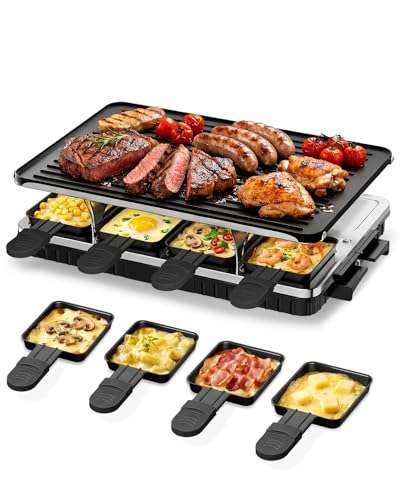
The best raclette grill set for most casual dinners is an eight-person, reversible grill-and-griddle model with adjustable heat and removable plates; choose a compact four-person set for limited table space or a larger, higher-wattage set when you regularly host a crowd.
Raclette sets vary most in how many people they can serve at once, whether the top plate is stone or metal, and how much effort cleanup takes. Before choosing, measure the table: the grill needs room not only for its base but also for diners to reach their pans safely.
Our top picks


As an Amazon Associate we earn from qualifying purchases at no extra cost to you. Ratings are shown as listed on Amazon.
Quick comparison: which type fits your table?
| Type or example | Capacity | Top cooking surface | Heat and practical notes | Best for |
|---|---|---|---|---|
| Compact four-person set | 4 pans | Usually a small metal grill plate | Often around 600–900 watts; smaller footprint, but less room to grill a full round of ingredients | Couples, small households, and occasional use |
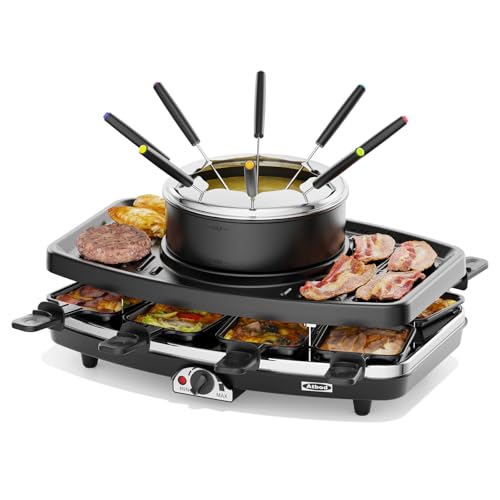
| Swissmar Classic Raclette, 8-person model | 8 pans | Reversible cast-aluminum grill and crepe plate | About 1,200 watts; separate pan stations make it easy for everyone to melt cheese at the same time | Regular family dinners and mixed menus |
| Swissmar Stelvio, 8-person model | 8 pans | Reversible grill and flat griddle plate | About 1,200 watts; offers more direct cooking area than a compact set, while retaining individual cheese pans | Hosts who want a versatile, all-in-one tabletop option |
| Stone-top raclette set | Commonly 8 pans | Natural stone, sometimes paired with a metal grill plate | Stone takes longer to heat and holds heat well; the exact wattage and dimensions depend on the model | Leisurely meals and diners who prefer a gentler, steady cooking surface |
| Large party set | 8–10 pans, depending on model | Metal or stone, sometimes with a reversible plate | Often roughly 1,200–1,500 watts; larger size needs generous table space and a nearby outlet | Frequent gatherings where several people cook at once |
Capacities and wattages are typical specifications, not guarantees across every version or regional model. Check the manufacturer’s listing for the exact dimensions, included pans, and electrical rating before buying. An eight-pan set means eight people can melt a portion simultaneously; it does not mean the top grill can cook eight full servings of meat at once.
Top picks by situation
Best all-around: an eight-person reversible metal-plate set
The Swissmar Classic and Stelvio are useful reference points for this category: both are established eight-person raclette models with reversible cast-aluminum cooking surfaces and individual cheese pans. Metal heats relatively quickly and is lighter to handle than a thick stone slab. A ridged side is handy for grilling; a flat side suits eggs, vegetables, or small pancakes, depending on the model and its instructions.
Choose this style if you want one appliance for occasional dinners and holiday gatherings. Its main trade-off is that the grill surface is shared: guests may need to cook in batches, especially if the meal includes several ingredients that take time to brown.
Best for a relaxed meal: a stone-top set
A stone plate retains heat, so it can keep cooking steadily as guests take turns. It is a good match for slow meals and simple ingredients, but it is not the quick-start option. Allow extra preheating time, and avoid placing a hot stone on a cold or wet surface. Stone is heavy and can crack if subjected to sudden temperature changes or impact, so storage and handling matter.
Stone can also be slower to scrub if food sticks. A metal plate is usually the more convenient pick when quick warm-up and easier handling matter more than heat retention.
Best for small tables: a four-person compact set
A smaller model uses less table space and suits a household that will rarely serve more than four. Its limitation is flexibility: if you invite extra guests, the group has to share pans or serve in shifts. Compare the appliance’s actual length and width—not just its listed serving count—with the usable space between plates, glasses, and serving dishes.
Best for frequent hosting: a larger set with removable, adjustable parts
For a regular crowd, prioritize enough pans for each guest, an adjustable thermostat, and a plate that lifts off for cleaning. A larger set can draw substantial power, so use a stable, heat-resistant surface and follow the manufacturer’s electrical guidance. Avoid running it through an overloaded power strip or placing the cord where someone could pull the hot appliance off the table.
How to choose: five criteria that matter
- Plate material: Cast aluminum heats faster and is easier to lift; stone is heavier and holds heat longer. Nonstick-coated metal can simplify cooking, but its coating needs gentle utensils and nonabrasive cleaning.
- Capacity: Match pan count to the number of people who will eat at once. For a larger group, also consider the top plate’s cooking area; pan count alone does not tell you how much food fits on top.
- Temperature control: A dial or thermostat gives more flexibility than a single on/off setting, especially when switching from warming cheese to grilling. Some models have limited heat adjustment, so check the controls rather than assuming they are included.
- Cleanup: Removable plates and dishwasher-safe pans can save time, but confirm which pieces are actually dishwasher-safe. The heating element and base should not be submerged.
- Table space: Allow room around the unit for pans to slide in and out, serving plates, and safe cord routing. A long appliance can crowd a narrow table even when its footprint looks reasonable on paper.
A practical fit check before you buy
Measure the clear tabletop area, then compare it with the set’s published length and width. Add roughly 12 inches around the appliance where possible for access to pans and serving dishes; this is a planning allowance, not a manufacturer requirement. For example, a 20-by-10-inch grill needs a clear central area of about 44 by 34 inches if you allow 12 inches on each side. If your table cannot spare that room, a compact set—or placing side dishes on a nearby counter—will make dinner less cramped.
Also check your outlet location. A cord stretched across a walkway can be a bigger problem than a slightly smaller grill surface. Position the appliance before guests sit down, and keep the hot top plate away from table edges and dangling linens.
Ownership and cleanup: what to expect
Cheese residue and grease are the main cleanup jobs. Let the appliance cool fully, then remove the plates and pans according to the manual. Soak stubborn residue in warm water if the manufacturer permits it; use a soft sponge on coated surfaces, not metal scouring pads. Wipe the base with a damp cloth only after unplugging it, and keep moisture away from the heating element and controls.
Coatings are often the first part to show wear. Metal utensils, abrasive cleaners, and overheating an empty coated plate can shorten its useful life. Stone avoids coating wear but can chip or crack if dropped, stored under heavy items, or exposed to abrupt temperature changes. Pans and wooden or heat-resistant plastic spatulas may also be replaceable, so check whether the maker offers compatible parts before purchasing.
A common mistake is loading the grill with too much food at once. Crowding reduces browning and can make cooking uneven. Cut ingredients into small, similar-sized pieces, cook in batches, and use the pans for cheese or other items the set is designed to melt. This keeps the tabletop grill from becoming a slow, overloaded hot plate.
Typical price ranges
Compact raclette sets commonly fall around $30–$70, while established eight-person metal-plate models often cost about $70–$150. Larger or stone-top sets may run roughly $100–$200 or more, depending on construction and included accessories. Treat these as broad market ranges: availability, sales, and regional versions can change the price, and a higher price does not automatically mean a larger cooking surface.
Bottom line
For most households, an eight-person reversible metal-plate raclette set with adjustable heat is the most balanced choice: it warms up faster than stone, accommodates a typical dinner group, and offers more than one cooking surface. Pick a compact four-person model when table space and occasional use are the priorities; choose stone for slower, heat-retaining cooking; and move up to a larger set only if your table, outlet, and hosting habits can support it.





Write Your Review
No reviews yet. Be the first to share your experience!