
Key takeaways
- Choose it for: busy restaurants, catering kitchens, and serious home kitchens with commercial ventilation.
- Watch for: substantial heat output, gas-line requirements, and the need for adequate overhead clearance.
- Best configuration: a 36-inch model with multiple rack heights and a removable, heavy-duty grate.
The best salamander broilers for even browning are the Vulcan V Series for a commercial-style gas kitchen, the Garland M Series for a flexible high-output line, and a 24-inch electric salamander for compact home or light-duty use.
A salamander is an overhead broiler designed to finish, brown, melt, glaze, and gratinate food from above. The right choice depends less on maximum BTU than on usable rack positions, heat distribution, interior clearance, installation requirements, and how often you will clean and operate it.
Our top picks
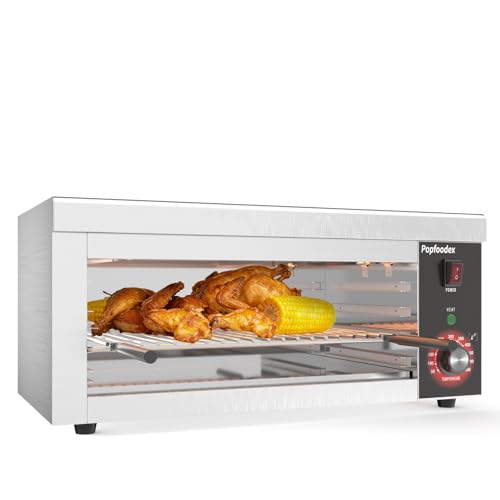


As an Amazon Associate we earn from qualifying purchases at no extra cost to you. Ratings are shown as listed on Amazon.
Best salamander broilers by kitchen situation
| Situation | Best fit | Why it works | Typical market range |
|---|---|---|---|
| Frequent restaurant service | 36-inch gas salamander, such as the Vulcan V Series | Wide cooking area, powerful burners, adjustable rack, fast recovery | $2,500–$5,000 |
| High-volume pass or finishing station | 36- to 48-inch Garland-style commercial salamander | Strong radiant heat and enough width for several plates or pans | $3,000–$6,000 |
| Small professional kitchen | 24-inch gas or electric salamander | Useful capacity without consuming a full 36 inches of wall space | $1,500–$3,500 |
| Home kitchen with occasional use | Compact electric overhead broiler | Simpler installation and more practical than a commercial gas unit | $500–$2,000 |
| Existing range or cooktop line | Range-mounted salamander matched to the appliance | Uses existing structure and may avoid a separate stand | $1,500–$4,500 |
Our top picks for the best salamander broilers
Best overall: Vulcan V Series
The Vulcan V Series is a strong all-purpose choice when the broiler will handle steaks, open-faced sandwiches, gratins, fish, and finishing work throughout the day. It is available in multiple widths, including common 36-inch configurations, and is built around commercial gas cooking requirements.
Its main advantage is working space. A broad grate lets a cook finish several plates at once, while adjustable rack positions make it easier to control browning on shallow dishes and taller pans. Gas infrared or radiant burner configurations also recover quickly after a cold tray is loaded.
- Choose it for: busy restaurants, catering kitchens, and serious home kitchens with commercial ventilation.
- Watch for: substantial heat output, gas-line requirements, and the need for adequate overhead clearance.
- Best configuration: a 36-inch model with multiple rack heights and a removable, heavy-duty grate.
Best for a high-output line: Garland M Series
Garland’s commercial salamander range is suited to kitchens where the broiler is part of the daily production line rather than an occasional finishing tool. The appeal is a combination of high radiant heat, durable stainless-steel construction, and a wide cooking surface in larger models.
Choose a 36-inch unit when most work consists of individual plates, small pans, and steaks. A 48-inch model makes more sense when two cooks may use the appliance at the same time or when a pass needs to handle many plates during a service rush.
- Choose it for: busy hotels, pubs, steak-focused restaurants, and large catering operations.
- Watch for: the difference between total width and actual grate width; side panels and controls reduce usable space.
- Best configuration: independent heat controls if the broiler will finish different foods simultaneously.
Best compact professional option: a 24-inch gas salamander
A 24-inch commercial salamander is often the most sensible compromise for a small restaurant. It provides real overhead-broiler performance but takes less wall space than a 36- or 48-inch model. It can usually accommodate several dinner plates, although it is less comfortable for full-size sheet pans.
Look for at least three rack positions, a grate that can be removed without tools, and front-mounted controls that remain cool enough to operate safely. Two independently controlled burners are preferable to one large heat zone because they reduce wasted gas when only part of the grate is occupied.
Best for home kitchens: compact electric salamander-style broiler
For most homes, a compact electric unit is easier to live with than a commercial gas salamander. It avoids gas plumbing and usually requires less complicated installation, although its electrical load may still be substantial. A model in the 1,500- to 3,000-watt range is suitable for browning smaller dishes, melting cheese, and finishing one or two portions at a time.
Electric elements can brown more gradually than powerful gas burners, but that can be helpful for delicate food. Choose a unit with separate upper and lower element controls, a timer, and a rack that slides smoothly between at least three positions.
What matters most for even browning
Broiler power
Gas output is commonly expressed in BTU per hour, while electric units use watts. Commercial gas salamanders often fall roughly between 30,000 and 60,000 BTU per hour, depending on width and burner design. Electric models commonly range from 1,500 to 4,000 watts.
More power does not automatically mean better browning. A very powerful burner can scorch the top of a casserole before the center is hot. The useful specification is power relative to grate area. As a practical target, a 36-inch commercial unit should have enough output to recover quickly after loading a cold tray, while still offering a lower setting for melting and delicate finishing.
Rack positions and vertical clearance
Rack adjustability is one of the biggest differences between an adequate broiler and a versatile one. At least three positions are useful; four or more provide better control. The lowest position is for fast browning, the middle position is the everyday setting, and the highest position is useful for melting or warming without aggressive color.
Measure the distance from the heating element to the rack, not just the outside height. A salamander that looks tall may have limited usable clearance once the burner guard and drip tray are included. For restaurant work, approximately 4 to 10 inches of adjustment above the grate covers many common finishing tasks.
Interior and grate dimensions
Do not assume a 36-inch exterior means a 36-inch cooking surface. Controls, insulation, and side walls reduce the opening. Before buying, measure the largest plates and pans you expect to use and leave room for air circulation.
| Broiler size | Approximate usable width | Typical usable depth | Practical capacity |
|---|---|---|---|
| 24-inch exterior | 20–22 inches | 14–18 inches | 2–4 plates or one small pan |
| 36-inch exterior | 31–34 inches | 14–20 inches | 4–8 plates or several small pans |
| 48-inch exterior | 42–46 inches | 14–20 inches | 8 or more plates, depending on spacing |
These are planning ranges rather than a substitute for the manufacturer’s drawing. A wide grate is valuable only when the burner pattern heats it evenly from edge to edge.
Heat consistency
Ask whether the appliance uses one continuous heat zone or multiple independently controlled zones. Multiple zones are usually better for unevenly sized orders. Also inspect the burner layout: a single burner concentrated in the center may leave the edges pale, while a distributed radiant design generally produces more consistent color.
A removable grate and reflective interior panels make it easier to keep performance consistent. Grease and carbon buildup can block radiant heat, create hot spots, and increase smoke even when the burners themselves are working correctly.
Installation requirements you should calculate before buying
A commercial gas salamander is not a plug-in countertop appliance. Plan for the following:
- Gas service: confirm the required gas type, inlet size, pressure, and BTU load with a qualified installer.
- Ventilation: commercial units normally require a code-compliant hood, filters, makeup air, and fire-suppression coverage where applicable.
- Electrical connection: ignition, controls, or lights may require a dedicated circuit even on a gas model.
- Mounting: range-mounted units need a compatible rear riser or manufacturer-approved support; wall-mounted units need a load-rated structure.
- Clearance: follow the installation manual for combustible surfaces and overhead spacing rather than estimating from appearance.
As a sizing example, suppose a kitchen already has 120,000 BTU per hour of gas capacity and the selected salamander requires 40,000 BTU per hour. Adding it would raise the connected load to 160,000 BTU per hour. The existing regulator, gas pipe, meter, and ventilation system must all be checked for that total—not just the broiler’s individual specification.
Ownership realities: cleaning, wear, and common mistakes
The grate and drip tray usually show wear first. Repeated high-heat cycles can warp thin metal, while acidic marinades and aggressive chemical cleaners can damage finishes. Burner ports, ceramic radiant surfaces, thermostats, ignition components, and rack guides are the other parts most likely to need attention over time.
Clean the crumb and grease tray frequently, brush the grate after it cools, and remove carbon from approved surfaces according to the manual. Never pour water onto hot radiant elements. Do not line the bottom with foil unless the manufacturer explicitly permits it: foil can restrict airflow, trap grease, and interfere with heat distribution.
Another common mistake is loading food too close to the element at maximum power. Start with a middle rack position, watch the first batch closely, and move the rack upward for cheese, sugar-based glazes, or thin bread. Preheat the broiler and allow cookware to warm when appropriate; a cold heavy pan can make browning appear uneven even when the heat pattern is good.
Final buying recommendation
Choose the Vulcan V Series when you want a dependable 36-inch commercial-style unit with broad capacity. Choose a Garland-style 36- or 48-inch salamander when service volume and multiple simultaneous orders justify the extra width. Choose a 24-inch gas model for a space-constrained professional kitchen, and choose compact electric equipment for occasional home use or locations where gas and hood installation are impractical.
Before purchasing, compare usable grate dimensions, burner-zone layout, rack adjustment, total heat input, and installation drawings. Those details predict even browning and ownership cost far better than exterior width or maximum BTU alone.





Write Your Review
No reviews yet. Be the first to share your experience!