
Key takeaways
- Depth: 11–12 inches fits standard books. Go 15″+ only if you shelve art books, binders, or vinyl — deeper shelves invite double-stacking, which kills accessibility.
- Height: Every inch above ~78″ requires a step stool for most adults, but also needs anchoring into a stud. Tall units in seismic zones are non-negotiable anchor candidates.
- Shelf span: Sag scales with span cubed. A 36″ laminate shelf flexes roughly 3× more than a 24″ shelf under the same load. If your collection is dense, narrower units beat wide ones even at the same total linear footage.
- Adjustable shelf pins: Standard 5mm pins handle ~25–35 lbs before the shelf starts to tilt. Fixed shelves distribute load into the frame — always prefer fixed for your heaviest rows.
The best bookshelves for large collections combine a load rating of at least 30–50 lbs per shelf, fixed or minimally adjustable shelving, and a wall-anchoring provision — because at collection sizes above roughly 400 books, stability and sag resistance matter more than style. Below, we break down the capacity math, compare shelf types by dimensions and weight limits, and match each option to a specific situation.
Our top picks
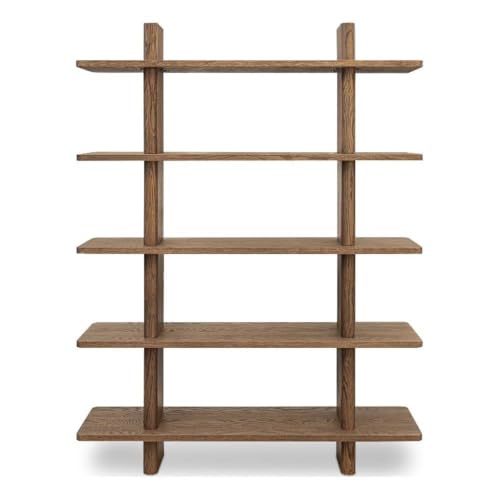


As an Amazon Associate we earn from qualifying purchases at no extra cost to you. Ratings are shown as listed on Amazon.
How Much Capacity Do You Actually Need?
Before comparing models, measure your collection in linear feet. A standard hardcover occupies about 1–1.5 inches of shelf width; paperbacks about 0.75–1 inch. A 500-book mixed collection typically needs 50–70 linear feet of shelving — that’s roughly three 6-foot-tall bookcases with five usable shelves each.
Weight is the hidden constraint. A full 36-inch shelf of hardcovers weighs approximately 40–60 lbs. Paperbacks run lighter at 25–40 lbs per shelf. This is why per-shelf weight ratings are the single most important spec for large collections — and why particleboard shelves rated under 25 lbs per shelf will sag visibly within a year under a dense hardcover load.
Shelf Types Compared: Capacity, Dimensions, and Limits
Real products in this space fall into five categories. The table compares representative models and typical specs for each type:
| Type / Example | Typical Size (H×W×D) | Shelves | Per-Shelf Weight Limit | Est. Book Capacity | Anchoring Needed? | Typical Price Range |
|---|---|---|---|---|---|---|
| IKEA Billy (particleboard/veneer) | 79.5″ × 31.5″ × 11″ | 5–6 adjustable | ~30 lbs | ~300 books | Yes — included strap, mandatory over 4 ft | $60–$110 |
| IKEA Kallax cube (4×2) | 58″ × 31″ × 15.5″ | 8 fixed cubbies | ~29 lbs per cubby | ~250–350 books | Yes — wall anchor recommended | $100–$150 |
| Sauder / Mainstays laminate 5-shelf | 71″ × 29″ × 11.5″ | 5 (3 adjustable) | 25–35 lbs | ~200–280 books | Yes — often included | $70–$140 |
| Solid wood bookcase (e.g., Room & Board, Vermont-made types) | 72–84″ × 36″ × 12″ | 4–6 | 75–150 lbs | ~300–450 books | Recommended; mass helps | $400–$1,500+ |
| Steel library shelving (e.g., Tennsco, Sandusky commercial) | 78–84″ × 36″ × 12–18″ | 6–7 adjustable | 200–400 lbs | 400–600+ books | Anchor seismic zones; otherwise optional | $200–$600 |
| Ladder/leaning shelf | 60–72″ × 24–30″ × 14″ | 4–5, narrowing upward | 10–25 lbs | ~80–150 books | Yes — must attach at top | $80–$250 |
The pattern is clear: fixed shelves outlast adjustable ones under heavy load, steel and solid wood beat laminate for dense collections, and ladder shelves are decorative — not storage solutions for a serious library.
Matching the Shelf to Your Situation
Use this decision matrix rather than chasing a single “best” pick:
| Your Situation | Best Shelf Type | Why |
|---|---|---|
| 600+ books, tight budget | Multiple Billy units, side by side | Lowest cost per linear foot (~$1.50–$2.00 per inch of shelf); uniform rows look built-in |
| Heavy hardcovers, textbooks, or art books | Steel library shelving or solid wood | 75+ lbs per shelf prevents sag; 12–18″ depth fits oversized volumes |
| Renter who moves every 1–3 years | Kallax cubes or modular laminate | Survives disassembly better than cam-lock tall cases; cubbies double as room dividers |
| Mixed media (books + vinyl + boxes) | Kallax or 15″-deep steel | 13″ cubbies fit LP records; deep shelves handle storage bins |
| Small footprint, growing collection | Tall narrow solid wood or stacked Billy + height extension | 84″+ vertical reach maximizes capacity per square foot of floor |
Dimensions That Matter (and the Ones People Get Wrong)
- Depth: 11–12 inches fits standard books. Go 15″+ only if you shelve art books, binders, or vinyl — deeper shelves invite double-stacking, which kills accessibility.
- Height: Every inch above ~78″ requires a step stool for most adults, but also needs anchoring into a stud. Tall units in seismic zones are non-negotiable anchor candidates.
- Shelf span: Sag scales with span cubed. A 36″ laminate shelf flexes roughly 3× more than a 24″ shelf under the same load. If your collection is dense, narrower units beat wide ones even at the same total linear footage.
- Adjustable shelf pins: Standard 5mm pins handle ~25–35 lbs before the shelf starts to tilt. Fixed shelves distribute load into the frame — always prefer fixed for your heaviest rows.
Anchoring: When It’s Optional and When It’s Not
Anything over 4 feet tall loaded with books should be anchored. A fully loaded 6-foot bookcase weighs 200–400 lbs and has a high center of gravity — it will tip if a child climbs it or during an earthquake, and unanchored bookcases are a documented household hazard.
Use the included strap if the unit ships with one, but upgrade to a metal L-bracket or anti-tip kit screwed into a wall stud for anything holding 300+ lbs of books. If you can’t find a stud where the shelf must sit, use toggle bolts rated for 50+ lbs each rather than plastic anchors. Renters should ask before drilling — most landlords approve anti-tip hardware because it protects the building too.
Ownership Realities: What Wears First
- Shelf sag is the #1 failure on laminate and particleboard units. Rotate heavy books toward the ends (directly over the side panels) and flip sagging shelves yearly to slow the bow.
- Cam locks and back panels loosen with moves. Flat-pack bookcases tolerate one or two disassemblies; beyond that, joints get wobbly. Solid wood and steel survive repeated moves.
- Veneer edges chip where books slide in and out. Edge banding repair is cosmetic but cheap; felt shelf liners prevent it.
- Dust accumulates fast on open shelving in large collections. A 500-book library on open shelves needs dusting every few weeks; glass-door versions of units like the Billy cut that roughly in half at the cost of a bit of usable depth.
- Common mistake: loading the top shelves with heavy hardcovers “to use the space.” Keep the heaviest books at knee-to-waist height — it lowers the center of gravity and reduces tip risk even when anchored.
FAQ
How many books does a standard bookcase actually hold?
Realistically 200–300 average books for a 6-foot, 30–36″ wide unit with five shelves — less if your collection skews toward thick hardcovers, more if it’s mostly mass-market paperbacks.
Is the IKEA Billy strong enough for a large collection?
Yes for mixed paperbacks and novels, at ~30 lbs per shelf. It’s marginal for dense art books or encyclopedias — for those, put a fixed shelf at the bottom or step up to solid wood/steel.
Do I need to anchor a bookcase on carpet?
Yes — carpet makes tall units more tippy, not less, because the base can rock. Anchor through the carpet into the stud.
What’s the cheapest shelving per book for a 1,000+ collection?
Commercial steel shelving or a wall of Billy-style units: both work out to roughly $0.30–$0.60 of shelf cost per book stored, versus $1+ for decorative furniture pieces.






Write Your Review
No reviews yet. Be the first to share your experience!