
Key takeaways
- Fixed-height desks (19-22 inches): Best for ages 3-6. Simple and very stable, but outgrown within 2-3 years.
- Adjustable-height desks (19-30 inches): Telescoping legs or crank systems grow with the child from preschool to middle school. Look for 4-6 height presets and a footrest if your child can’t yet touch the floor at the lowest setting.
- Tilt-top desks (0-40 degrees): Helpful for reading, drawing, and writing by bringing work closer without bending the neck. Check that the tilt lock is secure and that pencils won’t slide when flat.
The best kids desks for homework and play balance an adjustable height of 19 to 30 inches, a usable surface of at least 20 x 30 inches, and a stable base that doesn’t wobble when your child leans or draws. For most families, a height-adjustable desk with a tilt option and built-in storage like the IKEA FLISAT or IKEA PÅHL, or a compact fixed-height desk with hutches like the Guidecraft Children’s Media Desk, will cover both study and creative play without taking over the room.
Our top picks
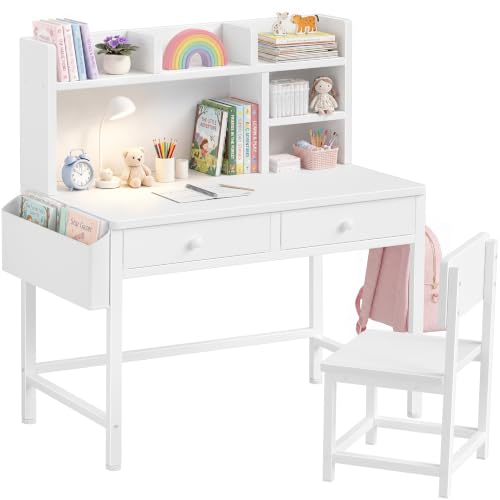
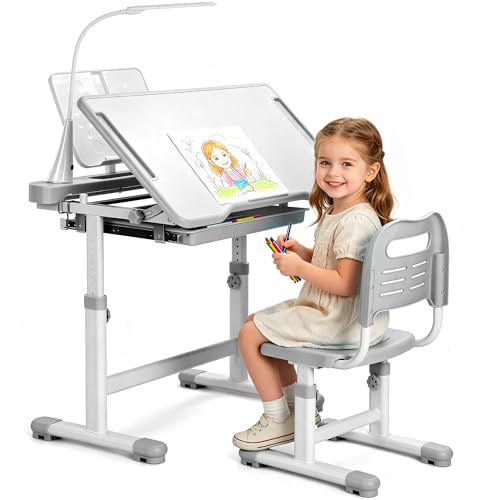

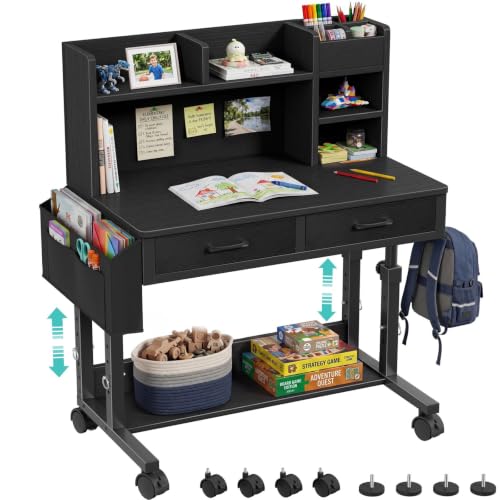
As an Amazon Associate we earn from qualifying purchases at no extra cost to you. Ratings are shown as listed on Amazon.
How to Choose the Right Kids Desk: 5 Decision Criteria
Unlike adult desks, kids desks need to fit the child now and in two years, fit the room, and survive daily art projects. Use these five filters before you look at styles.
1. Desk Height and Ergonomics
Proper height lets your child sit with feet flat on the floor, knees at about 90 degrees, and elbows resting comfortably on the desktop. If the desk is too high, shoulders hunch; too low, posture slumps.
- Fixed-height desks (19-22 inches): Best for ages 3-6. Simple and very stable, but outgrown within 2-3 years.
- Adjustable-height desks (19-30 inches): Telescoping legs or crank systems grow with the child from preschool to middle school. Look for 4-6 height presets and a footrest if your child can’t yet touch the floor at the lowest setting.
- Tilt-top desks (0-40 degrees): Helpful for reading, drawing, and writing by bringing work closer without bending the neck. Check that the tilt lock is secure and that pencils won’t slide when flat.
2. Usable Surface Area
Listed dimensions often include the frame. What matters is flat, uninterrupted workspace. For homework plus play, aim for:
- Small spaces / ages 3-5: 20 x 26 inches is enough for a coloring book, puzzle, and pencil cup.
- Homework-ready / ages 6-12: 30 x 20 inches to 40 x 24 inches fits an open textbook, notebook, and tablet or laptop with room to write.
- Shared or craft-heavy use: 42+ inches wide or an L-shaped surface. Consider a separate art trolley if floor space is tight rather than buying an oversized desk.
A good rule: if your child needs to rotate a 12 x 18 inch art paper without hanging off the edge, the desk is large enough.
3. Storage That Gets Used
Storage only helps if a child can reach and maintain it. Open bins and shallow drawers work better than deep cabinets for younger kids.
- Built-in drawers: One or two shallow drawers (3-4 inches deep) for pencils, scissors, and notebooks. Deep drawers tend to become junk drawers.
- Hutch or cubbies: Vertical storage above the desk saves floor space and keeps books visible. Best for 6+ when kids can organize by subject.
- Side bins or TROFAST-style tubs: Idea seen in IKEA FLISAT: removable bins under the tabletop for LEGO, clay, and craft supplies. Easy to clean and carry to the play area.
- Hook or side pocket: Useful for headphones, pencil cases, or reading bags.
4. Stability and Materials
Kids lean, climb, and bump desks. Stability matters more than weight alone.
- Solid wood or birch plywood: Heaviest and most stable, resists dents, can be sanded and repainted. Guidecraft and Pottery Barn Kids desks typically use this construction.
- MDF with laminate: Lighter, more affordable, and easy to wipe clean. Look for 0.6-inch+ thick tops and steel crossbars to prevent sagging or wobbling. IKEA PÅHL and IKEA MAMMUT use this combination.
- Plastic (polypropylene): Lightest, waterproof, and good for ages 2-5. Less stable for writing pressure; can slide on hard floors unless it has rubber feet.
- Stability check: A four-leg base with leg levelers is more stable than a pedestal base. Cross-bracing between legs and a back panel reduce racking. If the desk is over 30 inches wide, center support is important.
5. Assembly and Maintenance
Assembly time ranges from 15 minutes for a molded plastic table to 60-90 minutes for a desk with a hutch and drawers. Check whether the desk uses standard tools (Phillips screwdriver, included Allen key) or requires wood glue and cam locks. Two-person assembly is recommended for any hutch over 20 lbs. For maintenance, laminate and plastic wipe clean with damp cloth and mild soap; solid wood needs coasters for markers and occasional tightening of bolts every 6 months as wood expands and contracts.
Best Kids Desks Compared: Specs That Matter
These models represent the most common types families choose in 2026. All are widely available from their manufacturers and through major furniture retailers.
| Model / Type | Height Range (in) | Usable Top Surface (in) | Material / Weight | Storage | Assembly Time |
|---|---|---|---|---|---|
| IKEA FLISAT Children’s Table | 19.25 (fixed) | 32.75 x 22.75 | Solid pine frame, birch plywood top / ~18 lbs | 2 removable TROFAST bins under top | 20-30 min, 1 person |
| IKEA PÅHL Adjustable Desk | 23 – 28 (3 presets) | 37.75 x 23.5 | MDF/laminate top, steel legs / ~28 lbs | Optional add-on drawer unit or shelf | 40-60 min, 2 people recommended |
| IKEA MAMMUT Children’s Table | 18 (fixed) | 30.25 x 21.5 | Polypropylene plastic / ~8 lbs | None | 10-15 min, no tools |
| Guidecraft Children’s Media Desk and Chair Set | 22.5 (fixed, chair 12) | 42 x 20 (with hutch cubbies) | Birch plywood / ~35 lbs | 3 cubbies + side storage slot | 60-90 min, 2 people |
| Melissa & Doug Wooden Lift-Top Desk & Chair | 22.5 (fixed) | 25.5 x 18.5 (lift top) | MDF/solid wood / ~20 lbs | Hinged desktop storage, 2 fabric bins | 30-45 min, 1 person |
| Pottery Barn Kids Carolina Grow-With-You Desk | 22 – 30 (crank adjustable) | 40 x 24 | Solid poplar, MDF / ~52 lbs | Optional hutch, drawer, tackboard | 45-75 min, 2 people |
Which Desk Fits Your Situation?
Use this decision matrix to match your room and your child’s age to the right format instead of choosing by looks alone.
| Your Situation | Best Fit | Why It Works |
|---|---|---|
| Toddler/preschool (ages 2-5), small playroom or living room corner, budget is tight | Fixed plastic or pine table like IKEA MAMMUT or IKEA FLISAT | Low height, light to move for play, waterproof top, bin storage keeps toys contained. General market range $50-$180. |
| Early elementary (ages 5-9), needs dedicated homework space, limited floor space | Adjustable desk without hutch like IKEA PÅHL | Grows 3-5 years, large flat top for books and art, footprint under 9 sq ft. Pair with an adjustable chair. General range $150-$280. |
| Ages 6-12, lots of books and supplies, wants an organized station | Desk with hutch/cubbies like Guidecraft Media Desk | Vertical storage keeps reference books and bins off the floor, wide top for projects, very stable for daily use. General range $200-$350. |
| Shared sibling room or craft-heavy household | Adjustable solid wood desk like Pottery Barn Kids Carolina | Crank adjustment covers 8+ years, 40 x 24 inch top handles two activities at once, add-on hutch can be added later. General range $350-$650 with accessories. |
| Small apartment, desk must double as art table | Lift-top desk like Melissa & Doug Lift-Top | Hidden storage inside desktop keeps surface clear, smaller footprint, top contains markers and paper. General range $120-$200. |
Fit Check: Will It Fit Your Child and Your Room?
Before buying, do two quick calculations.
1. Chair-to-Desk Fit
Measure your child’s seated elbow height: have them sit on the chair with feet flat and measure from the floor to the bottom of the elbow. Ideal desk height is 1-2 inches above that number. For example, a 6-year-old with a 21-inch elbow height needs a desk around 22-23 inches high. If the desk is adjustable to 28-30 inches, it can last until elbow height reaches 27-28 inches around age 11-12.
2. Room Fit
Add 30 inches of clearance in front of the desk for chair pull-out and 20 inches on the side for getting in and out. A 38 x 24 inch desk therefore needs a floor area of about 68 x 44 inches to be comfortable. In a 7 x 9 foot bedroom, that leaves room for a twin bed and dresser but not a wide hutch; choose a narrower 32-inch table instead.
Durability and Ownership: What Actually Wears Out
A kids desk gets more abuse than an adult desk. Knowing what fails first helps you maintain it.
- Laminate edges and corners: The first place to chip when chairs bump or bins are dragged. Look for edge banding or rounded corners and avoid dragging the desk on hard floors.
- Drawer slides and hinges: Plastic slides crack and hinges loosen with repeated slamming. Soft-close metal slides and lid supports on lift-tops last longer. Tighten all bolts after the first two weeks of use, as they settle.
- Finish and cleanability: Washable markers, stickers, and tape residue are the most common stains. Matte laminate hides scratches better than glossy white. On wood, a clear matte sealant or removable desk mat protects against ink and glue.
- Common mistakes: Overloading a hutch with more than 15-20 lbs of books can tip a lightweight desk; anchor any hutch over 24 inches tall to the wall with an anti-tip strap. Not using levelers on uneven floors makes even a heavy desk wobble and stresses joints.
For families on 999coupons.com looking to save, the longest value often comes from an adjustable desk that can be handed down rather than replacing a fixed-height table every 2-3 years. Buying a simple table plus a separate rolling cart for supplies can also be more flexible and often costs less than a large integrated storage desk.
Frequently Asked Questions
What desk height is best for a 7-year-old?
Most 7-year-olds are comfortable at 22-24 inches. If buying an adjustable desk, choose one that starts at 22-23 inches and extends to at least 28 inches so it can be used through age 11-12 with an adjustable chair.
Do kids need an ergonomic or tilt desk for homework?
A tilt is nice for drawing and reading but not essential for homework. What matters most is that feet are supported, the top is large enough for an open book and notebook, and lighting is adequate. A separate footrest solves more posture problems than a tilt alone.
How big should a kids desk be for both homework and play?
For combined use, 32 x 22 inches is the minimum for play, while 38 x 24 inches comfortably fits homework materials. If space is very tight, a 30-inch wide table plus a small side cart for craft bins works better than a crowded large desk.





Write Your Review
No reviews yet. Be the first to share your experience!