
Key takeaways
- Best overall for most homeowners: A freestanding steel cabinet around 72 inches high, 36 inches wide, and 18 inches deep, with two adjustable shelves and a three-point lock.
- Best for a complete workshop wall: A modular system such as the Gladiator Modular Garage Storage range or NewAge Products Bold Series. These combine wall cabinets, rolling tool chests, and base cabinets in matching finishes.
- Best for heavy tools: A welded steel cabinet or industrial storage cabinet rated for at least 800 pounds total and 150 pounds per shelf.
- Best lower-cost option: A bolt-together steel cabinet with a powder-coated finish. It usually costs less and is easier to ship, although it may flex more under uneven loads.
- Best for damp or unheated garages: A resin cabinet, or powder-coated steel with raised feet and corrosion-resistant hardware. Resin will not rust, but it generally supports less weight and offers weaker security.
The best garage cabinets for tools are heavy-gauge steel cabinets with adjustable shelves, a lockable door, and enough depth for your largest equipment—choose a welded unit for maximum durability, a modular system for a fitted wall, or a resin cabinet for low-cost storage in a damp garage.
Our top picks
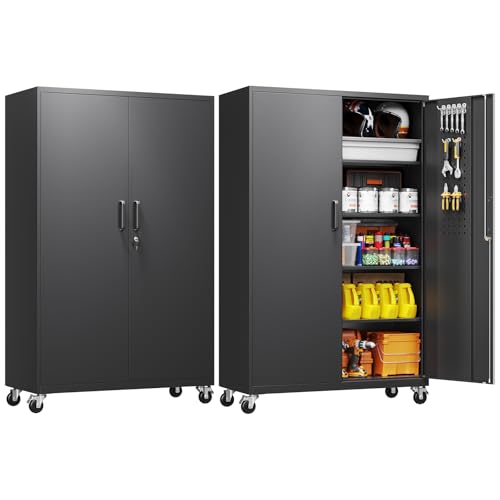


As an Amazon Associate we earn from qualifying purchases at no extra cost to you. Ratings are shown as listed on Amazon.
Quick picks by garage and budget
- Best overall for most homeowners: A freestanding steel cabinet around 72 inches high, 36 inches wide, and 18 inches deep, with two adjustable shelves and a three-point lock.
- Best for a complete workshop wall: A modular system such as the Gladiator Modular Garage Storage range or NewAge Products Bold Series. These combine wall cabinets, rolling tool chests, and base cabinets in matching finishes.
- Best for heavy tools: A welded steel cabinet or industrial storage cabinet rated for at least 800 pounds total and 150 pounds per shelf.
- Best lower-cost option: A bolt-together steel cabinet with a powder-coated finish. It usually costs less and is easier to ship, although it may flex more under uneven loads.
- Best for damp or unheated garages: A resin cabinet, or powder-coated steel with raised feet and corrosion-resistant hardware. Resin will not rust, but it generally supports less weight and offers weaker security.
Garage cabinet comparison
Cabinet dimensions matter more than a product photograph. Measure the wall, garage-door travel, vehicle clearance, and the depth of the items you plan to store before choosing a configuration.
| Cabinet type | Typical dimensions | Total capacity | Material | Locking options | Assembly | Best use |
|---|---|---|---|---|---|---|
| Compact wall cabinet | 30–36 W × 12–16 D × 24–30 H in. | 100–200 lb | Steel | Key lock or cam lock | Wall mounting required | Paint, fasteners, and small power tools |
| Full-height freestanding cabinet | 30–36 W × 18–24 D × 72–78 H in. | 600–1,000 lb | Steel, usually 20–24 gauge | Two-point or three-point lock | Moderate; tipping restraint recommended | General tool and gear storage |
| Modular base cabinet | 24–36 W × 20–24 D × 34–36 H in. | 400–800 lb | Powder-coated steel | Lockable doors or drawers | Moderate to high | Work surfaces and frequently used tools |
| Rolling tool cabinet | 27–72 W × 18–24 D × 35–45 H in. | 500–1,500 lb | Welded or bolted steel | Locking drawer system | Low to moderate | Tools that move around the garage |
| Resin cabinet | 24–36 W × 18–24 D × 65–75 H in. | 150–400 lb | High-density resin | Padlock hasp on some models | Low to moderate | Garden gear, chemicals, and light storage |
Capacity figures vary by model and shelf position, so treat these as planning ranges rather than universal ratings. A cabinet’s total capacity is not the same as its shelf capacity: a 700-pound cabinet may have shelves rated for only 100 or 150 pounds each.
Steel, resin, or modular construction?
Steel cabinets
Steel is the strongest general-purpose choice for hand tools, compressors, automotive equipment, and boxed hardware. Look for a powder-coated finish, folded or reinforced door edges, adjustable shelves, and a back panel that does not visibly bow. Welded cabinets tend to resist racking better than bolt-together models, but they are heavier, more expensive, and harder to move through a narrow doorway.
Gauge numbers require context: a lower gauge indicates thicker steel, but reinforcement, shelf supports, and the cabinet frame matter just as much. A well-braced 24-gauge cabinet can outperform a poorly designed thinner cabinet. For heavy equipment, prioritize the published shelf rating and a rigid frame over the gauge alone.
Resin cabinets
Resin avoids rust and is useful for garages with condensation, but shelves can sag under concentrated loads. Store bulky, lightweight items such as hoses, sports equipment, gardening supplies, and seasonal decorations inside. Do not assume a resin cabinet is secure simply because it has a padlock loop; the doors and hinges may still be easier to force than those on a steel cabinet.
Modular systems
Systems from Gladiator and NewAge Products are appealing when you want cabinets, worktops, wall storage, and rolling units to share a finish and mounting pattern. Their advantage is layout flexibility. Their drawback is cost: buying several matching pieces can cost substantially more than one freestanding cabinet, and installation takes longer because every unit must be leveled and joined correctly.
Which locking system should you choose?
- Cam lock: Adequate for keeping children away from chemicals or preventing casual access. It is common on economical cabinets.
- Two-point lock: Better for tall doors because the top and bottom engage with the frame, reducing door movement.
- Three-point lock: A strong choice for wide or full-height steel doors. Check that the rods engage smoothly before loading the cabinet.
- Locking drawers: Convenient for sockets, precision tools, and small parts. A drawer lock does not necessarily secure an attached cabinet compartment.
- Padlock hasp: Useful if several people need access or if you want to replace the lock, but the hasp hardware should be shielded from easy cutting.
For expensive tools, a garage cabinet is only one layer of security. Anchor tall cabinets to a wall stud or masonry, keep keys separate from the garage, and avoid storing the most valuable equipment in a cabinet with a simple exposed hasp.
Decision matrix: match the cabinet to your situation
| Your situation | Recommended choice | Minimum useful specification | Why |
|---|---|---|---|
| Budget under about $300 | Bolt-together steel cabinet | 18-inch depth, 2 shelves, 100 lb per shelf | Provides enclosed storage without paying for a complete system |
| Small garage or narrow side wall | Wall cabinet plus slim base cabinet | 12–16-inch wall depth; 24–30-inch width | Preserves floor and vehicle clearance |
| Frequent automotive work | Welded steel cabinet or rolling tool chest | 24-inch depth; 800 lb total capacity; locking drawers | Handles dense tools and provides faster access |
| First-time assembler | Preassembled or simple modular cabinet | Clear instructions; two-person lift; few major panels | Reduces alignment and door-adjustment problems |
| Damp, coastal, or unheated garage | Resin or corrosion-resistant powder-coated steel | Raised base; sealed or protected hardware | Limits damage from moisture and floor contact |
| Shared household storage | Modular wall and base combination | Adjustable shelves and at least one lockable compartment | Separates tools, chemicals, sports gear, and seasonal items |
How much cabinet space do you need?
Estimate the usable shelf volume before purchasing. For example, a cabinet measuring 36 inches wide by 18 inches deep with three shelves may appear to offer 972 square inches per shelf, but door clearance, frame rails, and shelf lips reduce the practical area. If each shelf is about 32 by 16 inches, the usable footprint is approximately 512 square inches. Three shelves provide about 1,536 square inches of shelf surface—enough for organized hand tools and supplies, but not three levels of large power equipment.
Leave at least 20 percent empty space. Overfilled cabinets make tools harder to find, place excessive point loads on shelves, and force doors to carry pressure. Heavy items should sit low, with lighter boxes and rarely used gear higher up.
Assembly and installation details that affect ownership
Bolt-together cabinets commonly need a rubber mallet, socket set, level, and a second person. Assemble them on a flat surface, loosely install all bolts first, square the frame, and tighten from the bottom upward. Tightening one corner completely before aligning the opposite side can leave doors uneven.
Full-height cabinets should be secured against tipping, particularly if they have deep shelves or drawers. Wall cabinets require fasteners matched to the wall: studs or masonry anchors are appropriate, while drywall anchors alone are generally unsuitable for heavy tool loads. Confirm that the wall can support both the cabinet and its contents.
Durability and maintenance realities
- Door hinges and drawer slides wear first: Keep shelves within their ratings and do not use doors as handles or steps.
- Locks need occasional cleaning: Remove grit and use a lubricant recommended for the lock type rather than forcing a sticky key.
- Rust starts at scratches and floor contact: Touch up exposed steel, keep the cabinet slightly off a wet floor, and wipe condensation from metal surfaces.
- Shelves can deform permanently: Put dense items such as batteries, sockets, and metal parts near supports instead of at the center of a long shelf.
- Clean spills promptly: Oil, fertilizer, and solvents can damage finishes or resin. Follow the cabinet manufacturer’s cleaning guidance and store chemicals in compatible secondary containers.
For most tool-focused garages, a 72-inch steel cabinet with 18–24 inches of depth, adjustable shelves rated at 100 pounds or more each, and a two- or three-point lock offers the best balance. Choose a modular Gladiator or NewAge Products setup when layout flexibility and a coordinated work area matter more than the lowest initial price; choose resin when rust resistance and light-duty storage are the priority.







Write Your Review
No reviews yet. Be the first to share your experience!