
Key takeaways
- Compare the best office chairs for sciatica, with flexible seat edges, adjustable seat depth, and lumbar support to ease pressure on the sciatic nerve.
Table of Contents
- Quick Answer
-
- Steelcase Leap Office Chair
-
- Herman Miller Embody Chair
-
- SIHOO Doro C300 Ergonomic Office Chair
-
- Hbada E3 Air Ergonomic Office Chair
-
- Nouhaus Ergo3D Ergonomic Office Chair
- How to Choose an Office Chair for Sciatica
- Who Should Skip These Chairs
- FAQ
- Final Verdict
- Product and ASIN Reference
Sciatica pain runs from the lower back down through the hip and the back of the leg, and a badly shaped chair seat can feed it all day. A seat pan that is too deep presses behind the knees, a hard front edge cuts into the underside of the thighs, and a flat backrest lets the pelvis roll backward, loading the lower spine. The result is that familiar burning or tingling that gets worse the longer you sit.
The chairs below were picked for the specific features that reduce that pressure: flexible or waterfall seat fronts, adjustable seat depth, and lumbar support that stays with your back as you move. They range from mid-range mesh chairs with self-adjusting lumbar systems to premium models with pressure-distributing seats, and each entry lists the published specifications that matter so you can match a chair to your body and your desk.
As an Amazon Associate, we earn from qualifying purchases.
Quick Answer
For most people with sciatica, the Steelcase Leap is the strongest pick because its flexible seat edge, adjustable seat depth, and firmness-adjustable lumbar support attack the three main pressure points at once. The Herman Miller Embody is the premium choice, with a pixelated seat that spreads weight evenly. On a mid-range budget, the SIHOO Doro C300 adds a self-adaptive lumbar and seat-depth adjustment.
1. Steelcase Leap Office Chair

The Leap is built around movement. Its LiveBack backrest changes shape as you shift, and the lumbar support adjusts in height so it meets the curve of your lower back rather than a fixed spot. A separate firmness control lets you dial how strongly that lumbar zone pushes back, which matters for sciatica because support that is too weak lets the pelvis slump, while support that is too aggressive becomes its own pressure point.
The seat is the other half of the story. The front edge flexes downward under the thighs instead of forming a hard ridge, and the seat depth slides so shorter legs are not left with the edge pressing behind the knees. The Natural Glide System moves the seat forward as you recline, keeping your back in contact with the backrest instead of sliding you away from the lumbar support.
Specs
- Backrest: LiveBack flexible back with height-adjustable lumbar support
- Lumbar firmness: adjustable lower back firmness control
- Seat: flexible front edge with adjustable seat depth
- Armrests: 4D adjustable (height, width, depth, pivot)
- Recline: Natural Glide System with variable back stop
- Seat height: 15.5 to 20.5 in
- Weight capacity: 400 lb
- Warranty: 12 years
2. Herman Miller Embody Chair

The Embody takes a different route to pressure relief: instead of padding, its seat is a matrix of flexing pixels that bend independently, spreading your weight across the whole seat surface rather than concentrating it under the sit bones and tailbone. For sciatica, that even distribution is the headline feature, because peak pressure under one side of the pelvis is a common trigger for leg symptoms.
The backrest is built like a spine, with a central column and flexible ribs that follow your back as you twist and recline. The BackFit adjustment sets the backrest to match your spinal curve, and the seat depth adjusts so the front of the seat stops short of the back of your knees. Fully adjustable arms, a tilt limiter, and carpet casters round out the configuration on this listing.
Specs
- Seat: Pixelated Support seat with independently flexing pixels
- Backrest: BackFit adjustment with central spine and flexible ribs
- Seat depth: adjustable, 15 to 18 in
- Seat height: 16 to 20.5 in
- Armrests: fully adjustable
- Tilt: tilt limiter with tension control
- Weight capacity: 300 lb
- Warranty: 12 years
3. SIHOO Doro C300 Ergonomic Office Chair

The Doro C300 is the mid-range option that still covers the sciatica essentials. Its lumbar support is self-adaptive: the support zone flexes and follows your lower back as you lean, sit upright, or shift sideways, so the contact does not disappear every time you move. The seat depth adjusts as well, letting you set the gap between the seat front and the back of your knees.
The backrest height adjusts to place the lumbar zone correctly for different torso lengths, and the mesh back keeps air moving through long sessions. Adjustable armrests and an adjustable headrest complete the fit adjustments. If the premium chairs are out of reach, this is the configuration that gives up the least on the features that matter for nerve pain.
Specs
- Lumbar support: self-adaptive dynamic lumbar that tracks back movement
- Seat depth: adjustable
- Backrest: height-adjustable mesh backrest
- Armrests: multi-way adjustable with padded tops
- Headrest: adjustable
- Weight capacity: 300 lb
4. Hbada E3 Air Ergonomic Office Chair

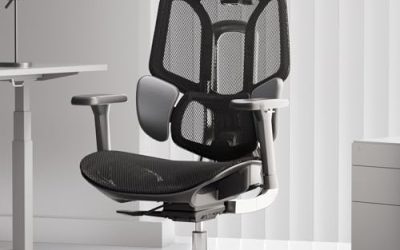
The E3 Air splits its lumbar support into three zones that respond independently, so the support can follow the lower back through reclines and posture changes instead of pushing at one fixed height. That three-zone design is the reason it earns a place here: sciatica symptoms often flare when support vanishes mid-recline, and a dynamic system keeps contact through the full tilt range.
The seat and back are full mesh, which keeps the sitting surface from packing down into a hard slab over a long day, and the chair is built for big and tall users, with a wide seat that leaves room to shift position. The headrest and armrests both adjust in three directions, so the upper body can be set up to match the back support rather than fighting it.
Specs
- Lumbar support: 3-zone dynamic lumbar support
- Headrest: 3D adjustable
- Armrests: 3D adjustable
- Seat and back: full mesh construction
- Fit: wide seat sized for big and tall users
- Weight capacity: not stated in the listing data checked
5. Nouhaus Ergo3D Ergonomic Office Chair

The Ergo3D pairs a 3D adjustable lumbar support with a waterfall mesh seat. The lumbar unit moves in height, depth, and angle, so it can be placed exactly at the belt line, and the curved front of the seat drops away under the thighs instead of ending in a straight edge. That combination covers the two adjustments that matter most when leg pain is part of the picture.
The ElastoMesh upholstery flexes rather than compresses, the 4D armrests adjust in height, width, depth, and angle, and the backrest reclines to 135 degrees for pressure-off breaks. An adjustable headrest and smooth blade wheels on an aluminum base finish the package at a mid-range tier.
Specs
- Lumbar support: 3D adjustable (height, depth, angle)
- Seat: waterfall-front ElastoMesh seat
- Armrests: 4D adjustable
- Headrest: adjustable
- Recline: up to 135 degrees
- Base: aluminum base with blade wheels
- Weight capacity: 300 lb
How to Choose an Office Chair for Sciatica
Start with seat depth. Sit with your back against the backrest and check the gap between the front edge of the seat and the back of your knees: you want roughly two to three fingers of clearance. A seat that is too deep presses into the calves and forces you to perch forward, away from the lumbar support. An adjustable seat depth, as on the Leap, Embody, and Doro C300, is the safest way to get this right.
Next, look at the seat front. A flexible edge or a waterfall curve reduces pressure on the underside of the thighs, where the sciatic nerve runs. Hard, square seat fronts are the feature to avoid. Then check the lumbar support: it should adjust in height at minimum, and dynamic systems that follow your movement help if your symptoms flare when you recline.
Finally, plan for movement. No chair removes the need to stand and walk at intervals, and a chair with a smooth recline and a tilt limiter makes those small posture changes easier through the day. Set the seat height so your feet rest flat on the floor with your thighs level or sloping slightly downward, and keep the armrests low enough that your shoulders stay relaxed.
Who Should Skip These Chairs
Skip this whole category if your leg pain comes with weakness, numbness that is spreading, or any change in bladder or bowel control. Those are medical warning signs, not furniture problems, and they need a clinician before a new chair. A chair can reduce sitting pressure; it cannot treat a compressed nerve root.
Also skip the premium picks if your desk setup is the real problem. A chair with perfect lumbar support still fails if your monitor forces you to lean forward or your desk height pushes the keyboard too high. Fix the workstation geometry first, and choose a chair with a footrest or a saddle design instead if you already know you cannot sit in a conventional task chair for medical reasons.
FAQ
What chair features matter most for sciatica?
Adjustable seat depth, a flexible or waterfall seat front, and height-adjustable lumbar support. Seat depth controls pressure behind the knees, the seat front controls pressure under the thighs, and lumbar support keeps the pelvis from rolling backward and loading the lower spine.
Is a mesh seat or a foam seat better for sciatica?
Both can work. What matters is pressure distribution and whether the seat front is shaped to drop away from the thighs. A pixelated or flexing seat spreads weight the most evenly, while a well-shaped foam or mesh seat with a waterfall front is a sound mid-range choice.
Can an office chair cure sciatica?
No. A chair can reduce the sitting pressure that aggravates symptoms, but sciatica has medical causes that seating cannot fix. Persistent, worsening, or one-sided leg pain with weakness or numbness should be assessed by a clinician.
How should I set up a chair if I have sciatica?
Set the seat height so your feet are flat and your thighs are level or angled slightly down. Slide the seat depth so a small gap remains behind your knees, place the lumbar support at your belt line, and recline slightly rather than sitting bolt upright. Stand and walk at regular intervals.
Final Verdict
The Steelcase Leap is the most complete sciatica chair here, because it adjusts the three things that drive sitting pressure: lumbar height and firmness, seat depth, and seat-edge flex. The Herman Miller Embody is the premium alternative, trading those dials for a seat that distributes weight more evenly than any padded design. For a mid-range budget, the SIHOO Doro C300 keeps the essential adjustments, while the Hbada E3 Air and Nouhaus Ergo3D add dynamic lumbar systems and waterfall mesh seats at accessible tiers.
Product and ASIN Reference
| Product | ASIN |
|---|---|
| Steelcase Leap Office Chair | B006H1QYBA |
| Herman Miller Embody Chair | B07SVJXDD7 |
| SIHOO Doro C300 Ergonomic Office Chair | B0C3T865C2 |
| Hbada E3 Air Ergonomic Office Chair | B0CQ4J5NGW |
| Nouhaus Ergo3D Ergonomic Office Chair | B07L4ZQMDX |

Write Your Review
No reviews yet. Be the first to share your experience!