
Our Top Picks
 Pack sizeArt3d 36-Pack Peel and Stick Vinyl Floor Tiles36 x 6 x 0.1 inches36 x 6 x 0.1 inches0.93 poundsCheck on Amazon
 WESTICK Marble Peel and Stick Floor Tile Bathroom20 Tiles12 x 12 x 0.04 inches7.4 PoundsCheck on Amazon
 ZRJT Peel and Stick Floor Tile 11.8” x590"L*11.8"W(48.4 Sq.Ft.)590 x 11.8 x 0.02 InchesCheck on Amazon
 FloorPops 12-in by 12-in Blue Ezra Vinyl Peel12 inches by 12 inches60 x 24 x 0.06 inches6 poundsCheck on Amazon


The best waterproof vinyl flooring for bathrooms overall is the Art3d 36-Pack Peel and Stick Vinyl Floor Tiles in Deep Gray (54 sq ft). One carton covers a typical 5 ft × 8 ft bathroom floor with roughly 10 sq ft left over for future repairs, the tiles are large-format enough to keep the number of seams down, and the deep gray stone print hides the water spots, hairspray overspray and stray toothpaste that show up on pale floors. It suits anyone tiling a main or guest bathroom who wants a single purchase, a forgiving install and a spare tile or two in the closet. If the budget is the deciding factor, the FloorPops Blue Ezra carton does a 25 sq ft powder room for the least money. If your bathroom is long and narrow, or broken up by a vanity and a toilet, the ZRJT 11.8 in × 590 in roll gets you 48.4 sq ft with almost no seams — which matters more in a wet room than almost any other spec. Everything below is organised so you can match your room’s square footage and layout to a format, then check the construction details before you buy.
Top 3 Picks
Best overall: Art3d 36-Pack Peel and Stick Vinyl Floor Tiles, Deep Gray (54 sq ft). The coverage-to-carton ratio is the best here — 1.5 sq ft per tile means 36 units do the work of 54 twelve-inch tiles, so there are fewer joints for water to work into. It is a premium-tier purchase, but it is also the closest thing on this list to a one-and-done bathroom floor.
Best budget: FloorPops 12-in by 12-in Blue Ezra Vinyl Peel & Stick Floor Tiles (10 tiles, 10 sq ft per carton). The lowest entry point per carton, and the pattern is the point — an encaustic-style blue geometric print that makes a small powder room or laundry corner look deliberate rather than cheap. Buy extra cartons; 10 sq ft goes fast.
Best for large or awkward floors: ZRJT Peel and Stick Floor Tile, 11.8 in × 590 in Vinyl Flooring Roll (48.4 sq ft). A single continuous roll is the fastest way to cover a galley bathroom, a bathroom-laundry run or any floor where tile-by-tile cutting would mean dozens of small pieces. Waterproof and scratch-resistant, with cut-to-length flexibility.
Quick Comparison
| Product | Best for | Key specs | Price tier |
|---|---|---|---|
| Art3d 36-Pack Peel and Stick Vinyl Floor Tiles, Deep Gray | Full bathroom floors, 40–55 sq ft | 36 tiles; 54 sq ft total (≈1.5 sq ft per tile); waterproof peel-and-stick vinyl; deep gray stone-look print | Premium |
| WESTICK Marble Peel and Stick Floor Tile | Marble look in powder rooms and small baths | Marble-print waterproof vinyl peel-and-stick tiles; carton coverage varies by pack size, so check the stated square footage | Mid-range |
| ZRJT Peel and Stick Floor Tile Roll, 11.8 in × 590 in | Large, long or awkward floors with minimal seams | Roll 11.8 in wide × 590 in long (≈300 mm × 15 m); 48.4 sq ft; waterproof, scratch-resistant | Mid-range |
| Art3d 30-Pack Peel and Stick Vinyl Floor Planks, Taupe Ash | Wood-look floors in small baths and half baths | 30 planks, 12 in × 12 in; 30 sq ft; taupe ash woodgrain print; peel-and-stick | Mid-range |
| FloorPops Blue Ezra Peel & Stick Floor Tiles | Pattern-forward powder rooms and rentals | 10 tiles, 12 in × 12 in; 10 sq ft per carton; blue Ezra encaustic-style print | Budget |
| auxua Woodgrain Vinyl Floor Roll, 11.8 in × 118 in | Budget wood look, narrow floors, cut-to-fit work | 11.8 in × 118 in (≈9.7 sq ft per roll); woodgrain print; quick-apply peel-and-stick | Budget |
| ZRJT 20-Pack Peel and Stick Floor Tiles, 12 in × 12 in | Low-cost tile-by-tile coverage and patching | 20 tiles, 12 in × 12 in; 20 sq ft; self-adhesive, waterproof, DIY-friendly | Budget |
How We Chose
The selection criteria started with waterproof construction rather than appearance, because a bathroom floor fails at the edges, the seams and the substrate — not in the middle of a tile. Every product here is a vinyl peel-and-stick system, which is the format that makes sense for a bathroom refresh you can complete in a weekend, but they differ in tile size, carton coverage, roll format and print depth, and those differences decide which rooms they suit.
From there we weighed four things. First, coverage math: stated carton or roll square footage against the real footprint of a typical 25 sq ft powder room, 40 sq ft full bath and 60 sq ft main bathroom, including a 10% waste allowance. Second, seam density — larger tiles and continuous rolls mean fewer joints, and joints are where water gets under a floor. Third, format fit: square tiles for square rooms, rolls for long or obstructed layouts, and small cartons for renters who need to lift the floor later. Fourth, the upgrade path, meaning how easy it is to buy matching spares, patch a single damaged tile, and move up to a heavier wear layer if the floor takes more traffic than expected.
1. Art3d 36-Pack Peel and Stick Vinyl Floor Tiles, Deep Gray – Best for Full Bathroom Floors
As an Amazon Associate we earn from qualifying purchases at no extra cost to you.
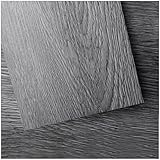
This is the pack to buy if you want to measure once, order once, and finish a standard bathroom floor in an afternoon. Thirty-six tiles covering 54 sq ft works out to about 1.5 sq ft per tile, which puts it in the large-format class for peel-and-stick vinyl. That single number does more work than any colour name: fewer tiles per square foot means fewer butt joints across the floor, and fewer joints means fewer places for splash water to creep under the adhesive and lift an edge.
Key specs
- Pack size: 36 peel-and-stick vinyl tiles
- Coverage: 54 sq ft total (≈1.5 sq ft per tile)
- Colour: Deep Gray
- Format: large-format square tiles, self-adhesive backing
- Construction: waterproof vinyl surface with printed stone-look wear layer
- Price tier: premium
- Best room size: 40–55 sq ft
How the coverage math works out. A common full bathroom is 5 ft × 8 ft, or 40 sq ft. Add the standard 10% waste allowance for perimeter cuts and one or two mistakes and you need 44 sq ft. One carton of 36 tiles gives you 54 sq ft — enough to finish the floor, keep the offcuts, and bank roughly 10 sq ft of spare tile for the day a toilet leak or a dropped tool takes out a single unit. That spare allowance is worth more than it sounds: peel-and-stick vinyl is printed in batches, and a replacement carton bought two years later may not match the floor you installed.
Why it works in a wet room. Deep gray is the practical colour for a bathroom. Pale floors show every hair, water ring and stray bit of toothpaste; mid-tone and dark greys hold up visually between cleans, and a stone-look print with a matte or lightly embossed finish hides the streaks that glossy marble-look prints exaggerate. The larger tile format also means you cut fewer pieces around the toilet flange and the tub apron, and every cut edge is a spot where the adhesive is exposed rather than factory-finished.
Installation reality. Peel-and-stick vinyl is only as good as the surface under it. The substrate needs to be flat — the working tolerance for this class of flooring is roughly 3/16 in of variance over a 10 ft span — clean, dry and primed so the adhesive grips. Laying these over a dusty concrete slab, a glossy painted floor or old adhesive residue is the single most common reason a peel-and-stick bathroom floor starts peeling at the corners within a year. Acclimate the carton in the room for 24 to 48 hours first, start the layout from the doorway or the most visible wall, and leave a 1/4 in gap at every wall covered by baseboard or quarter round.
Where it sits against the alternatives. Against the ZRJT roll, this pack trades seamlessness for repairability. A roll gives you 48.4 sq ft with almost no joints, but if you cut it wrong you have wasted a long continuous piece, and a puncture or a scorch mark means replacing a large section. With 1.5 sq ft tiles you can lift one damaged tile with gentle heat and swap in a spare. Against the Art3d 30-Pack Taupe Ash, this is the bigger job: 54 sq ft against 30 sq ft, and a stone look rather than wood. If your bathroom is under 30 sq ft, the Taupe Ash pack is the more sensible spend; if it is a full bath, the Deep Gray carton is the one that finishes the floor in one purchase.
Pros
- 54 sq ft in a single carton covers a typical full bathroom with spare tiles left over
- Large-format tiles reduce the number of joints across the floor
- Deep gray stone print hides water spots and daily soiling better than pale floors
- Single-tile replacement is straightforward if you keep the spares
- No grout, no thinset and no wet trades — a genuine one-day project
Cons
- Premium tier — the highest cost per carton on this list
- Demands a flat, primed, dust-free subfloor; it will not bridge an uneven slab
- Dark floors show dust, lint and dried water marks between cleans
- Overbuying is unavoidable if your bathroom is small, since there is no partial carton
2. WESTICK Marble Peel and Stick Floor Tile – Best for a Marble Look in Small Baths

If the look you want is marble but the budget is not, this is the format that gets you there without a stone fabricator. WESTICK’s marble peel-and-stick floor tile is built for bathrooms specifically — the listing names the bathroom use case directly — and the marble print does the visual work that a real stone floor would, at a fraction of the weight and installation effort. It suits powder rooms, small guest baths, and anyone refreshing a dated floor before a sale or a rental turnover.
Key specs
- Type: peel-and-stick vinyl floor tile, marble print
- Water resistance: waterproof vinyl construction
- Intended use: bathrooms and similar wet rooms
- Backing: self-adhesive, no separate glue required
- Carton coverage: varies by pack size — confirm the stated square footage on the carton you buy
- Price tier: mid-range
What marble print does well and badly in a bathroom. Marble-look vinyl is the most forgiving pattern for hiding dust and hair, because the veining breaks up the visual field. It is also the least forgiving about surface finish. A high-gloss marble print on a bathroom floor will show every footprint and dried water droplet in raking light, and it is slicker underfoot than a matte or textured print. If you go marble, look for a tile with a satin or lightly textured surface rather than a mirror finish, and put a mat in front of the shower and the vanity regardless of the slip rating.
Pattern matching is the hidden labour. A printed marble tile has a directional grain. If you lay every tile the same way up, the veins line up into obvious stripes; if you rotate them, the seams jump. The practical approach is to dry-lay a few tiles before you peel anything, decide on a rotation pattern that breaks up the repeat, and photograph the layout so you can reproduce it after you have moved the boxes. This is the step most people skip, and it is the reason some marble-look floors look expensive and others look like a print.
Carton coverage is the spec to check first. Unlike the Art3d 36-pack, which states 54 sq ft up front, marble peel-and-stick tiles are sold in a range of pack sizes, and the coverage per carton varies. Before ordering, work out your room’s square footage plus 10% and divide by the stated coverage per carton, then round up. Buying one carton short and reordering later risks a dye-lot mismatch between batches, which is far more visible on a marble print than on a solid colour.
How it compares with the nearest alternatives. Against the FloorPops Blue Ezra, the trade is budget for realism. FloorPops costs less per carton and gives you a bold pattern statement, but it reads as a printed tile rather than stone, and the carton only covers 10 sq ft. Against the Art3d Deep Gray pack, the trade is durability and coverage for looks: 54 sq ft of large-format gray against a marble print in a smaller carton. If your bathroom is a powder room where the floor is the design feature and nobody showers in it, marble is the better visual choice. If it is a family bathroom with wet feet and dropped shampoo bottles, the larger-format gray is the more hard-wearing call.
Pros
- Marble look without the cost, weight or installation of stone
- Veined pattern hides dust, hair and small debris well
- Purpose-built for bathroom use and fully waterproof vinyl
- Mid-range price tier for a high-impact visual upgrade
- Self-adhesive backing keeps the project tool-light
Cons
- Glossy marble prints show streaks and footprints more than matte finishes
- Directional veining requires a deliberate rotation pattern to look right
- Carton coverage varies by pack, so you must check the square footage before buying
- Small pack sizes mean multiple cartons and a batch-matching risk on larger rooms
3. ZRJT Peel and Stick Floor Tile Roll, 11.8 in × 590 in – Best for Large or Awkward Floors

This is the pick for floors that resist a grid. The roll is 11.8 in wide and 590 in long — a nominal 300 mm × 15 m metric size — and it covers 48.4 sq ft in one continuous piece. Run the arithmetic and it checks out: 11.8 in × 590 in is 6,962 sq in, and divided by 144 that is 48.35 sq ft. There is no rounding trick in the listing. That matters because roll products sometimes quote coverage optimistically, and this one does not.
Key specs
- Format: continuous vinyl flooring roll, peel-and-stick
- Dimensions: 11.8 in wide × 590 in long (≈300 mm × 15 m)
- Coverage: 48.4 sq ft per roll
- Surface: waterproof, scratch-resistant wear layer
- Installation: cut to length, peel and press
- Price tier: mid-range
- Best room size: 35–48 sq ft, or larger rooms in multiple rolls
Why a roll beats tiles in some bathrooms. In a galley bathroom — say 4 ft × 10 ft — a tile layout wastes a lot of material on cut pieces, and every one of those cuts is a seam. A roll 11.8 in wide laid in parallel strips across a 4 ft width needs roughly four strips, so you get three seams across the entire floor instead of a grid of dozens. Fewer seams means less adhesive edge exposed to splash water, less pattern interruption, and a faster install. The same logic applies to a bathroom-laundry run, a narrow WC, or a floor with a vanity, a toilet and a linen cabinet all breaking up the field.
Working out how many rolls you need. Take your floor area, add 10% for cuts and trimming, then divide by 48.4. A 40 sq ft bathroom becomes 44 sq ft, which is one roll with about 4 sq ft of margin — thin, so if the room has an unusual shape or you are a first-timer, buy two. A 60 sq ft main bathroom needs 66 sq ft, which is two rolls at 96.8 sq ft, leaving enough spare for a future patch. Note that the spare matters more with a roll than with tiles: if the floor is damaged in the middle of a strip, you are replacing the whole strip, not a single 1 sq ft unit.
Cutting and layout. Unroll the flooring and let it relax flat in the room for at least a day before installing. Vinyl roll carries memory from the coil, and installing it while it still wants to curl is how you end up with lifted edges at the seams. Plan your strips so the last one is a full-width piece at the least visible wall rather than a 2 in sliver beside the tub, and stagger the end joints between strips so four strip ends do not line up into a single visible line across the floor. Overlap the strips slightly, then trim through both layers with a straightedge for a tight seam.
How it compares with the nearest alternatives. Against the ZRJT 20-Pack of 12 in × 12 in tiles, this is the same brand solving the same problem two ways. The 20-pack gives you 20 sq ft in discrete units — cheap, easy to patch, ideal for a small floor or an accent area. The roll gives you 48.4 sq ft with far fewer seams and a much faster install, at a mid-range price rather than a budget one. Against the Art3d 36-pack, the roll wins on seam count and loses on repairability: a tile can be swapped, a strip cannot. Choose the roll for long, narrow or obstruction-heavy floors, and the tile pack for square rooms where you want a simple grid and easy future repairs.
Pros
- 48.4 sq ft in one continuous piece, verified by the stated dimensions
- Dramatically fewer seams than a tile grid — the main failure point in wet rooms
- Fast coverage: cut to length and press, no per-unit layout
- Waterproof and scratch-resistant surface
- Ideal for galley bathrooms, WC runs and floors broken up by fixtures
Cons
- A single miscut wastes a long, expensive piece of material
- Roll memory causes curling if you skip the acclimation step
- Damage in the middle of a strip means replacing the whole strip
- Strip seams must be trimmed precisely; sloppy overlaps show in raking light
4. Art3d 30-Pack Peel and Stick Vinyl Floor Planks, 12 x 12 in, Taupe Ash – Best for Wood-Look Small Bathrooms

Wood-look vinyl is the most requested bathroom floor look, and this pack delivers it in a 30 sq ft carton that suits half baths, powder rooms and small ensuites. Despite the “planks” in the name, the format is 12 in × 12 in squares — 30 of them, one square foot each — so the coverage is easy to calculate and the layout is a straight grid with no staggered plank ends to plan around.
Key specs
- Pack size: 30 peel-and-stick vinyl planks
- Format: 12 in × 12 in squares
- Coverage: 30 sq ft per carton
- Colour: Taupe Ash woodgrain print
- Construction: waterproof vinyl with self-adhesive backing
- Price tier: mid-range
- Best room size: 20–30 sq ft
The square-plank advantage. Traditional wood-look plank flooring comes in long rectangles — often 48 in × 7 in — which means every row needs an end joint staggered against the row before it. That staggering is where beginners lose time and waste material. A 12 in × 12 in square sidesteps it entirely: lay a straight grid, keep the joints aligned or offset them deliberately, and the woodgrain print still reads as a timber floor from standing height. The trade-off is that at close range, a square-format wood floor looks like a square-format floor rather than a plank floor. In a 25 sq ft powder room, nobody notices.
Coverage and the two-carton question. A 5 ft × 5 ft powder room is 25 sq ft; with 10% waste that is 27.5 sq ft, so one 30 sq ft carton covers it with about 2.5 sq ft spare. A 5 ft × 6 ft bathroom is 30 sq ft, which becomes 33 sq ft with waste — just over one carton, so you need two, and the second carton leaves you with nearly a full box of spares. That is not wasted money: matching spares for a woodgrain print are genuinely hard to source later, and taupe ash is a mid-tone that hides dust better than a pale oak print while staying warmer than grey.
Bathroom-specific notes. Wood-look vinyl in a bathroom is a visual choice, not a structural one — the tile is waterproof vinyl either way, and the “wood” is a printed wear layer. What you should think about is how the print behaves around water. Mid-tone woodgrains like taupe ash hide dried water rings far better than whitewashed or very pale oak prints, which show every splash as a faint outline. They also show less lint than dark charcoal or black wood-look floors. If the bathroom has a shower or tub with a curtain rather than a screen, expect more splash at the long edge and seal the perimeter there with a bead of silicone rather than relying on the baseboard.
How it compares with the nearest alternatives. Against the auxua woodgrain roll, this is the higher-tier, easier-layout option: 30 sq ft in a square grid at a mid-range price, versus roughly 9.7 sq ft per roll at a budget price, which means five rolls and four extra seams for the same floor. Against the Art3d Deep Gray 36-pack, it is simply smaller — 30 sq ft against 54 sq ft — and warmer in tone. Pick the Taupe Ash pack for a powder room or half bath where you want wood, and the Deep Gray carton for a full bathroom where coverage and seam count matter more than colour.
Pros
- 30 sq ft in one carton, enough for a typical powder room with spares
- Square format removes the staggered end-joint planning of plank flooring
- Mid-tone taupe ash hides water rings and lint better than pale or dark prints
- Warm wood look softens an all-white or all-grey bathroom scheme
- Peel-and-stick install with no grout or adhesive mixing
Cons
- Reads as squares rather than planks at close range
- 30 sq ft will not cover a full bathroom on its own
- Woodgrain prints are harder to match across batches than solid colours
- Same subfloor demands as any peel-and-stick: flat, dry, primed
5. FloorPops 12-in by 12-in Blue Ezra Vinyl Peel & Stick Floor Tiles – Best Budget Pattern Statement

FloorPops is the name most people encounter first when they start looking at peel-and-stick floor tiles, and the Blue Ezra pattern shows why: it is an encaustic-style geometric print in blue that makes a small floor look designed rather than defaulted to. The carton holds 10 tiles at 12 in × 12 in, so 10 sq ft per carton. That is a small carton, and understanding what it covers is the whole decision.
Key specs
- Pack size: 10 vinyl peel-and-stick floor tiles
- Format: 12 in × 12 in squares
- Coverage: 10 sq ft per carton
- Pattern: Blue Ezra encaustic-style geometric print
- Construction: self-adhesive vinyl floor tile
- Price tier: budget
- Best room size: 8–25 sq ft
Do the carton math before you order. This is the product where people most often under-buy. A 5 ft × 5 ft powder room is 25 sq ft; add 10% for perimeter cuts and you need 27.5 sq ft, which is three cartons of 10 sq ft each — 30 sq ft, with 2.5 sq ft spare. A 4 ft × 5 ft laundry corner is 20 sq ft, so 22 sq ft with waste, which is three cartons again if you want spares or two if you are confident and the room is genuinely square. A tiny 3 ft × 3 ft WC is 9 sq ft, which one carton covers with almost nothing left. Buy the third carton when the room is anywhere near the boundary: the pattern is bold enough that a batch mismatch will be obvious, and 10 sq ft goes faster than most people expect once you start cutting around a toilet.
Where the pattern works hardest. Bold geometric prints are a design tool, not a neutral. They make a small bathroom feel intentional and they distract from dated fixtures, which is why they are so common in rentals and quick-turnover properties. They also lock you into a scheme — Blue Ezra wants white, brass, matte black or warm wood, and it fights with busy wall tile. In a room where the floor is the only surface you are changing, that is an advantage. In a room with patterned wallpaper, it is a conflict. As a renter’s floor, peel-and-stick tiles lift with gentle heat and a putty knife, which is the main reason this format dominates small rental bathrooms.
Durability expectations at this price tier. Budget peel-and-stick vinyl has a thinner printed wear layer than the premium end of this list, and in a bathroom the wear shows up first at the doorway, in front of the vanity, and at the edge of the shower or tub where water sits. In a powder room with no shower, the floor mostly just needs wiping; in a full bathroom with daily showers, expect a budget print to look tired sooner than a heavier-wear-layer product. The practical mitigations cost almost nothing: a bath mat on the wet side, felt pads on anything that slides, and a silicone bead at the tub edge so water cannot run under the tile line.
How it compares with the nearest alternatives. Against the WESTICK marble tile, FloorPops is cheaper and bolder, WESTICK is more realistic and more neutral. If the goal is the lowest possible spend on a small floor that will look deliberate, FloorPops wins. If the goal is a floor that reads as stone and will not date as quickly, WESTICK is the better buy. Against the ZRJT 20-pack, FloorPops gives you half the coverage for a comparable budget outlay but a genuinely distinctive pattern, while the ZRJT tiles are plain squares best used for patching, closets and utilitarian floors.
Pros
- Lowest cost per carton on this list
- Bold encaustic-style pattern makes a small room look designed
- Removable with gentle heat — ideal for renters
- 12 in × 12 in format is simple to lay in a square room
- Easy to wipe clean and forgiving of a slightly imperfect substrate
Cons
- Only 10 sq ft per carton, so most rooms need three or more cartons
- Bold pattern limits what wall colours and tiles it will work with
- Thinner wear layer than premium and mid-range options
- Batch matching across repeat orders can be a problem on a printed pattern
6. auxua Woodgrain Vinyl Floor Roll, 11.8″ x 118″ – Best Budget Wood Look

This is the cheapest way to get a wood-look waterproof floor into a bathroom, and it is sold by the roll rather than the carton. Each roll is 11.8 in wide and 118 in long — about 9.7 sq ft, since 11.8 × 118 is 1,392 sq in and that divides out to 9.67 sq ft. The “quick-apply peel & stick” backing means no separate adhesive, and the roll format lets you cut exactly the length you need for a narrow strip, a closet floor or an odd-shaped area that a grid of squares would leave full of offcuts.
Key specs
- Format: vinyl flooring roll, peel-and-stick
- Dimensions: 11.8 in wide × 118 in long
- Coverage: ≈9.7 sq ft per roll
- Pattern: woodgrain print
- Installation: quick-apply, cut to length, press down
- Price tier: budget
- Best room size: small floors, narrow runs, closets
The roll-count calculation. This is where a budget roll either saves you money or quietly costs more than a carton. A 40 sq ft bathroom needs 44 sq ft with waste, which is five rolls at 9.7 sq ft each — 48.5 sq ft, with about 4.5 sq ft spare. Five budget rolls may still land under a mid-range 30 sq ft carton, but you are now handling five separate pieces, four more seams, and four more chances to misalign a print. For a 20 sq ft laundry or a 9 sq ft WC, though, the roll is genuinely efficient: two rolls cover 20 sq ft with margin, and one roll covers a closet or a small entry area inside a bathroom.
Running the strips the right way. At 11.8 in wide, the roll is close to a foot, so the layout question is whether to run strips along the long axis of the room or across it. Running along the long axis gives you fewer, longer pieces and fewer cross seams; running across gives you shorter, easier-to-handle pieces but more seams. In a narrow bathroom, run lengthwise and accept that you will trim long slivers at the walls. In a wider, shorter room, crosswise strips are easier to keep straight. Either way, stagger the end joints between adjacent strips so the seams do not form a ladder pattern.
What to expect from a budget woodgrain print. The print depth on a budget roll is shallower than on a mid-range carton: the grain repeat is usually shorter, so a long strip can show the same knot or plank line every few feet. In a small bathroom this rarely shows, because the floor is broken up by the toilet, the vanity and the door swing. In a longer room, lay strips so the repeats do not line up side by side, and keep the most visible strip in the middle of the floor. Also check the surface finish — a matte or lightly embossed woodgrain print is a better choice for a wet room than a glossy one, both for grip and for hiding water marks.
How it compares with the nearest alternatives. Against the Art3d 30-Pack Taupe Ash, the auxua roll is cheaper but more work: roughly 9.7 sq ft per roll against 30 sq ft per carton, and four extra seams on a typical powder room. The Art3d squares also lay in a clean grid, while rolls demand straight, staggered strips. Against the ZRJT 48.4 sq ft roll, the auxua is the smaller, cheaper, more forgiving unit — you can afford to miscut a 9.7 sq ft roll in a way you cannot afford to miscut a 48.4 sq ft one. Choose auxua for small areas, tight budgets and cut-to-fit awkward spaces; choose the bigger roll when the floor is large enough that seam count is the deciding factor.
Pros
- Lowest-cost route to a wood-look waterproof floor
- Cut-to-length format suits narrow runs, closets and awkward shapes
- Small rolls mean a miscut costs very little
- Peel-and-stick application with no adhesive or grout
- Woodgrain print warms up an otherwise plain bathroom
Cons
- Only ≈9.7 sq ft per roll — a full bathroom needs five or more rolls
- More seams than a carton or a large roll, and more chances to misalign
- Shorter print repeat than mid-range woodgrain products
- Roll memory requires acclimation before installation
7. ZRJT 20-Pack Peel and Stick Floor Tiles, 12 x 12 in – Best Budget Tile-by-Tile Coverage

Twenty self-adhesive 12 in × 12 in tiles gives you 20 sq ft of waterproof, DIY-friendly flooring at a budget price — and the value here is in the unit size rather than the total. Discrete 1 sq ft tiles are the easiest thing to patch, the easiest thing to lay in a small room, and the easiest thing to store as spares. If you want a floor you can repair a square at a time, this is the format.
Key specs
- Pack size: 20 peel-and-stick floor tiles
- Format: 12 in × 12 in squares
- Coverage: 20 sq ft per pack
-
Affiliate disclosure. As an Amazon Associate we earn from qualifying purchases at no extra cost to you. Prices accurate as of the date shown.Best Waterproof Vinyl Flooring for BathroomsCheck price on Amazon


Write Your Review
No reviews yet. Be the first to share your experience!