
Key takeaways
- The best dovetail jigs for fine joinery are the Leigh D4R Pro for maximum control, the Leigh RTJ400 for router-table repeatability, the Keller Journeyman for simple, durable through-dovetails, and a well-made 12-inch template jig for occasional work on a tighter…
The best dovetail jigs for fine joinery are the Leigh D4R Pro for maximum control, the Leigh RTJ400 for router-table repeatability, the Keller Journeyman for simple, durable through-dovetails, and a well-made 12-inch template jig for occasional work on a tighter budget.
Fine joinery demands more than a convincing dovetail shape. The jig must hold the work squarely, keep the template rigid, allow precise depth and spacing adjustments, and repeat the same fit across several drawers or boxes. The right choice also depends on whether you want half-blind dovetails, through-dovetails, sliding dovetails, or joints that will receive final fitting with a chisel.
Our top picks

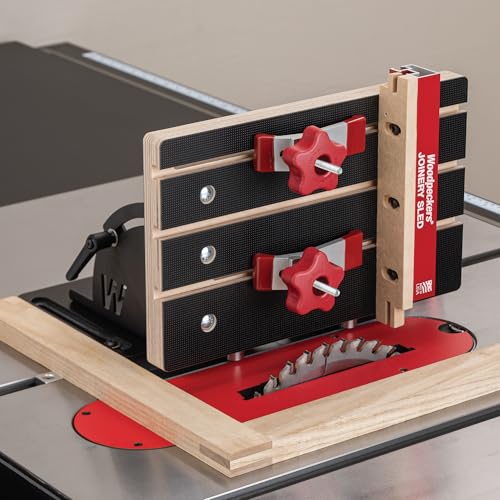

As an Amazon Associate we earn from qualifying purchases at no extra cost to you. Ratings are shown as listed on Amazon.
Best dovetail jigs for fine joinery: quick comparison
| Jig | Best use | Typical capacity | Adjustment and template system | Approximate market range |
|---|---|---|---|---|
| Leigh D4R Pro | Premium furniture and varied drawer work | Up to about 24 in. stock width; roughly 1/4–1 1/2 in. board thickness, depending on joint and setup | Adjustable finger assembly; multiple joint types; precision aluminum construction | $850–$1,100 |
| Leigh RTJ400 | Repeatable router-table production | About 12 in. board width; commonly 1/2–1 1/4 in. stock | Fixed template with guided setup; designed for router-table use | $350–$500 |
| Keller Journeyman | Clean through-dovetails and straightforward setup | About 12 in. width; approximately 1/2–1 1/4 in. stock, depending on cutter | Fixed aluminum template; spacing is determined by the template and bit | $150–$250 |
| Porter-Cable 4216-style jig | General-purpose half-blind and through-dovetails | About 12 in. width; commonly 1/2–1 1/4 in. stock | Interchangeable templates and adjustable guide fingers | $180–$300 when available |
| Quality 12-inch aluminum template jig | Occasional drawers and small cabinets | Usually 12 in. width; often 1/2–1 in. stock | Usually fixed or semi-adjustable template; quality varies substantially | $80–$180 |
Capacities are representative rather than interchangeable specifications. Bit diameter, template type, guide bushing, and the exact revision of a jig can change the usable range. Check the manufacturer’s current manual before buying a router bit set or planning a project around maximum board thickness.
Best overall for fine joinery: Leigh D4R Pro
The Leigh D4R Pro is the strongest choice when accuracy and flexibility matter more than price. Its adjustable finger assembly lets you alter pin and tail spacing instead of accepting one permanently fixed pattern. That matters when matching an existing piece, creating narrow pins, or scaling a joint to suit a particular board thickness.
Its broad capacity is useful for blanket chests, wide drawers, and cabinet components that exceed the practical width of many 12-inch jigs. The aluminum template and adjustable guides also make it suitable for both half-blind and through-dovetails, with additional joint options depending on the accessory and cutter configuration.
Why it suits hand-finished joinery
A high-end adjustable jig does not eliminate handwork; it makes the machine-cut joint predictable enough that handwork remains controlled. You can leave a deliberately small amount of material for paring, then refine the fit with a sharp chisel rather than correcting an uneven layout. The main disadvantage is setup complexity. The D4R Pro rewards careful measuring, test cuts, and recording settings for future batches.
Best for repeatable router-table work: Leigh RTJ400
The Leigh RTJ400 is a better fit when you make repeated drawers or boxes and already use a router table. Its fixed template approach is less flexible than the D4R Pro, but that limitation can improve consistency: once the fence, bit height, guide bushing, and workholding routine are established, identical parts can be processed with fewer variables.
It is particularly attractive for half-blind drawer joints, where the visible front face benefits from a consistent baseline and clean shoulders. It is not the best choice if you regularly change tail spacing, work with unusually thick stock, or want one jig to cover many specialized joint styles.
Best simple through-dovetail jig: Keller Journeyman
The Keller Journeyman uses a fixed aluminum template and is appealing because the layout is uncomplicated. It is a strong option for through-dovetails in boxes, chests, and carcases where the pattern will remain visible on both faces. The template is rigid, easy to understand, and less dependent on a complicated finger-adjustment procedure.
The trade-off is fixed spacing. You cannot freely design tiny pins, asymmetric patterns, or custom layouts in the same way as with an adjustable jig. It also requires attention to the relationship between the template, router bit, and guide arrangement. For a woodworker who values a repeatable traditional-looking pattern over maximum versatility, that is a reasonable compromise.
Best mid-range versatile option: Porter-Cable 4216-style jig
A Porter-Cable 4216-style jig remains a practical middle-ground design when available through current tool channels or replacement inventory. Its interchangeable templates and adjustable guide fingers cover common half-blind, through-, and box-joint work, while its roughly 12-inch capacity suits ordinary drawer and cabinet construction.
Its suitability for fine work depends heavily on setup discipline. Inspect the template for burrs, ensure the guide fingers seat evenly, and use a stable mounting board. Budget versions or worn examples may have play in the template or clamp components. Those problems show up as inconsistent pin widths, sloping shoulders, and joints that fit at one end but not the other.
Decision matrix: which jig fits your situation?
| Your situation | Recommended direction | Reason |
|---|---|---|
| One or two small projects each year | Quality 12-inch fixed or semi-adjustable jig | Lower ownership cost and adequate capacity for standard drawers |
| Frequent drawers with identical dimensions | Leigh RTJ400 | Router-table setup can be locked down for repeatability |
| Wide furniture or many joint patterns | Leigh D4R Pro | Greater width and adjustable spacing provide more design control |
| Mostly visible through-dovetails | Keller Journeyman | Simple fixed template and durable aluminum construction |
| Limited shop space | Compact 12-inch jig mounted to a removable board | Can be stored vertically and clamped to a bench only when needed |
| Beginner learning router joinery | Fixed-template jig with clear instructions | Fewer adjustments make it easier to isolate mistakes |
What determines accuracy more than the brand?
Template rigidity and guide-bushing fit
A thin or poorly supported template can flex under router pressure. Look for a rigid aluminum template or a well-supported steel design, and confirm that the guide bushing fits the template opening without excessive side play. A few thousandths of an inch of looseness can become visible across a row of pins.
Clamping and squareness
The workpiece must be held firmly without being crushed or tilted. A clamp that grips only near the center can allow the board ends to lift. Before routing, place a straightedge against the workpiece and check that its face is square to the jig base. If the board is not square, changing bit height will not correct the resulting uneven joint.
Adjustment range
Adjustable fingers are valuable when you want narrow pins, varied spacing, or a joint that matches an existing piece. They also introduce more opportunities for error. Fixed templates are often faster for repeated standard work, while adjustable systems are better for custom furniture.
Setup method for a hand-finished fit
-
Prepare matched test stock. Use scraps with the same species, thickness, and grain direction as the project. A test cut in thinner or softer material can give a misleading fit.
-
Mark the reference faces. Label the inside, outside, top, and bottom of every board. Many dovetail mistakes come from reversing one piece rather than from a bad jig.
-
Set bit height conservatively. For a through-dovetail, the tails should project only as much as your design requires. For a half-blind joint, use the manufacturer’s depth guidance and confirm it with a test cut.
-
Make a complete test joint. Do not judge fit from one isolated pin. Routing the full width reveals whether the template is square and whether the clamp is allowing movement.
-
Adjust in small increments. On many half-blind setups, changing bit height by roughly 1/64 inch can noticeably alter the fit. Record every change rather than turning the adjustment randomly.
-
Leave only minimal hand-fitting work. If the joint needs heavy force or extensive paring, stop and correct the setup. Hand finishing should refine a nearly correct joint, not rescue an inaccurate one.
Durability and ownership realities
The template itself usually lasts for years, but router bits, guide bushings, clamp pads, and mounting hardware are the parts most likely to affect performance over time. Dull bits burn the end grain and increase pressure on the jig. Replace or sharpen the bit when the cut becomes fuzzy, the router needs unusual force, or the joint dimensions begin drifting.
Keep dust from packing into template slots and clamp threads. Vacuum the jig after use, wipe resin from the clamp faces, and inspect adjustable fingers for looseness. Do not lubricate surfaces that must hold a workpiece by friction; instead, clean them and replace worn pads. Store the jig flat or supported so a long template cannot gradually warp.
Consider the cost per use before choosing a premium model. A $950 jig used for 190 drawers costs about $5 per drawer before bits and lumber. A $150 jig used for 15 projects costs $10 per project. The premium model becomes easier to justify when wide stock, custom spacing, or repeat production saves setup time and prevents expensive furniture mistakes.
Final recommendation
Choose the Leigh D4R Pro if fine joinery means maximum control, unusual dimensions, and custom pin-and-tail layouts. Choose the Leigh RTJ400 for repeatable router-table drawer production, the Keller Journeyman for uncomplicated through-dovetails, and a quality 12-inch template jig for occasional standard-sized work. Whichever model you select, prioritize a rigid template, reliable clamping, accurate reference-face marking, and a complete test joint; those factors determine whether a machine-cut dovetail is ready for hand finishing or requires major correction.








Write Your Review
No reviews yet. Be the first to share your experience!