
The best aviation snips and sheet metal shears for HVAC are the Wiss M1R/M2R/M3R family for dependable hand cutting, Midwest or Malco offset snips for frequent ductwork, and electric shears when long, repetitive cuts justify the cost.
Our top picks
 HURRICANE 3 pc Aviation Tin Snips Set
- 【Complete 3-Piece Set】Includes Yellow (Straight Cut), Red (Left…
- 【Purpose-Built for Straight, Left & Right Cuts】Unlike single…
- 【Reliable Cutting Capacity】Each snip cuts up to 20-gauge…
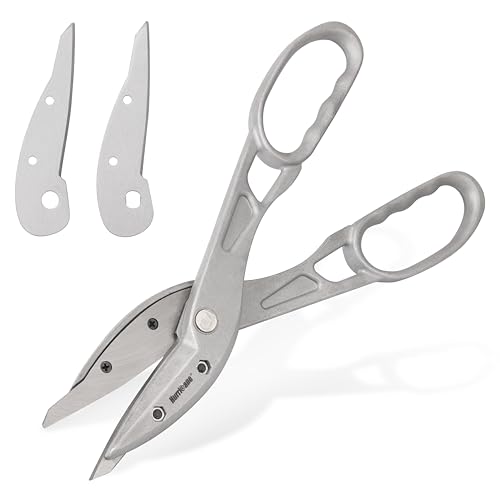 HURRICANE 12 Inch Aluminum Tin Snips
- Lightweight & Easy to Control: Made of sturdy…
- Effortlessly Cuts Common Materials: Sharp high-carbon steel blades…
- Extra-Large Glove-Friendly Handles: Oversized loops provide excellent leverage…
 HURRICANE 10 Inch Aviation Tin Snips
- 【Premium CR-MO Steel & Clean Cuts】 Forged from…
- 【Balanced Leverage for DIY Projects】 The compound leverage…
- 【Comfort Grip & ASME Quality】 Built to meet…
As an Amazon Associate we earn from qualifying purchases at no extra cost to you.
Quick picks by HVAC situation
| Situation | Best choice | Why it fits | Typical market range |
|---|---|---|---|
| One general-purpose pair | Wiss M1R straight-cut snips | Versatile for straight cuts, notches, and light trimming; widely available replacement style | $15–$30 |
| Most left-curving cuts | Wiss M2R or equivalent left-cut aviation snips | Jaw geometry keeps the waste side out of the way when the cut turns left | $15–$35 |
| Most right-curving cuts | Wiss M3R or equivalent right-cut aviation snips | More controllable on right-hand arcs and offset transitions | $15–$35 |
| Frequent duct installation | Malco Max2000 or Midwest offset snips | Offset jaws improve knuckle clearance and reduce wrist twisting around flanges | $25–$50 |
| Long, repetitive sheet runs | Electric or cordless sheet-metal shears | Much faster on long straight cuts, although they cost more and leave a larger minimum-radius limitation | $150–$400 plus battery where applicable |
What matters more than the brand name
Cut direction
Straight-cut snips are the best first purchase because they handle straight lines and many small notches. They are not a substitute for left- and right-cut versions when shaping duct corners. The color convention is usually green for right-cut, red for left-cut, and yellow for straight, but manufacturers can vary, so read the blade marking rather than relying only on handle color.
Left- and right-cut snips do not mean that the tool only cuts in one direction. They describe the direction in which the tool naturally turns and, importantly, which side of the material curls away. On a long HVAC cut, the correct pair prevents the offcut from folding into the jaws and obstructing your sightline.
Jaw capacity and sheet-metal gauge
Most quality aviation snips are intended for common galvanized HVAC sheet rather than every thickness sold as “sheet metal.” A practical target is approximately 22-gauge galvanized steel, about 0.030 inch thick, for repeated work. Many models can cut around 18-gauge mild steel, approximately 0.048 inch, for short sections, while stainless steel is substantially harder and may have a lower rated capacity.
| Material | Approximate thickness | Suitable hand-tool expectation |
|---|---|---|
| 26-gauge galvanized steel | 0.018 inch | Easy for good aviation snips |
| 24-gauge galvanized steel | 0.024 inch | Comfortable for routine duct fittings |
| 22-gauge galvanized steel | 0.030 inch | Good working limit for many quality snips |
| 18-gauge mild steel | 0.048 inch | Short cuts only; expect more hand force |
| 22-gauge stainless steel | Approximately 0.030 inch | Check the exact rating; stainless can damage ordinary blades faster |
Gauge numbers are not universal across every metal. Use thickness in inches when comparing the manufacturer’s capacity, and never force the handles through material beyond the rating. Excessive force can twist the jaws, loosen the pivot, and leave a rough cut that is more difficult to fold.
Head-to-head: the leading hand-snips styles
Wiss M1R, M2R, and M3R
The Wiss M1R straight, M2R left, and M3R right aviation snips are sensible choices for technicians who want familiar, replaceable-style tools at a moderate price. Their serrated cutting edges grip galvanized steel instead of skating across it, and the compound linkage provides more leverage than ordinary household scissors.
Choose the M1R first if you are building a tool bag from scratch. Add the M2R or M3R based on the kind of fittings you make most often. The main limitation is that traditional straight-handle designs can put your knuckles close to the work, particularly when cutting around a standing seam or flange.
Midwest offset snips
Midwest offset aviation snips are attractive for installers who spend much of the day cutting duct, flashing, and heavier galvanized stock. The offset jaw places the hand farther above the sheet, improving clearance and keeping the wrist closer to a neutral position. That advantage becomes noticeable when making long cuts in a panel or trimming a duct corner.
Offset snips are not automatically better for every cut. Their head can be less convenient inside a very tight notch, and the larger profile may be awkward in a crowded fitting. Select straight, left, or right cut according to the actual jaw configuration rather than choosing only by the offset handle.
Malco Max2000
Malco’s Max2000 aviation-snips range is aimed at trade users who want a robust compound mechanism and comfortable grips for repeated work. It is a strong upgrade when inexpensive snips develop loose pivots or uncomfortable handles after regular installation use. The higher purchase price makes more sense for a professional who uses snips weekly than for an occasional homeowner.
Electric and cordless sheet-metal shears
Power shears are the better answer when a project contains many long cuts, not because they make delicate shaping easier. They reduce hand fatigue and can cut faster through standard HVAC sheet, but they need room to start and turn. They also produce a narrow curled waste strip and are less convenient for tiny notches around collars and tabs.
A useful buying calculation is break-even time. If a $250 power shear saves 12 minutes on each of 25 jobs per year, it saves 300 minutes, or five hours, annually. At a labor value of $50 per hour, that is $250 of recovered time in the first year, before considering battery or blade costs. For ten small jobs per year, quality manual snips are usually the better value.
Handle comfort, lock design, and hardened materials
Look for a compound linkage, textured non-slip grips, and a spring that opens the jaws without requiring the thumb to pry them apart. A broad handle is useful when wearing gloves, but a very bulky grip can reduce control during small notches. Test whether you can close the tool without your little finger slipping past the handle.
The lock should hold the jaws closed securely but release with one hand. A sliding latch is generally quicker during repeated cuts, while a ring-style or wire-style lock can be durable but slower with gloves. Avoid a lock that sits directly in the palm or requires excessive force; it will become irritating during routine use.
Hardened carbon-steel or forged-steel jaws are preferable to soft stamped blades for HVAC work. Serrations should be sharp and even, with no visible gap at the front of the jaws when closed. Hardened blades still wear if used on screws, nails, hardened seams, or abrasive cement board. Do not use aviation snips as general-purpose pliers.
Decision matrix: which tool should you buy?
| Your priority | Recommended configuration | Reason |
|---|---|---|
| Lowest sensible cost | One straight-cut pair with a compound pivot | Covers most occasional repairs without paying for three specialized directions |
| Beginner doing one duct project | Straight pair plus a permanent marker and deburring tool | Layout accuracy and safe edges matter more than premium linkage |
| Professional, frequent use | Straight, left, and right offset pairs | Using the correct direction reduces distortion, force, and wasted sheet |
| Limited storage or crawlspace work | Compact straight snips with a one-hand latch | Less bulk is easier to control in confined areas |
| Long production cuts | Corded or cordless electric shears plus manual snips | Power handles length; manual snips handle corners and notches |
How to keep aviation snips cutting cleanly
- Mark the cut with a fine permanent marker and leave enough material for the intended hem or fold.
- Start at an edge or drill a suitable entry hole; do not twist closed snips sideways to force an entry.
- Use the correct left, right, or straight jaw so the waste curls away from the work.
- Keep the jaws roughly perpendicular to the sheet and make full, controlled strokes rather than repeatedly nibbling.
- Brush away metal chips, wipe moisture from the pivot, and apply a small drop of light oil when the joint feels dry.
- Store the tool locked closed, but do not leave it under tension or exposed to wet insulation and construction debris.
The cutting edges usually wear before the handles fail. A gritty pivot, spreading jaws, crushed serrations, or increasing burrs are signs to replace the snips rather than sharpening them casually. Filing the serrations can remove the grip that keeps galvanized sheet from slipping. For safe handling, wear cut-resistant work gloves and eye protection, and cover or deburr exposed edges after cutting.
Final verdict
For most HVAC tool bags, start with a quality straight-cut compound pair such as the Wiss M1R, then add the corresponding left- and right-cut versions when your work regularly involves curves and fittings. Choose Midwest or Malco offset snips when comfort, clearance, and daily durability matter more than the lowest price. Reserve electric shears for repeated long cuts; they complement rather than replace manual aviation snips.



Write Your Review
No reviews yet. Be the first to share your experience!