
Our Short List of 3

- Best for: Functional printing in ABS and ASA, with a multicolor upgrade path later.
- Build volume: 256 × 256 × 256 mm
- Motion system: CoreXY, fully enclosed body
- Max speed: 500 mm/s; max acceleration: 20,000 mm/s²
- Extruder: direct drive

- Best for: Multicolor hobby printing in a living space, where low noise matters.
- Build volume: 256 × 256 × 256 mm
- Max speed: 500 mm/s; max acceleration: 10,000 mm/s²
- Multicolor: AMS lite feeder included, multi-color printing supported
- Calibration: full-auto, with active flow rate compensation
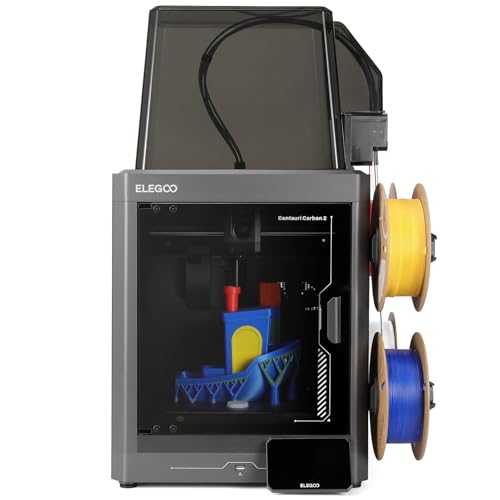
- Best for: Enclosed multicolor printing that also needs a 350°C hotend for filled filaments.
- Build volume: 256 × 256 × 256 mm
- Motion system: CoreXY, enclosed
- Max speed: 500 mm/s
- Multicolor: CANVAS system, multi-color printing
All 4 Picks at a Glance
| Product | Specs | Action |
|---|---|---|
| Bambu Lab P1S |
| Check price on Amazon |
| Bambu Lab A1 Combo |
| Check price on Amazon |
| ELEGOO Centauri Carbon 2 Combo |
| Check price on Amazon |
 Anycubic Kobra 3 Combo |
| Check price on Amazon |
Key takeaways
- Four fast 3D printers from the middle tier compared on Amazon listing specs: enclosed CoreXY machines and multicolor combos from Bambu Lab, Elegoo and Anycubic, with build volumes, hotend limits and included feeders checked.
The real decision in this tier is not raw speed, because every machine here advertises fast motion and a big build cube. It is what that speed costs you somewhere else: an enclosed chamber that holds heat for ABS and ASA, a multicolor feeder that dries filament while it prints, or an open frame that keeps the footprint small and the setup simple. Pick the wrong strength and you end up with a quick printer that cannot run the materials you actually bought it for.
This roundup is for home workshops, hobby benches and small studios that want a clear step up from entry-level machines without moving into flagship territory. Every pick was chosen from its Amazon listing — build volume, hotend temperature, motion system and what is physically included in the box — so the comparisons below rest on printed specifications rather than headline claims.
Quick Picks
As an Amazon Associate we earn from qualifying purchases.
| Product | Best for | Key spec from title |
|---|---|---|
| Bambu Lab P1S | Enclosed printing with ABS and ASA | CoreXY, 500mm/s, fully enclosed |
| Bambu Lab A1 Combo | Quiet multicolor printing on an open bench | AMS lite included, full-auto calibration |
| ELEGOO Centauri Carbon 2 Combo | High-temperature filaments in color | 350°C nozzle, CANVAS multicolor system |
| Anycubic Kobra 3 Combo | Multicolor prints with filament drying | 600mm/s, ACE Pro 4-color unit |
How to Choose
Decide whether you need an enclosure first
An enclosed chamber holds heat around the part, which is what ABS, ASA and many filled blends need to avoid warping and layer splitting on larger prints. Open-frame machines give that up, but they are easier to reach into, easier to cool, and usually smaller on the desk. If nearly everything you print is PLA or PETG, an enclosure buys you little. If you already know you want functional parts in engineering materials, it should be the first filter you apply, before speed or color.
Read the multicolor system, not the headline color count
Title copy often quotes the maximum color count a platform can reach with extra feeder units stacked on. What matters is what ships in the box you are ordering: a single four-slot feeder is the common setup in this tier, and anything beyond that is an add-on. Also check whether the feeder dries filament while it prints, because PETG and TPU pick up moisture quickly. Finally, remember that every color change purges material, so multicolor jobs take longer and waste more filament than the same model printed in one color.
Match the hotend ceiling to your filaments
Nozzle temperature decides which materials are realistic. A hotend in the 300°C class covers PLA, PETG, TPU, ABS and ASA comfortably. A 350°C hardened steel nozzle goes further, into abrasive carbon-fiber and glass-fiber blends that chew through softer nozzles. Check the nozzle material as well as the number: a high temperature rating on a soft nozzle still wears out fast on filled filaments. Bed temperature matters too for warp-prone materials, so confirm both figures on the listing instead of trusting the speed headline.
Check calibration claims and the true footprint
Full-auto calibration — bed leveling, flow rate and vibration compensation handled by the machine — removes most of the setup friction that made older printers tedious. Listings in this tier all promise some version of it, so compare what is actually automated. Then measure your space honestly. The dimensions on a listing describe the printer body; side-mounted spool holders, feeder units and door swing can add a lot of width. A machine that technically fits your shelf but cannot open its door is the wrong machine.
The 4 Best Options
Bambu Lab P1S
- Best for: Functional printing in ABS and ASA, with a multicolor upgrade path later.
- Build volume: 256 × 256 × 256 mm
- Motion system: CoreXY, fully enclosed body
- Max speed: 500 mm/s; max acceleration: 20,000 mm/s²
- Extruder: direct drive
Functional printing in ABS and ASA, with a multicolor upgrade path later.
The base unit ships without an AMS feeder, so multicolor printing needs a separate purchase; confirm you are ordering the standalone P1S and not the Combo listing, which carries a different ASIN.
The P1S is the enclosed CoreXY pick for buyers who have outgrown PLA-only printing. Its chamber, direct-drive extruder and auto bed leveling suit ABS, ASA and PET blends, and the built-in camera records time-lapse video of long jobs. The base printer is single-color as shipped, but it is built to accept Bambu Lab AMS feeder units later, up to sixteen colors across multiple units, so it grows with you instead of being replaced. If your projects are brackets, enclosures and functional parts rather than figurines, this is the most balanced machine in the group.
Bambu Lab A1 Combo
- Best for: Multicolor hobby printing in a living space, where low noise matters.
- Build volume: 256 × 256 × 256 mm
- Max speed: 500 mm/s; max acceleration: 10,000 mm/s²
- Multicolor: AMS lite feeder included, multi-color printing supported
- Calibration: full-auto, with active flow rate compensation
Multicolor hobby printing in a living space, where low noise matters.
The AMS lite holds spools out in the open with no drying function, so moisture-sensitive filament needs separate storage; check live stock on this listing before ordering, as its availability has flickered in recent crawls.
The A1 Combo pairs an open-frame printer with the AMS lite feeder in one box, so four-color printing works from the first day without extra orders. Its full-auto calibration covers leveling and active flow rate compensation, and the listing rates it at or under 48 dB, which makes it the easiest of the four to live with in a shared room. The trade-off is the open frame: it is happiest with PLA and PETG, and tall ABS parts will warp without a chamber. For decorative prints, signs, toys and prototypes, that trade is usually worth it.
ELEGOO Centauri Carbon 2 Combo
- Best for: Enclosed multicolor printing that also needs a 350°C hotend for filled filaments.
- Build volume: 256 × 256 × 256 mm
- Motion system: CoreXY, enclosed
- Max speed: 500 mm/s
- Multicolor: CANVAS system, multi-color printing
Enclosed multicolor printing that also needs a 350°C hotend for filled filaments.
The CANVAS spool holders mount on the sides and widen the working footprint well beyond the body dimensions on the listing, so measure your bench width with the holders fitted, not just the printer.
The Centauri Carbon 2 Combo is the high-temperature pick: an enclosed CoreXY machine whose hardened nozzle is rated to 350°C, paired with Elegoo’s CANVAS four-color system. One-click full auto leveling and a 256 mm build cube match the Bambu machines on paper, while the hotend ceiling reaches into the fiber-filled materials the others treat cautiously. It is also the newest platform in this group, first listed in December 2025, so its accessory and spare-parts ecosystem is younger. Buyers who want enclosed multicolor printing plus engineering filaments in one box should start here.
Anycubic Kobra 3 Combo
- Best for: Multicolor printing in humid spaces, where filament drying during the job prevents stringy, weak parts.
- Build volume: 250 × 250 × 260 mm
- Max speed: 600 mm/s; max acceleration: 20,000 mm/s²
- Multicolor: ACE Pro feeder, 4 colors as shipped (expandable to 8 with a second unit)
- Feeder features: active filament drying, clog detection, auto load and unload
Multicolor printing in humid spaces, where filament drying during the job prevents stringy, weak parts.
Four colors is the ceiling unless you add a second ACE Pro, and every color change adds purge waste and print time; the printer and feeder ship in separate boxes that may not arrive together.
The Kobra 3 Combo posts the highest headline speed here, 600 mm/s, and its ACE Pro feeder does something the other feeders in this group do not: it actively dries filament while it prints, alongside clog detection and automatic loading. That matters in humid rooms, where PETG quality falls apart on damp spools. The printer itself is an open-frame design with a slightly smaller build area than the 256 mm cube machines, and the Anycubic app handles monitoring and remote control. It ships as two units, the printer and the ACE Pro, which can arrive separately.
Which One Fits Your Situation
You print functional parts that take heat and load
Start with the P1S. The enclosed chamber and direct-drive extruder are the combination ABS and ASA need, and the automatic leveling keeps long prints uneventful. If those same parts also need color coding or you plan to move into fiber-filled blends, take the Centauri Carbon 2 Combo instead for its 350°C hardened nozzle.
The printer shares a room with people
Choose the A1 Combo. Its listing carries an explicit low-noise rating, the open frame makes loading and unloading quick, and full-auto calibration means less time leaning over the machine making adjustments. It is the only pick here designed from the start to sit on a desk in a lived-in room rather than in a workshop corner.
You print decor, cosplay pieces and gifts in several colors
Both combos serve you, in different ways. The Kobra 3 Combo dries filament inside its feeder, which keeps bright PETG colors clean in damp climates. The Centauri Carbon 2 Combo encloses the whole print, which helps taller color pieces in ASA or PETG blends. Pick based on your room humidity and whether your models need the chamber.
You are buying your first serious printer
Take the A1 Combo if your projects are decorative, or the P1S if they are functional. Both calibrate themselves almost completely, which removes the steepest part of the learning curve. The Elegoo and Anycubic machines are capable, but their newer or split-box setups ask slightly more patience from a first-time owner during the first week.
Common Mistakes
- Choosing by headline speed alone, when the enclosure question decides which materials you can print at all.
- Assuming the color count in a title is what ships in the box, when it often describes the platform maximum with extra feeders added.
- Ignoring purge waste: multicolor prints consume extra filament and time at every color change, which surprises first-time buyers.
- Measuring only the printer body and forgetting side spool holders, feeder units and door swing when planning bench space.
- Running carbon-fiber or glass-fiber filament through a nozzle that is not hardened steel, then blaming the printer for worn, sloppy output.
Frequently Asked Questions
Is an enclosed printer worth it if I mostly print PLA?
Usually not. PLA prints happily in open air, and an enclosure adds size, weight and cost without improving PLA results. The chamber earns its place when you move to ABS, ASA or larger PETG parts that warp as they cool. Buy the enclosure for the materials on your list, not for the ones you might try someday.
How many colors can these printers run as shipped?
Three of the four print four colors out of the box: the A1 Combo through its AMS lite, the Centauri Carbon 2 Combo through CANVAS, and the Kobra 3 Combo through its ACE Pro. The P1S is the exception — it ships as a single-color printer and needs an AMS feeder added before it can print in color at all.
Does the faster headline speed mean shorter real print times?
Only partly. Acceleration, flow limits and cooling decide how much of a rated top speed a real model ever reaches, and small parts may never get near it. Treat the speed figure as a ceiling, and weigh calibration quality and feeder behavior more heavily, because those affect every single print rather than the longest straight lines.
What should I check before ordering abrasive filament?
Confirm the nozzle is hardened steel and rated for the temperature your filament needs. In this group, the Centauri Carbon 2 Combo ships with a 350°C high-temp nozzle suited to filled blends. On the other machines, check the listing for the fitted nozzle material and keep a spare on hand, since abrasive filament wears even hardened nozzles over time.

Write Your Review
No reviews yet. Be the first to share your experience!