
Our Short List of 3

- Best for: Renovations, big garage cleanouts and standing water after leaks.
- Tank capacity: 16 gallons
- Motor: 6.5 peak HP, 12 amp
- Hose: 2-1/2 in x 7 ft Dual-Flex locking hose
- Power cord: 20 ft
- Best for: A single all-round vacuum for a home workshop and garage.
- Tank capacity: 9 gallons, poly
- Motor: 5 peak HP, 10 amp
- Airflow: 90 CFM
- Water lift: 70 in

- Best for: Small garages, vehicle detailing and anyone short on storage space.
- Tank capacity: 5 gallons, polypropylene
- Motor: 5.5 peak HP, 11 amp
- Airflow: 102 CFM
- Water lift: 82 in
All 4 Picks at a Glance
| Product | Specs | Action |
|---|---|---|
| CRAFTSMAN CMXEVBE17595 16-Gallon Wet/Dry Vacuum |
| Check price on Amazon |
| DEWALT DXV09P 9-Gallon Wet/Dry Vacuum |
| Check price on Amazon |
| Vacmaster Beast VFB511H 0201 5-Gallon Wet/Dry Vacuum |
| Check price on Amazon |
 Stanley SL18116P 6-Gallon Wet/Dry Vacuum |
| Check price on Amazon |
Key takeaways
- Four wet dry vacuums compared on tank size, hose diameter, filtration and reach, from a 16-gallon Craftsman for renovation water to a compact Vacmaster Beast.
The real decision with a wet dry vacuum is not raw suction. It is how often you will stop to empty the tank, whether the hose swallows the debris your space actually produces, and whether emptying a drum of dirty water is a one-minute job or a wrestling match. A big tank with a narrow hose clogs on renovation chunks; a small tank with a wide hose fills before you finish one bay of the garage.
This guide is for garage and workshop owners clearing sawdust and standing water, renovators dealing with drywall chunks and leaks, and drivers who want one machine for interior cleanups. Every pick below was chosen from its Amazon product title and listing specifications, and the four cover the tank sizes most homes genuinely need.
Quick Picks
As an Amazon Associate we earn from qualifying purchases.
| Product | Best for | Key spec from title |
|---|---|---|
| CRAFTSMAN CMXEVBE17595 | Renovation debris and large water pickups | 16 gallon, 6.5 peak HP |
| DEWALT DXV09P | One all-round vac for a home workshop | 9 gallon, 5 peak HP |
| Vacmaster Beast VFB511H 0201 | Compact storage with full-size suction | 5 gallon, 5.5 peak HP |
| Stanley SL18116P | Car interiors and small garages | 6 gallon, 4 peak HP |
How to Choose
Match tank size to your worst mess, not your average one
Tank capacity decides how many emptying stops interrupt a job. Two to six gallons suits car interiors, small spills and bench cleanup. Nine to twelve gallons covers a full garage session of sawdust without a mid-job trip to the drain. Fourteen gallons and up earns its floor space when you regularly face renovation debris or standing water from leaks, because a drum of water is heavy and nobody wants to haul it twice. Buy for the worst mess you realistically expect twice a year, not the everyday sweep.
Read hose diameter before horsepower
Peak horsepower is a laboratory stall figure, not working power, so it compares poorly across brands. Hose diameter tells you more: a 2-1/2 inch hose passes wood chips, screws and drywall chunks that jam narrower tubes, while a 1-1/4 inch hose is lighter and better for car crevices but clogs on coarse debris. Airflow in CFM and water lift in inches, where the listing publishes them, describe real pickup better than the HP badge. Check those numbers first and treat HP as a rough size class marker only.
Plan the filter swap between wet and dry work
Every wet dry vacuum in this class asks you to change filtration when you switch modes. Dry fine dust wants a cartridge filter, ideally with a collection bag so the cartridge lasts longer; liquid pickup wants a foam sleeve, and running the dry cartridge through dirty water shortens its life. Look for tool-free filter changes, such as quick-lock mounts, and confirm replacement filters and bags for your exact model are easy to find. A vacuum that makes the swap annoying is one you will eventually run in the wrong configuration.
Count total reach, then check the drain
Cleaning reach is hose length plus cord length, and it decides how often you hunt for a new outlet. Seven feet of hose with a ten-foot cord keeps you near one wall; eighteen to twenty feet of cord lets the vacuum sit still while you work around a vehicle. For wet work, a built-in drain near the base of the tank beats tipping a full drum into a sink. Also confirm the casters and handle suit your floors, because a full mid-size tank of water is a serious lift.
The 4 Best Options
CRAFTSMAN CMXEVBE17595 16-Gallon Wet/Dry Vacuum
- Best for: Renovations, big garage cleanouts and standing water after leaks.
- Tank capacity: 16 gallons
- Motor: 6.5 peak HP, 12 amp
- Hose: 2-1/2 in x 7 ft Dual-Flex locking hose
- Power cord: 20 ft
Renovations, big garage cleanouts and standing water after leaks.
It is a roll-around machine, not a carry-upstairs one, and a full drum of water is heavy even with the drain.
The Craftsman is the capacity answer in this group: a 16-gallon drum and a 6.5 peak HP motor sized for renovation cleanouts, flooded corners and full garage resets. Its 2-1/2 inch Dual-Flex hose is the joint-widest format here and resists kinking at both ends, so it passes the chunky debris that stalls narrower hoses. An oversized built-in drain handles the reality that sixteen gallons of water is far too heavy to tip, and a rear blower port clears leaves and dust from the driveway apron.
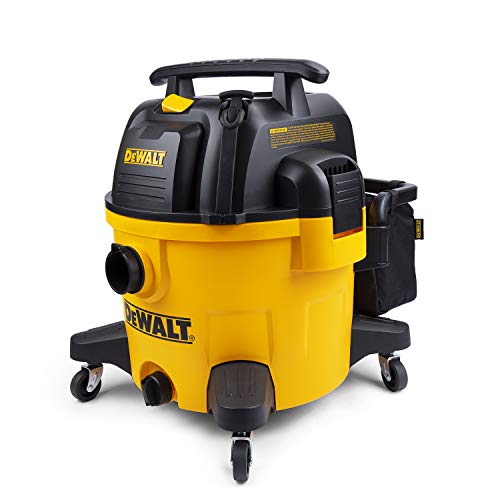
DEWALT DXV09P 9-Gallon Wet/Dry Vacuum
- Best for: A single all-round vacuum for a home workshop and garage.
- Tank capacity: 9 gallons, poly
- Motor: 5 peak HP, 10 amp
- Airflow: 90 CFM
- Water lift: 70 in
A single all-round vacuum for a home workshop and garage.
The ten-foot cord is short for large spaces, so plan on an extension cord for full-garage work.
The DXV09P sits in the middle of the range and suits most home workshops: a 9-gallon poly tank that shrugs off dents, a 5 peak HP motor, and published airflow of 90 CFM with 70 inches of water lift. The 1-7/8 inch hose splits the difference between debris capacity and maneuverability around vehicle interiors. A built-in tank drain simplifies wet emptying, the washable cartridge filter keeps running costs down, and the mesh accessory bag hangs on the back so nozzles and wands stay with the machine instead of scattering across the garage.
Vacmaster Beast VFB511H 0201 5-Gallon Wet/Dry Vacuum
- Best for: Small garages, vehicle detailing and anyone short on storage space.
- Tank capacity: 5 gallons, polypropylene
- Motor: 5.5 peak HP, 11 amp
- Airflow: 102 CFM
- Water lift: 82 in
Small garages, vehicle detailing and anyone short on storage space.
Five gallons fills quickly on renovation debris, and the float shut-off limits usable wet capacity below the nominal tank size.
The Beast makes the case for going small without going weak. Its 5-gallon polypropylene tank carries a 5.5 peak HP motor, and Vacmaster publishes the figures many makers skip: 102 CFM, 82 inches of water lift and 320 air watts, tested at the end of the hose. An 18-foot cord plus the 7-foot hose gives a 25-foot cleaning reach, the longest working radius here relative to size. The fine dust cartridge filter and dust bag handle dry debris, a foam filter covers wet pickup, and the unit converts to a blower for drying a washed car.
Stanley SL18116P 6-Gallon Wet/Dry Vacuum
- Best for: Car interiors, small garages and quick household wet or dry spills.
- Tank capacity: 6 gallons, poly
- Motor: 4 peak HP
- Airflow: 85 CFM
- Hose: 1-1/4 in x 6 ft
Car interiors, small garages and quick household wet or dry spills.
The narrow 1-1/4 inch hose clogs on chunky debris, and the ten-foot cord limits reach in larger spaces.
The Stanley is the lightest full-function option here at 13.4 pounds, with a 6-gallon poly tank and a 4 peak HP motor that produces 85 CFM. That combination fits apartment garages, car interiors and quick household spills better than the bigger drums, and the machine converts to a blower for clearing a porch or drying wheels after a wash. The 1-1/4 inch hose is the narrowest in this group, which keeps it nimble between seats but makes it the wrong choice for coarse workshop waste. Four swivel casters and a top handle keep it easy to move.
Which One Fits Your Situation
You are renovating or cleaning up after a leak
Choose the CRAFTSMAN CMXEVBE17595. Renovation work produces exactly the coarse debris its 2-1/2 inch hose is built to pass, and the 16-gallon drum means fewer stops mid-job. When water is involved, the oversized drain empties the drum without lifting it, which matters more than any suction figure once the tank is full.
You want one vacuum for the whole garage
Choose the DEWALT DXV09P. Nine gallons covers a full session of sawdust and floor cleanup, the 1-7/8 inch hose handles both bench debris and car interiors, and the accessory bag keeps every nozzle on the machine. It is the balanced footprint for a workshop that cannot spare a corner for a 16-gallon drum.
Your storage space is a single shelf or closet corner
Choose the Vacmaster Beast VFB511H 0201. It delivers the strongest published suction figures in this group from a 5-gallon body that carries by its top handle, and the 25-foot reach compensates for a small tank by keeping you moving. It suits detailing and spot cleanup far better than whole-house renovation waste.
You mainly clean cars and small spills
Choose the Stanley SL18116P. At 13.4 pounds it is easy to carry to the driveway, the narrow hose and crevice tool reach between seats, and the blower mode dries wheels and grilles after washing. Six gallons is plenty for interior work, and the machine stores in spaces the bigger drums cannot use.
Common Mistakes
- Comparing vacuums by peak horsepower alone, when the figure is a laboratory stall rating and hose diameter plus published CFM predict real pickup better.
- Vacuuming liquids with the dry cartridge filter fitted, which waterlogs the filter and shortens its life; swap to the foam sleeve first.
- Choosing a tank so large that a full load of water becomes too heavy to move, or so small that dry debris fills it in minutes.
- Ignoring total reach and discovering the cord plus hose cannot circle a vehicle without moving the vacuum and changing outlets.
- Forgetting replacement filters and bags when comparing models, since each brand uses its own sizes and the ongoing supply matters.
Frequently Asked Questions
Can a wet dry vacuum replace a regular household vacuum?
For garages, workshops and hard floors, yes, and it handles debris a household vacuum cannot. For finished living spaces it is usually louder, bulkier and fitted with a wider hose than you want around furniture. Most owners keep the household machine indoors and let the wet dry vacuum own the garage, basement and driveway work.
What size wet dry vacuum do most homes need?
A 5 to 9 gallon model covers the majority of home use: car interiors, garage floors, bench cleanup and the occasional spill. Step up to 14 gallons or more only if you regularly face renovation debris or standing water, because the larger drum costs storage space and gets heavy fast when it fills with liquid.
Do I need a filter bag as well as a cartridge filter?
A bag is not required, but it helps. The bag catches the bulk of dry debris before it reaches the cartridge, so the cartridge clogs more slowly and emptying the tank is less dusty. For fine material such as drywall or cold ash, a bag plus a fine dust cartridge is the combination listings for these machines assume.
How do I switch a wet dry vacuum from dry to wet pickup?
Stop the machine, remove the dry cartridge filter or bag if your model requires it, and fit the foam sleeve over the filter cage so liquid cannot reach the motor. Empty the tank first, since leftover dry debris turns to sludge. When you return to dry work, let the foam sleeve dry fully and refit the cartridge before starting.







Write Your Review
No reviews yet. Be the first to share your experience!