
Our Short List of 3
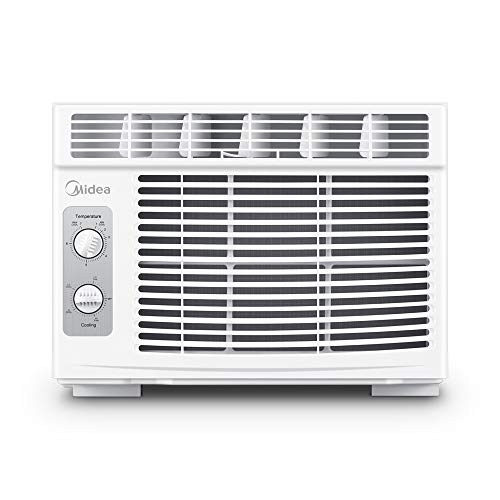
- Cooling capacity: 5,000 BTU, rated for rooms up to 150 sq ft
- Controls: Mechanical dials, 7 temperature settings, 2 cooling and 2 fan speeds
- Filter: Reusable washable mesh filter, front access
- Window fit: Double-hung windows 23 to 36 inches wide

- Cooling capacity: 5,000 BTU, rated for rooms up to 150 sq ft
- Noise: 52 dBA on the low setting
- Efficiency: CEER 11.0
- Controls: Mechanical, 2 fan speeds, auto restart after outages

- Cooling capacity: 5,000 BTU, rated for rooms up to 150 sq ft
- Noise: 56 dB
- Efficiency: CEER 11.0, 450 watts
- Weight: About 37 pounds, the lightest pick here
All 4 Picks at a Glance
| Product | Specs | Action |
|---|---|---|
| Midea EasyCool 5,000 BTU Window Air Conditioner (MAW05M1BWT) |
| Check price on Amazon |
| Frigidaire 5,000 BTU Window Air Conditioner (FFRA051WAE) |
| Check price on Amazon |
| Amazon Basics 5,000 BTU Window Air Conditioner (MWHUK-05CMN8-BCK0) |
| Check price on Amazon |
 GE 5,000 BTU Window Air Conditioner (AWAS05BWA) |
| Check price on Amazon |
Key takeaways
- The best budget window air conditioners compared: five 5,000 and 6,000 BTU picks with sizing, noise, CEER and install advice for small rooms.
A window air conditioner is still the cheapest honest way to cool one room properly. Unlike desktop evaporative boxes that mostly move humid air around, a real window unit uses a compressor and refrigerant to pull heat and moisture out of the room. The catch is that budget models all look similar on paper, so the differences that matter are sizing, noise, efficiency ratings and how well the installation kit seals your window.
Disclosure: As an Amazon Associate, I earn from qualifying purchases.
This guide compares five widely available budget models. Four are 5,000 BTU units sized for small rooms up to about 150 square feet, covering most bedrooms, dorms and home offices. The fifth is a 6,000 BTU step-up for rooms up to 250 square feet. All five use mechanical dials or basic electronic controls, washable filters and standard 115-volt plugs.
How to Choose a Budget Window Air Conditioner
Match the BTU rating to the room. BTU measures cooling capacity, and bigger is not automatically better. A 5,000 BTU unit suits rooms of roughly 100 to 150 square feet; step up to 6,000 BTU for 150 to 250 square feet. An oversized unit cools fast, shuts off, and leaves the room clammy because it did not run long enough to remove humidity. An undersized unit runs constantly and still loses ground on hot afternoons. Add about 10 percent capacity for a very sunny room, and roughly 600 BTU per extra regular occupant.
Check the noise rating before you buy for a bedroom. Noise is listed in decibels, usually for the low fan setting. Budget 5,000 BTU models generally land between 50 and 56 dB indoors on low, close to a quiet conversation, and climb higher on top speed. Just as important is the compressor thump when the unit cycles on at night, which no decibel figure captures well. Light sleepers should favor the quieter-rated models below and run the fan continuously instead of letting it cycle.
Understand CEER. The Combined Energy Efficiency Ratio rates cooling per watt under standardized conditions, including standby power. Small window units must meet a federal minimum around 11.0, and most budget models cluster between 11.0 and 11.3, so running costs are similar. Inverter and U-shaped models reach CEER 15 or more but cost considerably more up front, which is why they are not in this budget list.
Measure your window and judge the install kit. Most of these units fit double-hung windows 23 to 36 inches wide with a minimum opening height of about 12 to 13 inches. The included accordion side panels are thin and leak air and insects, so plan on adding foam weatherstripping. The unit should tilt very slightly outward so condensate drains instead of pooling. Units here weigh roughly 37 to 45 pounds, so a second pair of hands is wise, and a support bracket helps with heavier models.
Decide between dials and electronics. Mechanical rotary controls are the budget norm: simple, cheap to repair and immune to surge damage to control boards, but you get no remote, timer or precise temperature setting. Electronic controls add a remote, a 24-hour timer and an energy-saver mode that stops the fan with the compressor. Choose based on whether you will actually use those extras.
Midea EasyCool 5,000 BTU Window Air Conditioner (MAW05M1BWT)
- Cooling capacity: 5,000 BTU, rated for rooms up to 150 sq ft
- Controls: Mechanical dials, 7 temperature settings, 2 cooling and 2 fan speeds
- Filter: Reusable washable mesh filter, front access
- Window fit: Double-hung windows 23 to 36 inches wide
The Midea EasyCool is the default recommendation in this class because it gets the basics right. It is a straightforward mechanical model with two chunky dials, seven temperature settings, two cooling speeds and two fan-only speeds. The washable filter slides out from the front for rinsing, and the compact cabinet makes installation a one-afternoon job. Cooling is what you expect from a healthy 5,000 BTU unit: a small bedroom drops to a comfortable temperature and stays there, with proper dehumidification from a correctly sized compressor run.
Pros:
– Simple dials with more temperature steps than most rivals
– Compact, light cabinet that is easy to seat in the window
– Washable filter keeps maintenance costs at zero
Cons:
– No remote, timer or energy-saver mode
– Accordion side panels are flimsy and need extra foam sealing
– Fan is noticeable on the higher speed
Who it suits: Anyone cooling a small bedroom, dorm or office who wants the simplest reliable version of a 5,000 BTU window unit.
Frigidaire 5,000 BTU Window Air Conditioner (FFRA051WAE)
- Cooling capacity: 5,000 BTU, rated for rooms up to 150 sq ft
- Noise: 52 dBA on the low setting
- Efficiency: CEER 11.0
- Controls: Mechanical, 2 fan speeds, auto restart after outages
The Frigidaire FFRA051WAE is the quiet pick of the group. Frigidaire rates it at 52 dBA, and the low fan setting is genuinely unobtrusive for a budget compressor unit, making it a sensible choice for bedrooms. Controls are mechanical and deliberately plain: a rotary thermostat and a mode knob. A useful detail is auto restart, which restores your settings after a power outage instead of leaving the unit off. The washable filter is easy to reach, and the brand’s service network is a real advantage over no-name alternatives.
Pros:
– Quietest operation in this roundup on low
– Auto restart after power cuts
– Established brand with accessible parts and service
Cons:
– Only two fan speeds, so airflow steps are coarse
– No timer or remote control
– Temperature dial has no degree markings
Who it suits: Light sleepers and bedroom users who value low noise and brand support over extra features.
Amazon Basics 5,000 BTU Window Air Conditioner (MWHUK-05CMN8-BCK0)
- Cooling capacity: 5,000 BTU, rated for rooms up to 150 sq ft
- Noise: 56 dB
- Efficiency: CEER 11.0, 450 watts
- Weight: About 37 pounds, the lightest pick here
The Amazon Basics model is the value play: a no-frills 5,000 BTU unit with mechanical knobs, a washable filter and an adjustable window kit in the box. At roughly 37 pounds it is the lightest unit here, making it the easiest to install, store in winter and move between rooms. It covers cooling, fan and a dry dehumidifying function through the dial. The trade-offs are equally clear: the listed noise figure is 56 dB, the highest in this group, and the casing and side panels feel thinner than the brand-name rivals. It cools a small room just as well once installed, but asks for more foam sealing and tolerance for fan noise.
Pros:
– Light weight makes solo installation and storage easier
– Simple controls with a useful dry mode for damp rooms
– Window kit and washable filter included
Cons:
– Loudest unit in this comparison
– Thin accordion panels need added insulation to seal well
– Support limited to Amazon’s standard warranty channels
Who it suits: Renters and dorm residents who need the easiest unit to install, remove and store, and who are not bothered by fan noise.
GE 5,000 BTU Window Air Conditioner (AWAS05BWA)
- Cooling capacity: 5,000 BTU, rated for rooms up to 150 sq ft
- Controls: Mechanical rotary dials, 2 cooling and 2 fan speeds
- Dimensions: About 16.4 x 12.6 x 15 inches
- Installation: Easy install kit included in the box
GE’s 5,000 BTU mechanical model stands out for what comes in the box: its easy install kit is more complete than most, shortening the fiddliest part of the job. The cabinet measures about 16.4 inches wide, 12.6 inches high and 15 inches deep, fitting smaller openings that defeat wider units. Two rotary dials handle temperature and mode, with two cooling and two fan speeds. There are no electronics to fail, and GE’s parts availability is among the best in the category.
Pros:
– More complete installation kit than most budget rivals
– Compact cabinet fits narrower windows
– Strong parts and service network behind it
Cons:
– No remote, timer or digital temperature readout
– Dial thermostat is imprecise compared with electronic models
– Side panels still benefit from extra foam tape
Who it suits: Buyers with a smaller or older window opening who want an easier install and long-term parts support.
LG 6,000 BTU Window Air Conditioner (LW6017R)
The LG LW6017R is the step-up pick for rooms the 5,000 BTU models cannot honestly cover. Its 6,000 BTU rating handles up to about 250 square feet, opening up larger bedrooms, studios and living rooms. It is also the feature outlier here: electronic controls, a remote, a 24-hour timer, three cooling and fan speeds plus an Auto Cool mode, and a filter check reminder. Despite the larger capacity it stays civilized on noise, rated at 52 dB indoors on low, and its CEER of 11.3 is the best in this group. It also removes about 1.8 pints of moisture per hour, noticeably more than the smaller units.
Specs
- Cooling capacity: 6,000 BTU, rated for rooms up to 250 sq ft
- Efficiency: CEER 11.3
- Noise: 52 dB indoors on the low setting
- Controls: Electronic with remote, 24-hour timer, 3 speeds plus Auto Cool
- Extras: Filter check reminder, dehumidification 1.8 pints per hour
Pros:
– Cools rooms up to 250 sq ft that defeat 5,000 BTU models
– Remote, timer and energy-saving fan behavior included
– Best CEER and joint-quietest low setting in the group
Cons:
– Heavier and bulkier to install than the 5,000 BTU picks
– Costs more than the mechanical models
– Electronic controls are one more thing to fail long-term
Who it suits: Anyone with a 150 to 250 square foot room, or who wants a timer and remote without leaving the budget category.
Comparison Table
| Product | Capacity | Room size | Controls | Noise on low | CEER | Best for |
|---|---|---|---|---|---|---|
| Midea EasyCool MAW05M1BWT | 5,000 BTU | Up to 150 sq ft | Mechanical dials | Not listed | Not listed | Best all-round small-room pick |
| Frigidaire FFRA051WAE | 5,000 BTU | Up to 150 sq ft | Mechanical | 52 dBA | 11.0 | Quiet bedrooms |
| Amazon Basics MWHUK-05CMN8-BCK0 | 5,000 BTU | Up to 150 sq ft | Mechanical knobs | 56 dB | 11.0 | Lightest, easiest to move |
| GE AWAS05BWA | 5,000 BTU | Up to 150 sq ft | Mechanical dials | Not listed | Not listed | Easier installation |
| LG LW6017R | 6,000 BTU | Up to 250 sq ft | Electronic with remote | 52 dB | 11.3 | Larger rooms, timer and remote |
FAQ
What size window air conditioner do I need for a bedroom?
For most bedrooms of 100 to 150 square feet, a 5,000 BTU unit is the right size and will dehumidify properly. If the room is larger, has high ceilings, or gets strong afternoon sun, step up to a 6,000 BTU model like the LG here rather than letting a small unit run flat out all day.
Are budget window air conditioners expensive to run?
Not particularly. These models draw roughly 450 to 550 watts while the compressor runs, and with CEER ratings of 11.0 to 11.3 their efficiency is close to the class average. Running costs depend far more on your electricity rate, insulation and set temperature than on which of these five you choose.
How loud is a 5,000 BTU window air conditioner in practice?
Expect a steady fan sound in the low 50 dB range on low, similar to a quiet conversation, rising on higher speeds. The compressor starting and stopping is what wakes most people, so running the fan continuously overnight is a common workaround for light sleepers.
Can I install a window air conditioner by myself?
Usually yes for the lighter 5,000 BTU models, which weigh around 37 to 45 pounds, if you can lift the unit to sill height safely. A second person makes the job faster and safer. Add foam sealing around the side panels, and confirm the unit tilts slightly outward so water drains outside.
Conclusion
For a typical small bedroom or office, the Midea EasyCool is the easiest budget window air conditioner to recommend: simple, compact and effective. Choose the Frigidaire if low noise matters most, the Amazon Basics if light weight and easy storage top your list, and the GE if your window is small or you want the smoothest install. If your room runs past 150 square feet, go straight to the 6,000 BTU LG, the only pick here honestly sized for it. Whichever you choose, measure the window first, seal the side panels properly, and size the BTU rating to the room.





Write Your Review
No reviews yet. Be the first to share your experience!