
Key takeaways
- The best timing lights for most DIY ignition work are the Innova 5568 if you want advance, tachometer, and voltage information in one tool, the Innova 3568 for a simpler digital-advance setup, and a basic inductive light such as the…
The best timing lights for most DIY ignition work are the Innova 5568 if you want advance, tachometer, and voltage information in one tool, the Innova 3568 for a simpler digital-advance setup, and a basic inductive light such as the Actron CP7529 when low cost matters more than diagnostics.
A timing light is only useful when its flash remains easy to see, its inductive pickup fits the ignition wire, and its leads reach the engine without pulling on the clamp. The right choice depends less on peak specifications than on whether you work on an older distributor-equipped engine once a year or tune several vehicles in a bright workshop.
Our top picks
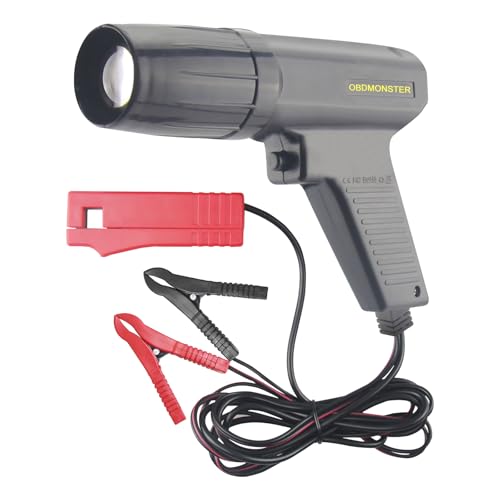


As an Amazon Associate we earn from qualifying purchases at no extra cost to you. Ratings are shown as listed on Amazon.
Best timing lights by situation
| Situation | Best fit | Why | Typical market range |
|---|---|---|---|
| Basic, occasional timing checks | Actron CP7529 or similar inductive light | Simple controls, conventional 12-volt connection, lower purchase cost | $35–$70 |
| DIY tuning and mixed older vehicles | Innova 3568 | Digital advance adjustment and clearer readout than a basic light | $90–$140 |
| Frequent tuning or diagnostic work | Innova 5568 | Advance, tachometer, voltage information, and a more comprehensive display | $140–$220 |
| High-performance distributor systems | MSD 8992 or another performance inductive light | Designed for demanding ignition setups and adjustable timing functions | $180–$300 |
Head-to-head: what separates the leading choices?
Innova 5568: best all-around diagnostic timing light
The Innova 5568 is the strongest pick when a timing light is part of a larger diagnostic kit rather than a tool used only for setting base timing. Its digital advance function lets you dial in the specified advance instead of relying on a marked timing tab that may be difficult to read. It also provides tachometer and system-voltage information, which can help reveal an unstable idle or charging problem while you are checking ignition timing.
Its main advantage is information density. Its main disadvantage is that additional buttons and readouts take longer to learn. For a first-time user who only needs to align a timing mark, it may be more tool than necessary. The inductive pickup is intended for conventional spark-plug wires; confirm compatibility before buying if your vehicle uses an unusual coil-on-plug or waste-spark arrangement.
Innova 3568: the sensible digital-advance choice
The Innova 3568 suits owners who want adjustable advance without paying for every diagnostic function. A digital display is easier to read than a dial in many positions, and the advance control is useful when timing marks are obscured or when you need to verify total timing at a particular engine speed.
Choose it over a basic light if you work on multiple distributor-equipped vehicles, compare initial and total timing, or tune in a garage where leaning over the fender makes a timing tab hard to see. It is less compelling if your engine manual gives a single idle timing specification and you expect to use the tool only once or twice a year.
Actron CP7529: best budget-friendly basic light
The Actron CP7529 represents the basic inductive timing-light category: connect the red and black power leads to the battery, place the pickup around the number-one spark-plug wire, and use the flashing mark to set timing. This approach is inexpensive and quick to understand.
The trade-off is that a basic light normally does not provide the same digital advance, RPM, or voltage information as a higher-end unit. It is also less convenient when the timing pointer is difficult to see. For a stock older vehicle with a conventional distributor, however, simplicity can be a benefit because there are fewer settings to enter incorrectly.
MSD 8992: for performance-oriented ignition systems
The MSD 8992 is aimed at users who spend more time tuning performance engines and aftermarket ignition systems. A performance-oriented timing light is worthwhile when you regularly check initial timing, mechanical advance, and higher-RPM total timing, or when access around headers and ignition components is awkward.
Before selecting it, verify the ignition-system requirements and pickup compatibility. Performance ignition boxes can produce strong electrical interference, and not every timing light behaves identically with every aftermarket setup. This category also costs more, so it is difficult to justify for an otherwise standard commuter vehicle.
Comparison of the features that matter in a workshop
| Feature | Basic inductive light | Digital-advance light | Diagnostic/performance light |
|---|---|---|---|
| Typical flash source | LED or xenon-style strobe | High-output strobe with digital controls | High-output strobe designed for demanding ignition systems |
| Advance control | Usually none | Commonly 0–60 degrees, depending on model | Often adjustable; check the individual manual |
| RPM display | Usually absent | May be absent or limited | Common on higher-end diagnostic models |
| Voltage display | Usually absent | Model-dependent | Common on multifunction models |
| Power source | Vehicle 12-volt battery | Vehicle 12-volt battery | Vehicle 12-volt battery |
| Useful lead length | About 4–6 feet on many handheld units | About 5–6 feet on many units | About 6 feet or more on some performance models |
| Bright-workshop usability | Acceptable only with good aim or shade | Better if the display is backlit and the flash is strong | Best when the light includes a bright xenon-style or high-output strobe |
Flash brightness matters more than headline accuracy
Most timing lights are accurate enough for ordinary distributor timing when connected correctly. The practical problem is often visibility: direct sunlight, white-painted timing marks, reflective pulleys, and engine-bay shadows can make a perfectly timed flash appear to wander.
For bright workshops, look for a high-output strobe, a focused beam, and a display that remains readable at an angle. A hood or shade over the timing pointer can improve visibility more than spending substantially more on a light. White correction fluid or a narrow strip of timing tape on the correct mark also helps, but clean the area first so the mark does not migrate.
Clamp compatibility and cord length
The inductive pickup should close fully around the number-one plug wire without forcing the wire sideways. A loose clamp can miss pulses; a clamp that is too small can damage insulation or fail to fit over a thick aftermarket wire. Many conventional plug wires are compatible, but always check the manufacturer’s instructions for solid-core wires, unusual shielding, waste-spark systems, and electronic ignition modules.
Cord length is a practical specification. A 4-foot lead may work on a compact four-cylinder with the battery nearby, while a 6-foot lead is more comfortable on a longitudinal V8 or an engine with the battery mounted at the rear. Measure the route from the battery to the timing pointer, then add roughly 12 inches for safe slack. Do not route the cable across belts, pulleys, exhaust manifolds, or cooling fans.
How to use a timing light without creating a false reading
-
Check the service information for the correct timing procedure. Some engines require a diagnostic connector, a disconnected vacuum advance, or a specific idle speed.
-
Warm the engine to normal operating temperature and stabilize the idle. An incorrect idle speed can change the timing reading on systems with mechanical or vacuum advance.
-
Connect the red lead to positive battery voltage and the black lead to a clean negative connection. Keep both leads clear of moving parts.
-
Place the pickup on the number-one spark-plug wire, following the arrow or orientation marking on the clamp. Reversed orientation can produce a weak or inconsistent flash on some lights.
-
Mark the timing pointer and pulley notch, then aim the light from a safe position. Use the light’s advance function only when the procedure calls for it.
-
After adjustment, raise the engine speed if the manual specifies checking total advance. Return the engine to idle before disconnecting the equipment.
Ownership realities: what wears first?
The pickup clamp and cable usually suffer more abuse than the electronics. Repeatedly bending the lead sharply at the handle, laying it across hot exhaust parts, or closing the hood on it can cause intermittent operation. The plastic clamp can also crack if it is forced around an oversized wire.
Store the light with the clamp closed loosely rather than twisted around the handle. Wipe oil and dust from the lens with a soft, slightly damp cloth; solvents can cloud some plastics. If the flash becomes intermittent, first inspect the battery connections, pickup orientation, plug-wire condition, and cable strain relief before assuming the strobe has failed.
Final recommendation
Buy the Actron CP7529 or a comparable basic inductive model for occasional stock-engine work. Choose the Innova 3568 when digital advance is the feature you will actually use. Choose the Innova 5568 when RPM and voltage readings can save separate diagnostic steps. Select the MSD 8992 or a similar performance light only when your ignition system and tuning routine justify the extra cost. In every case, prioritize a bright, clearly aimed flash, a compatible pickup clamp, and enough cable to keep your hands away from moving and hot engine parts.







Write Your Review
No reviews yet. Be the first to share your experience!