
Key takeaways
- Rechargeable batteries: Lithium-ion capacity declines with age and repeated charge cycles. Avoid storing a lantern fully drained for long periods, and follow its manual for charging and storage.
- Replaceable cells: Keep spares dry and correctly oriented. Remove batteries before long-term storage to reduce the risk of leakage damaging the contacts.
- Solar panels: Wipe dust and residue from the panel with a soft, damp cloth. A dirty or shaded panel charges less effectively; do not assume a short sunny spell will restore a depleted battery.
- Seals and ports: Dirt around a charging-port cover or battery compartment can interfere with a seal. Clean and dry the lantern before closing it, and inspect seals for cracks or deformation.
- Globe and frame: On fuel lanterns, the glass globe can break in transit and mantles are consumables. Pack the unit so the globe is protected, use the correct fuel, and follow the maker’s instructions for maintenance and ventilation.
Best Outdoor Lanterns for Patio and Camping: Quick Picks
The best outdoor lanterns depend on where you’ll use them: choose a rechargeable, dimmable LED lantern for a patio, a compact dual-fuel model for a backcountry trip, or a solar lantern when low running costs matter more than dependable all-night brightness. Before buying, compare usable runtime at the brightness you’ll actually use, power options, packed size, and protection from rain—not just the highest lumen figure.
Compare the Main Lantern Types
The figures below are representative ranges, not promises for every model. Manufacturers measure runtime and water resistance under different conditions, so check the specific product’s manual and test the lantern before relying on it outdoors.
Our top picks
 KOOPER 4 Pack Solar Lantern Outdoor Lights
- 【Vivid Dancing Flames & Brighter 】Solar lights outdoor…
- 【Upgraded Solar Panel & Long Working Time】The solar…
- 【All-Weather Resistance & Tough】Outdoor lights designed with IP65…
 Collapsible Portable LED Camping Lantern XTAUTO Lightweight
- 【360° Lighting Coverage】Adopts 6+1 high-intensity LED chips, energy…
- 【Lightweight & Portable】Collapsible design, as small as a…
- 【Durable & Waterproof】Made of high quality ABS material,…
 2 Pack 14'' Durable Tempered Glass Solar
- Efficient Solar Charging: Our lanterns use advanced monocrystalline…
- Enhanced Protection: Features over-charge, short-circuit protection, and waterproof…
- Realistic Candle-Like Appearance: Utilizes SMD light technology to…
| Product | Key specs | |
|---|---|---|
| KOOPER 4 Pack Solar Lantern Outdoor Lights | 【Vivid Dancing Flames & Brighter 】Solar lights outdoor… 【Upgraded Solar Panel & Long Working Time】The solar… 【All-Weather Resistance & Tough】Outdoor lights designed with IP65… | Check price |
| Collapsible Portable LED Camping Lantern XTAUTO Lightweight | 【360° Lighting Coverage】Adopts 6+1 high-intensity LED chips, energy… 【Lightweight & Portable】Collapsible design, as small as a… 【Durable & Waterproof】Made of high quality ABS material,… | Check price |
| 2 Pack 14'' Durable Tempered Glass Solar | Efficient Solar Charging: Our lanterns use advanced monocrystalline… Enhanced Protection: Features over-charge, short-circuit protection, and waterproof… Realistic Candle-Like Appearance: Utilizes SMD light technology to… | Check price |
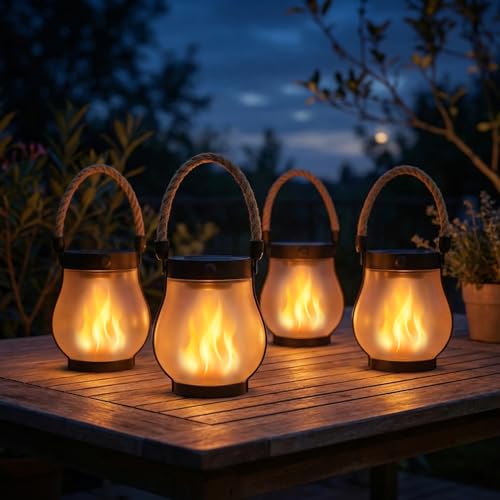 Solar Lanterns Outdoor Waterproof 4-Pack | 【4-PACK SOLAR LANTERNS OUTDOOR WATERPROOF】- These outdoor solar… 【2nd Gen FLICKERING FLAME SOLAR LANTERNS】- Choose a… 【HANGING SOLAR LANTERNS OR TABLETOP DECOR】 - Use… | Check price |
As an Amazon Associate we earn from qualifying purchases at no extra cost to you.
| Type | Typical brightness | Typical runtime | Power and weight | Best fit |
|---|---|---|---|---|
| Rechargeable LED | 100–1,000 lumens | 4–30 hours, depending on setting | USB-rechargeable battery; roughly 200–700 g | Patios, car camping, and regular use near a charging source |
| Battery-powered LED | 50–500 lumens | 10–100 hours, often on low | AA or D cells; roughly 150–800 g before spare batteries | Emergency kits and trips where replaceable batteries are useful |
| Solar LED | 20–200 lumens | About 3–12 hours after a full charge | Built-in panel and battery; roughly 100–500 g | Ambient patio lighting and sunny trips with modest light needs |
| Dual-fuel gas lantern | Typically 500–1,500 lumens | Often 5–15 hours per fuel canister or fill | Fuel, glass globe, and metal frame; commonly 1–2 kg or more | Bright base-camp lighting where weight and ventilation are manageable |
For most households, an LED is the practical starting point: it is easy to dim, has no hot mantle or fragile glass globe, and usually offers useful low-light settings. Gas lanterns can provide intense light, but their heat, fuel handling, maintenance, and ventilation requirements make them unsuitable for enclosed spaces. Never use a fuel-burning lantern inside a tent, vehicle, or home.
Choose by Where You’ll Use It
For a patio or backyard
Look for a rechargeable LED lantern with a warm or adjustable color setting, a stable base or hanging handle, and low mode for dinner-table use. A practical range is roughly 100–300 lumens for ambient light over a small seating area; use more only when you need to illuminate a work surface or a larger space. Several dimmable lanterns placed around a yard can feel more comfortable than one glaring light in the middle.
If the lantern will live outside, solar can be convenient, but only if its panel gets enough direct sun. Shade from a roof, trees, or winter daylight can leave the battery partly charged. For a frequently used patio, use solar as supplemental lighting or pick a model that can also charge by USB. A product described as water-resistant is not necessarily suitable for being left outdoors through storms; bring it in when practical.
For car camping
Prioritize a rechargeable LED with a handle, hanging hook, and enough battery capacity for a weekend. A USB output can be helpful for small devices, but using the lantern as a power bank reduces the energy available for light. A built-in battery is convenient when you can recharge between trips; a model that accepts replaceable cells is easier to replenish at a remote shop.
For a group, consider two lights rather than one oversized lantern: one can illuminate the cooking area while the other stays near the tent entrance. This also gives you a backup if one lantern runs low or gets misplaced.
For backpacking and backcountry use
Favor low packed weight, a protected switch, and a dependable low mode over maximum brightness. A compact lantern in the 50–200-lumen range is often sufficient for a tent or campsite, while a headlamp is usually better for walking because it keeps your hands free. Check whether the lantern can hang securely and whether its battery can be replaced or recharged with the equipment you already carry.
Solar lanterns can work for longer trips with sunny days, but they are a risky sole light source when weather or campsite shade could prevent charging. For a remote trip, carry a headlamp and spare or backup power even if the lantern’s advertised runtime looks ample.
Brightness, Runtime, and Weather Resistance: What the Specs Don’t Tell You
Lumens describe total light output, not how usefully that light is distributed. A clear globe can throw light broadly but cause glare; a diffuser makes light softer for a table or tent. If possible, compare the lantern’s low and medium settings, not just its maximum output. High mode often drains the battery much faster and may be unnecessary for close-up tasks.
Runtime figures are commonly measured on low mode or under controlled conditions. Cold weather, an aging battery, frequent switching to high, and charging a phone can all shorten practical use. Estimate your needs using the setting you expect to use: for example, a stated 12-hour runtime on medium provides only a six-hour cushion for an overnight outing if the lantern is used for six hours each evening—before allowing for cold or battery wear.
For rain protection, look for an IP rating and understand its limits. IPX4 indicates protection against splashing water, while IPX7 indicates a specified temporary immersion test; neither means the lantern is indestructible, and seals can wear or be compromised by damage. If you plan to use it in exposed or wet conditions, favor a weather-resistant design with a covered charging port and follow the manufacturer’s instructions. A rating does not protect against salt corrosion, grit, or impact.
A Simple Decision Matrix
| Your situation | What to prioritize | Best starting choice |
|---|---|---|
| Occasional backyard dinners; low budget | Simple controls, dimming, replaceable batteries | Battery-powered LED, roughly $15–$40 |
| Patio used several nights a week | USB charging, warm dimming, stable base | Rechargeable LED, roughly $25–$80 |
| Sunny campsite; light use | Small size, solar charging, USB backup | Solar or hybrid LED, roughly $20–$70 |
| Backpacking; tight pack space | Low weight, low-mode efficiency, compact shape | Small rechargeable LED, roughly $20–$60, plus a headlamp |
| Base camp needing very bright area light | High output, stable placement, safe fuel handling | Large LED or, where appropriate, a fuel lantern; roughly $40–$150+ |
These are broad market ranges, not quotes for a particular model. Materials, battery capacity, charging features, and weather protection can shift prices substantially.
Ownership: Batteries, Cleaning, and Wear
- Rechargeable batteries: Lithium-ion capacity declines with age and repeated charge cycles. Avoid storing a lantern fully drained for long periods, and follow its manual for charging and storage.
- Replaceable cells: Keep spares dry and correctly oriented. Remove batteries before long-term storage to reduce the risk of leakage damaging the contacts.
- Solar panels: Wipe dust and residue from the panel with a soft, damp cloth. A dirty or shaded panel charges less effectively; do not assume a short sunny spell will restore a depleted battery.
- Seals and ports: Dirt around a charging-port cover or battery compartment can interfere with a seal. Clean and dry the lantern before closing it, and inspect seals for cracks or deformation.
- Globe and frame: On fuel lanterns, the glass globe can break in transit and mantles are consumables. Pack the unit so the globe is protected, use the correct fuel, and follow the maker’s instructions for maintenance and ventilation.
Bottom Line
For most patios and car-camping trips, a dimmable rechargeable LED offers the best balance of convenience, brightness, and manageable upkeep. Choose solar for supplemental light where sunlight is reliable, replaceable-battery LEDs for simple emergency readiness, and a compact, efficient lantern for backpacking. Whatever the type, match the IP rating and runtime to the conditions you’ll face—and carry a separate headlamp or backup light when darkness would create a safety problem.





Write Your Review
No reviews yet. Be the first to share your experience!