
Key takeaways
- Compare the best sunrise alarm clocks for kids, including ok-to-wake sleep trainers with night lights, sounds, nap timers and app control for toddlers.
A sunrise alarm clock for kids replaces the jarring beep of a standard alarm with light. Most models here are ok-to-wake sleep trainers: the clock glows one color at bedtime, then turns green, or shows a smiling face, at the wake time parents set, so a child who cannot yet tell time still knows when it is fine to get up. Many add a night light, sleep sounds and a nap timer in the same unit.
The five clocks below were chosen for clear wake signals, published safety certifications and sensible power options. They range from a Wi-Fi model with app routines to simple plug-in trainers with a child lock, covering toddlers just moving to a big-kid bed and older children learning a school routine.
As an Amazon Associate, we earn from qualifying purchases.
Table of Contents
- Quick Answer
-
- LittleHippo Mella
-
- Hatch Rest+ 2nd Gen
-
- PlayMonster OK to Wake! Alarm Clock & Night-Light
-
- Windflyer Little Teddi OK to Wake Clock
-
- I·CODE OK to Wake Kids Alarm Clock
- How to Choose
- Who Should Skip
- FAQ
- Final Verdict
Quick Answer
The LittleHippo Mella is the strongest all-round pick for most families, pairing a clear color-and-face wake signal with sleep sounds, a night light and a nap timer. The Hatch Rest+ 2nd Gen adds Wi-Fi app control and a charging base for parents who want routines managed from a phone.
1. LittleHippo Mella — Best Overall
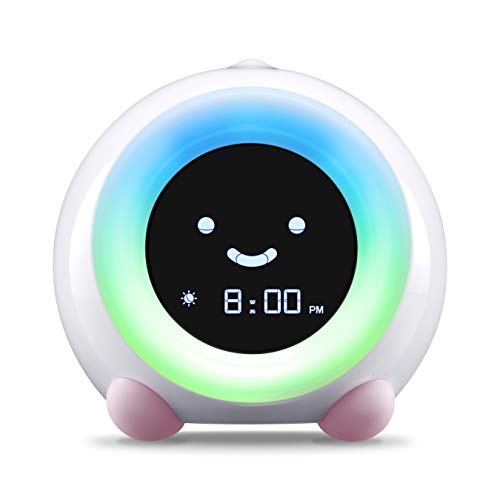
Mella teaches the routine with facial expressions as well as color. At the set sleep time its eyes close, and an optional automatic night light comes on. Up to 30 minutes before the wake time it can glow yellow, the signal to play quietly, and at the wake time it greets your child with a smile and a green glow. The yellow stage can be shortened or switched off entirely.
Mella also works as a sound machine with three sleep sounds, a night light with six colors, and a nap timer that can end silently or with sound. The light ring has three brightness settings and the display has five, and the face can be dimmed all the way to black for light-sensitive sleepers.
Specs:
- Wake signal: green glow with smiling face, optional yellow quiet-play light 5 to 30 minutes before
- Sounds: 3 sleep sounds (white noise, waves, lullaby) and 3 alarm sound options
- Night light: 6 colors, 3 brightness settings; display has 5 brightness settings
- Power: corded electric AC adapter; CR2032 backup battery keeps time and settings only
- Size and weight: 4.25 x 4.25 x 4.5 inches; 8 ounces
- Extras: nap timer, 12 or 24 hour mode, ABS and silicone body, FCC, CE, RoHS and CPSIA compliant
Mella sits in the mid-range tier and fits families who want one device to handle the full night, with no phone or app needed.
2. Hatch Rest+ 2nd Gen — Best With App Control
The Rest+ 2nd Gen is the connected option in this group. It connects over Wi-Fi and is set up in the Hatch app, where parents build routines that combine light colors and sounds, schedule a Time-to-Rise light for the morning, and adjust everything without entering the child’s room.
As a sound machine it plays white noise and other sleep sounds, plus bedtime stories and music from the app library. Uniquely here, it is portable: it sits on a charging base with a built-in backup battery, so it can travel or keep running through a short power cut.
Specs:
- Wake signal: programmable Time-to-Rise light with customizable colors in the app
- Sounds: sound machine with white noise, bedtime stories and music via the app
- Controls: Wi-Fi app control, Amazon Alexa, touch ring on the unit
- Power: charging base with built-in backup battery; cordless away from the base
- Size and weight: 5.04 x 5.04 x 6.82 inches; 1.2 pounds
- Extras: night light with adjustable brightness, alarm clock, plastic body, model HBR4600
The Rest+ is the premium tier pick. Choose it if you expect to adjust routines often, or want one device that starts in the nursery and later serves as a toddler wake-up clock.
3. PlayMonster OK to Wake! Alarm Clock & Night-Light — Best for Young Toddlers

This is the long-running classic of the category, sold under the Mirari name and now made by PlayMonster. The whole clock glows green when it is OK to get out of bed, and a softer yellow light serves as the night light. There are no apps or menus; hidden parental controls set the night light, green light and brightness.
Two interchangeable faceplates, a pink flower and a green bug, let the clock feel personal, and the toe buttons trigger fun animations. A nap timer and an audible alarm with snooze are built in, so the clock can shift from sleep trainer to a first real alarm as your child grows.
Specs:
- Wake signal: full-clock green glow; yellow night light
- Sounds: audible alarm with snooze (no sound machine)
- Controls: hidden parental controls; kid-friendly toe buttons for lights and animations
- Power: USB cord; 4 AA batteries required for backup (not included); wall adapter not included
- Size and weight: 5 x 4.3 inches; 8 ounces
- Extras: nap timer, 2 interchangeable faceplates, digital display, model DP8091Z
It sits in the mid-range tier and suits parents who want the simplest possible signal for a child of two to four, with nothing to configure beyond the wake time.
4. Windflyer Little Teddi OK to Wake Clock — Best for Quiet-Play Training

Little Teddi uses expressions to stretch the morning in stages. At bedtime its eyes shut, and four sleep modes let you combine sound and light, use one only, or neither. Before the wake time, an optional PLAY mode shows a winky face with a pale green glow for up to 90 minutes, the cue to read or play quietly in the room. At the wake time the face smiles and glows green, and it stays on for hours in case your child sleeps in.
A panel lock stops small fingers from changing settings, and the triangular base resists knocks when a half-asleep child reaches for the snooze button.
Specs:
- Wake signal: smiling face with green glow; optional pale green PLAY mode 0 to 90 minutes before
- Sounds: sound machine with 4 sleep modes (sound and light, light only, sound only, sleep only)
- Controls: panel child lock, 5 volume settings, LCD display with 4 brightness settings
- Power: corded electric, DC 5V adapter with 5.9 foot cable; CR2032 memory battery included
- Size: 4.6 x 5.5 inches
- Extras: nap timer, alarm clock, 12 or 24 hour mode, ABS and silicone, FCC, CE and RoHS approved
Little Teddi is a budget tier pick that still covers the full feature list, and suits children who wake early and need a structured quiet-play window.
5. I·CODE OK to Wake Kids Alarm Clock — Best Simple Plug-In

The I·CODE clock keeps the system to two faces and two colors. At night it shows a sleep face with a red light, which stays on for 13 hours, and in the morning it switches to a wake face with a green light that lasts for one hour. Side buttons keep setup short, and a child lock protects the settings.
Four alarm sounds, a nine-minute snooze and a nap timer cover the basics, and the warm light has three brightness levels. The brand markets it for children from two to ten years old, so it can stay in service well past the toddler stage.
Specs:
- Wake signal: wake face with green light for 1 hour; sleep face with red light for 13 hours
- Sounds: 4 alarm sounds; nine-minute snooze
- Controls: side buttons with icons, child lock, adjustable volume
- Power: corded electric plug-in (night light can run all night)
- Size and weight: 4.7 x 4.7 inches; 1.41 pounds
- Extras: nap timer, warm light with 3 brightness levels, ABS body, model A100
This is a budget tier clock for families who want the core sleep-training idea without a sound library or an app.
How to Choose
Start with the wake signal. Color-only clocks work well once a child understands the rule, while face-based clocks such as Mella, Little Teddi and the I·CODE give pre-readers a second cue. A quiet-play stage, offered by Mella and Little Teddi, helps early risers stay in their room.
Next, decide how much else the clock should do. If your child falls asleep to white noise, a built-in sound machine removes a second device from the nightstand. If you want to change the routine from your phone, or run different weekday and weekend schedules, the Wi-Fi Hatch Rest+ is the only pick here with app control.
Check the power source against the room. Corded models such as Mella, Little Teddi and the I·CODE can run a night light all night, and a memory backup battery keeps the clock set through power cuts. The PlayMonster clock runs from a USB cord with AA backup, and its wall adapter is not included. Finally, look for a child lock if your child likes pressing buttons, and confirm the display can dim fully for a dark room.
Who Should Skip
Skip this whole category if your child is old enough to read a digital clock and follow a stated wake time; a standard alarm clock will serve them better. Families who keep Wi-Fi devices out of children’s rooms should pass on the Hatch Rest+ and choose a standalone model instead. If your child is frightened by colored light at night, or a sibling shares the room on a different schedule, a light-based signal can cause more problems than it solves. And if all you need is a night light with no training routine, a plain night light is the simpler purchase.
FAQ
What age are ok-to-wake clocks best for?
Most are designed for children from about two years old, once they sleep in a toddler bed and can understand a simple rule such as waiting for the green light. Face-based models suit the youngest children, and several clocks here, including the I·CODE, are marketed for use up to around ten years old.
What is the difference between a sunrise alarm clock and an ok-to-wake clock?
Adult sunrise clocks gradually brighten a lamp to mimic dawn. Kids’ versions usually skip the slow dawn simulation and instead switch a color or face at a set wake time, which is easier for young children to understand. Every pick here uses that color-signal approach.
Do these clocks need Wi-Fi or an app?
Only the Hatch Rest+ 2nd Gen uses Wi-Fi and an app, which is how its routines, stories and Time-to-Rise schedules are managed. The other four clocks are standalone: you set the times on the device itself, and they need nothing more than power.
Can the night light stay on all night?
Yes, on the corded models. Mella’s sound machine and night light both offer continuous all-night durations, and the I·CODE’s night light can stay on all night while plugged in. On any model, check the duration setting, because several default to a 30 minute timer out of the box.
Final Verdict
For most families, the LittleHippo Mella covers the whole routine in one unit: a readable face-and-color signal, sleep sounds, a flexible night light and a nap timer, with no app required. Pick the Hatch Rest+ 2nd Gen if app control and portability matter more. The PlayMonster OK to Wake! remains the simplest choice for very young toddlers, while the Windflyer Little Teddi and the I·CODE deliver the same core training idea at the budget tier, with Little Teddi adding the useful quiet-play stage.







Write Your Review
No reviews yet. Be the first to share your experience!