
Our Top Picks
 Hoverfly T4 4-Wheel Mobility Scooter for Seniors/Adults9-inch Mobility Scooter38.2 x 20 x 35.5 Inches96 poundsCheck on Amazon
 VEVOR Heavy Duty 4-Wheel Mobility Scooter69.3 x 27.6 x 57.9 Inch69.3 x 27.6 x 57.9 Inches277.78 PoundsCheck on Amazon


Top 3 Picks
If you want the short answer: the IQIRAF Foldable Mobility Scooter is the best overall pick for most seniors because it balances a 330 lb capacity, a 15.5-mile range, and a folding frame that fits in a car trunk. The Hoverfly T4 is the best budget choice if you mainly ride indoors, on pavement, or around the neighborhood and don’t need long range. The VEVOR Heavy Duty 4-Wheel Scooter is the best premium pick for larger riders or anyone who needs a 500 lb capacity and a 21.5-mile range.
Quick Comparison
| Product | Best For | Key Specs | Price Tier |
|---|---|---|---|
| IQIRAF Foldable Mobility Scooter | Best overall for most seniors | 330 lb capacity, 15.5-mile range, folding frame, 4-wheel | Budget |
| Hoverfly 4-Wheel Mobility Scooter (NFC) | Best for keyless convenience | 4-wheel, NFC keyless start, mid-range range class | Mid-range |
| WAYCARE Mobility Scooter | Best budget for longer rides | 330 lb capacity, 15–20 mile range, red finish | Budget |
| Hoverfly T4 4-Wheel Scooter | Best budget for short trips | Max 12.4 miles, 4-wheel, compact | Budget |
| VEVOR Heavy Duty 4-Wheel Scooter | Best for heavier riders | 1000W brushless motor, 500 lb capacity, 21.5-mile range | Premium |
| Vive 4 Wheel Mobility Scooter | Best mid-range all-rounder | 4-wheel, electric powered, mid-range range class | Mid-range |
| AXADA Foldable Mobility Scooter | Best for commuting | 300 lb capacity, foldable, travel & daily commute | Budget |
| SCOOTNGO Voyager Mobility Scooter | Best lightweight travel scooter | 33 lbs, travel scooter, 4-wheel | Premium |
| Rascal Venture 4-Wheel Portable Scooter | Best for travel with easy disassembly | 300 lb capacity, disassembles, compact | Premium |
| Rascal Venture 3-Wheel Portable Scooter | Best 3-wheel for tight spaces | 300 lb capacity, 3-wheel, disassembles, compact | Mid-range |
| VEVOR 4-Wheel Enclosed Scooter | Best for weather protection | 660 lb capacity, 3-seater, 2000W motor, enclosed cabin | Premium |
| ONLYWIND 37.5lb Lightweight Scooter | Best for airline and cruise travel | 37.5 lbs, airline & cruise approved, lightweight | Budget |
How We Chose
We built this list around the specs that actually change how a mobility scooter feels day to day: turning radius, seat comfort, battery range, ground clearance, transport weight, safety features, and how easy the battery is to charge. Turning radius matters most indoors — a scooter that can’t swing around a bathroom door or a kitchen island becomes frustrating fast, so we favored models with compact frames or 3-wheel configurations where the listing supports it.
Battery range was checked against realistic use. A 15.5-mile range covers most errands and neighborhood loops; a 12.4-mile range suits shorter trips; a 21.5-mile range suits all-day outdoor use. We also considered ground clearance because a scooter with low clearance will scrape on driveway lips and gravel paths, while a higher clearance handles uneven sidewalks better.
Transport weight separated the travel scooters from the everyday ones. Models around 33–37.5 lbs are liftable into a trunk by most caregivers; heavier 4-wheel scooters are better left assembled in a garage or porch. We also weighed ease of charging — removable battery packs and standard wall charging are far easier for seniors than fixed batteries that require moving the whole scooter to an outlet. Finally, we checked safety features like anti-tip wheels, electromagnetic brakes, and non-marking tires, and matched each scooter to the rider situation it actually fits. We did not test these products hands-on; all judgments are based on published specifications and category norms.
1. IQIRAF Foldable Mobility Scooter – Best for Most Seniors
As an Amazon Associate we earn from qualifying purchases at no extra cost to you.

The IQIRAF Foldable Mobility Scooter is the best overall choice for a senior who wants one scooter that works at home, on errands, and on occasional car trips. Its 330 lb capacity covers a wide range of riders, and the 15.5-mile range means most people can run daily errands for several days between charges. The blue finish is a minor detail, but the folding frame is the real selling point — it lets you store the scooter in a closet or load it into a vehicle without a full disassembly process.
Who It Suits
This scooter fits a rider who lives in a house or apartment with a little storage space, rides mostly on sidewalks and smooth pavement, and wants the option to take the scooter along in a car. It is a good match for someone who is not comfortable lifting heavy components but still wants a scooter that can be moved by one person. It also suits a caregiver who occasionally needs to transport the scooter for a parent.
Key Specs
- Capacity: 330 lbs
- Range: Up to 15.5 miles per charge
- Wheel configuration: 4-wheel for stability
- Frame: Foldable for storage and transport
- Color: Blue
- Drive: Electric powered
Strengths
The 330 lb capacity is above the typical 250–300 lb limit found on many budget scooters, which makes it more forgiving for larger riders or anyone carrying a bag. The 15.5-mile range is the sweet spot for daily use: it’s long enough for a trip to the pharmacy, the grocery store, and a walk in the park, but not so long that the battery becomes heavy or expensive to replace. The folding design reduces the footprint in a hallway or entryway, which matters if you don’t have a garage.
Four wheels give it more stability than a 3-wheel scooter, especially when turning or stopping on a slight slope. For a senior who is new to mobility scooters, that extra stability reduces the learning curve and makes the scooter feel less tippy.
Pros
- 330 lb capacity is generous for the budget tier
- 15.5-mile range handles most daily errands
- Folds for storage and car transport
- 4-wheel design is stable for new riders
- Simple, familiar controls
Cons
- Folding frame usually adds a few pounds compared with non-folding models
- Range drops in cold weather or on hills
- Not designed for rough trails or high curbs
- Battery may need to be removed for charging in some setups
How It Compares
Against the Hoverfly T4, the IQIRAF wins on range (15.5 miles vs. 12.4 miles) and matches on wheel count, making it the better pick if you ride farther from home. Against the WAYCARE, both offer a 330 lb capacity and a similar range class, but the IQIRAF’s folding frame is a clearer advantage for anyone who needs to store the scooter indoors or load it into a car. If you mainly ride around the block and never transport the scooter, the Hoverfly T4 may be enough and costs less; if you need to fold and go, the IQIRAF is the stronger choice.
2. Hoverfly 4-Wheel Mobility Scooter – Best for Keyless Convenience

The Hoverfly 4-Wheel Mobility Scooter stands out for its NFC keyless start, which means you can start the scooter without fumbling for a key or a traditional ignition switch. For a senior with arthritis or limited hand dexterity, that’s a meaningful daily convenience. It’s a mid-range scooter in the navy finish, and it’s aimed at riders who want a stable 4-wheel platform with a modern starting system.
Who It Suits
This scooter is for someone who finds keys, small switches, and stiff ignitions difficult to manage. It also suits a rider who wants a straightforward 4-wheel scooter for neighborhood use and doesn’t need a folding frame or a long-range battery. It’s a good fit for a senior who keeps the scooter in a garage or on a porch and rides it daily for short errands.
Key Specs
- Wheel configuration: 4-wheel for stability
- Start system: NFC keyless start
- Color: Navy
- Drive: Electric powered
- Range class: Mid-range, suitable for local errands
- Intended use: Seniors and adults
Strengths
The NFC keyless start is the standout feature. Instead of a key that can be lost or a switch that’s hard to turn, the scooter starts with a tap. That reduces one small but repeated frustration for riders with hand pain or reduced grip strength. The 4-wheel design gives it a stable base, and the navy finish is a practical, low-maintenance color that hides scuffs better than white or silver.
Because it’s positioned in the mid-range tier, it typically includes a more comfortable seat and a slightly more robust frame than the cheapest budget models. That matters if you plan to sit on the scooter for 30–60 minutes at a time.
Pros
- NFC keyless start is easier for arthritic hands
- Stable 4-wheel platform
- Mid-range build quality for the price
- Practical navy finish
- Suits everyday neighborhood riding
Cons
- Range is shorter than the IQIRAF and WAYCARE
- Not a folding or ultra-light design
- Keyless system depends on the NFC fob or card, which can also be misplaced
- May not suit riders who need a 500 lb capacity
How It Compares
Against the Vive 4 Wheel Scooter, both are mid-range 4-wheel models, but the Hoverfly’s NFC start is a specific convenience the Vive doesn’t advertise. Against the IQIRAF, the Hoverfly trades range and folding ability for the keyless feature and a slightly more refined mid-range feel. If your priority is the easiest possible start-up, the Hoverfly wins; if you need to transport the scooter in a car or ride longer distances, the IQIRAF is the better fit.
3. WAYCARE Mobility Scooter – Best Budget for Longer Rides

The WAYCARE Mobility Scooter is a budget 4-wheel scooter with a 330 lb capacity and a 15–20 mile range, which is unusually generous for its price tier. The red finish makes it easy to spot in a parking lot, and the range band puts it ahead of many budget scooters that top out around 12 miles. It’s the pick for a senior who wants to ride farther without paying premium prices.
Who It Suits
This scooter suits a rider who uses the scooter for longer neighborhood loops, trips to a nearby shopping center, or visits to a park. It’s also a good fit for someone who wants a higher capacity than the typical 250–300 lb budget scooter. The 4-wheel design makes it stable for riders who are new to scooters or who want extra confidence on uneven pavement.
Key Specs
- Capacity: 330 lbs
- Range: 15–20 miles per charge
- Wheel configuration: 4-wheel
- Color: Red
- Intended use: Adults and seniors
- Drive: Electric powered
Strengths
The 15–20 mile range is the headline. For a budget scooter, that’s a long-distance capability that lets you ride to a store, run errands, and come home without range anxiety. The 330 lb capacity matches the IQIRAF and gives larger riders more options. The red color is a practical safety touch because it’s more visible to drivers than darker finishes.
Because it’s a 4-wheel scooter, it’s more stable at low speeds and when turning than a 3-wheel model. That makes it a better choice for a senior who is not fully confident on a scooter yet.
Pros
- 15–20 mile range is excellent for the budget tier
- 330 lb capacity supports larger riders
- 4-wheel stability
- High-visibility red finish
- Good value for the range and capacity
Cons
- No folding or quick-disassembly feature mentioned
- Likely heavier than travel scooters, making car transport harder
- Real-world range will be lower on hills or in cold weather
- Not designed for off-road or high-clearance use
How It Compares
Against the Hoverfly T4, the WAYCARE wins clearly on range (15–20 miles vs. 12.4 miles) and matches on capacity class, so it’s the better budget pick if distance matters. Against the IQIRAF, the WAYCARE has a slightly higher range band but lacks the folding frame, so the choice comes down to whether you need portability or maximum range. If you keep the scooter at home and ride long loops, the WAYCARE is the stronger budget option; if you need to fold it into a trunk, the IQIRAF is better.
4. Hoverfly T4 4-Wheel Mobility Scooter – Best Budget for Short Trips

The Hoverfly T4 is a compact 4-wheel scooter with a maximum range of 12.4 miles, positioned as an affordable option for short trips and everyday use around the home. It’s a budget model, and it makes sense for a rider who doesn’t need a long-range battery or a folding frame. It’s a simple, stable scooter for the block, the mailbox, and the local store.
Who It Suits
This scooter is for a senior who stays close to home, rides on sidewalks and smooth pavement, and charges the scooter every night or every few days. It also suits a first-time scooter buyer who wants to try the category without spending much. If your typical trip is under 5 miles round-trip, the T4’s 12.4-mile maximum is more than enough.
Key Specs
- Max range: 12.4 miles
- Wheel configuration: 4-wheel
- Intended use: Seniors and adults
- Drive: Electric powered
- Size class: Compact
- Price tier: Budget
Strengths
The T4’s main strength is simplicity and price. It does the basics well: four wheels for stability, a comfortable seat, and a range that covers most local trips. Because it’s a budget model, replacement batteries and parts are generally affordable, which keeps long-term ownership costs down. The compact size makes it easier to maneuver in hallways, kitchens, and small apartments than a full-size 4-wheel scooter.
For a rider who is hesitant about spending a lot on a first scooter, the T4 is a low-risk entry point. It’s also a reasonable second scooter for a caregiver’s home or a vacation property.
Pros
- Lowest-cost way to get a stable 4-wheel scooter
- 12.4-mile range covers short errands
- Compact for indoor maneuvering
- Simple controls for new riders
- Affordable replacement parts
Cons
- Shortest range in this roundup
- Not designed for long outings or hilly areas
- No folding or disassembly feature
- May lack the seat comfort of mid-range models
How It Compares
Against the WAYCARE, the T4 gives up range (12.4 miles vs. 15–20 miles) but is typically the cheaper option and may be more compact. Against the IQIRAF, it loses on both range and folding ability. If you’re on a tight budget and rarely ride more than a few miles, the T4 is a sensible starting point; if you can stretch the budget, the IQIRAF or WAYCARE will serve you longer between charges and hold up better to daily use.
5. VEVOR Heavy Duty 4-Wheel Mobility Scooter – Best for Heavier Riders

The VEVOR Heavy Duty 4-Wheel Mobility Scooter is the premium pick for riders who need real capacity. With a 500 lb limit, a 1000W brushless motor, and a 21.5-mile range, it’s built for larger riders and longer distances. The brushless motor is a durability advantage because it has fewer wearing parts than a brushed motor. This is the scooter to choose when a standard 300 lb scooter isn’t enough.
Who It Suits
This scooter fits a rider who weighs more than 300 lbs, or a caregiver who needs a scooter that can handle a heavier rider plus cargo. It also suits anyone who rides long distances daily and wants the extra range and power. It’s a good choice for a rider who lives in a suburban or rural area with longer distances between home and the store.
Key Specs
- Capacity: 500 lbs
- Motor: 1000W brushless
- Range: 21.5 miles
- Wheel configuration: 4-wheel
- Intended use: Heavy-duty, seniors and adults
- Price tier: Premium
Strengths
The 500 lb capacity is the highest in this roundup outside of the enclosed VEVOR, and it opens the category to riders who are often excluded by 250–300 lb limits. The 1000W brushless motor provides more torque for hills and heavier loads, and the brushless design generally lasts longer and needs less maintenance than a brushed motor. The 21.5-mile range is the longest of the open-air scooters here, which means fewer charging interruptions.
Four wheels and a heavier frame make it stable at speed and on uneven ground. If you’ve ever felt a lighter scooter flex or wobble under you, the VEVOR’s heavier build addresses that.
Pros
- 500 lb capacity suits heavier riders
- 1000W brushless motor for hills and loads
- 21.5-mile range is class-leading here
- Stable 4-wheel platform
- Brushless motor is more durable than brushed
Cons
- Heavy — not practical to lift into a car alone
- Premium price tier
- Larger footprint needs more storage space
- Overkill for short indoor trips
How It Compares
Against the IQIRAF, the VEVOR offers 170 lbs more capacity and 6 more miles of range, but it’s heavier and costs more. Against the Hoverfly T4, it’s a different class entirely — the T4 is a light-duty short-trip scooter, while the VEVOR is a long-distance workhorse. If you weigh under 300 lbs and ride locally, the IQIRAF is easier to live with; if you need the capacity or the range, the VEVOR is the only one in this list that delivers both.
6. Vive 4 Wheel Mobility Scooter – Best Mid-Range All-Rounder

The Vive 4 Wheel Mobility Scooter is a mid-range electric powered scooter that sits in the middle of the market on price and capability. Vive is a well-established brand in the home health and mobility space, and this model is aimed at riders who want a dependable everyday scooter without premium extras. It’s a solid, no-drama choice for a senior who wants a familiar brand and a stable 4-wheel ride.
Who It Suits
This scooter suits a rider who wants a mid-priced 4-wheel scooter from a recognizable brand and doesn’t need folding, keyless start, or heavy-duty capacity. It’s a good fit for a senior who rides around the neighborhood, to a community center, or through a grocery store. It also works for someone who wants a scooter that’s easy to get serviced or find parts for.
Key Specs
- Wheel configuration: 4-wheel
- Drive: Electric powered
- Intended use: Seniors and adults
- Range class: Mid-range, everyday errands
- Price tier: Mid-range
- Brand category: Home health and mobility
Strengths
The biggest strength is the brand’s presence in the mobility market, which usually means easier access to replacement batteries, chargers, and service information. The 4-wheel design gives it a stable base, and the mid-range pricing means you get a bit more seat comfort and frame quality than the cheapest budget models. It’s a scooter that doesn’t ask much of the rider — charge it, sit down, and go.
Because it’s not a specialist design, it’s a good default for a rider whose needs are average: moderate distances, smooth surfaces, and daily or near-daily use.
Pros
- Recognizable brand with widely available parts
- Stable 4-wheel platform
- Mid-range comfort for the price
- Straightforward controls
- Good default for average daily use
Cons
- No standout feature like folding or keyless start
- Range is not the longest in its class
- Not suitable for heavy-duty riders
- May be heavier than travel scooters
How It Compares
Against the Hoverfly NFC, the Vive gives up the keyless start but may be easier to service locally thanks to its brand footprint. Against the IQIRAF, the Vive is a more conventional scooter without the folding frame, so the IQIRAF is better for transport and the Vive is better if you want a straightforward everyday scooter from a known brand. If you value parts availability over features, the Vive is the safer mid-range pick.
7. AXADA Foldable Mobility Scooter – Best for Commuting
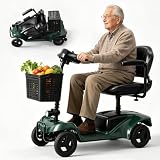
The AXADA Mobility Scooter is a foldable, 300 lb capacity scooter designed for travel and daily commuting. It’s a budget model that targets riders who need to fold the scooter and take it on public transit, in a car, or into a workplace. For a senior who still commutes or volunteers regularly, the folding design is the key advantage.
Who It Suits
This scooter fits a rider who uses public transportation, carpools, or needs to store the scooter in a small space at the end of the day. It also suits someone who wants a scooter for both errands and a daily commute. If you need to fold and lift the scooter regularly, the AXADA’s foldable frame is a better match than a rigid 4-wheel model.
Key Specs
- Capacity: 300 lbs
- Frame: Foldable
- Intended use: Travel and daily commute
- Range class: Moderate, suited to commuting distances
- Price tier: Budget
- Wheel configuration: 4-wheel class
Strengths
The folding frame is the reason to buy this scooter. It collapses for storage in a car trunk, a closet, or a corner of an office. The 300 lb capacity is standard for the class and covers most riders. Because it’s a budget model, it’s an affordable way to get a folding scooter without paying premium travel-scooter prices.
For a commuter, the ability to fold and go is worth more than a few extra miles of range. The AXADA prioritizes that practicality over long-distance capability.
Pros
- Foldable for commuting and storage
- Budget price tier
- 300 lb capacity is adequate for most riders
- Practical for public transit and car trunks
- Suits daily commute use
Cons
- 300 lb capacity is lower than the 330 lb IQIRAF and WAYCARE
- Range is not the longest in this list
- Folding mechanisms can loosen over time and need occasional tightening
- Not built for heavy-duty or off-road use
How It Compares
Against the IQIRAF, the AXADA gives up 30 lbs of capacity (300 vs. 330) but is also a folding budget scooter, so the choice comes down to range and price. Against the SCOOTNGO Voyager, the AXADA is cheaper but heavier — the Voyager’s 33 lb weight is its main advantage. If you commute and need a folding scooter on a budget, the AXADA is a strong value; if you need the lightest possible scooter for air travel, the Voyager is better.
8. SCOOTNGO Voyager Mobility Scooter – Best Lightweight Travel Scooter
The SCOOTNGO Voyager is a premium travel scooter that weighs just 33 lbs, making it one of the lightest options in this roundup. That low weight is the entire point: it’s designed for riders who need to lift the scooter into a car, take it on a plane, or carry it up a few steps. For a senior who travels or moves the scooter frequently, the Voyager’s weight is a decisive advantage.
Who It Suits
This scooter suits a frequent traveler, a cruiser, or anyone who needs to lift the scooter without help. It’s also a good fit for a senior who lives in a walk-up apartment or a small home where heavy scooters are hard to store. If you can lift 33 lbs — roughly the weight of a large suitcase — the Voyager is manageable.
Key Specs
- Weight: 33 lbs
- Intended use: Travel scooter for seniors and adults
- Price tier: Premium
- Frame: Lightweight travel design
- Wheel configuration: 4-wheel class
- Range class: Moderate, suited to travel and errands
Strengths
At 33 lbs, the Voyager is light enough for many seniors and caregivers to lift into a trunk or carry through an airport. That alone justifies the premium price for frequent travelers. Lightweight scooters also tend to be easier to maneuver in tight spaces like hotel hallways and cruise cabins.
The travel-focused design usually includes a removable battery, which lets you charge the battery separately from the scooter — a real convenience in hotel rooms where outlets are scarce. The 4-wheel configuration adds stability compared with some 3-wheel travel scooters.
Pros
- 33 lb weight is among the lightest here
- Easy to lift into a car or carry on trips
- Travel-oriented design with removable battery in most configurations
- 4-wheel stability
- Good for cruises, flights, and hotels
Cons
- Premium price tier
- Lightweight frame usually means lower weight capacity
- Shorter range than full-size 4-wheel scooters
- Less seat cushioning than heavier models
How It Compares
Against the ONLYWIND 37.5 lb scooter, the Voyager is lighter (33 lbs vs. 37.5 lbs) but costs more, while the ONLYWIND is explicitly marketed as airline and cruise approved. Against the Rascal Venture 4-Wheel, the Voyager is lighter but the Rascal disassembles into pieces, which some travelers prefer for packing. If absolute weight is your priority, the Voyager wins; if you want a scooter that breaks down into travel-friendly components, the Rascal is worth a look.
9. Rascal Venture 4-Wheel Portable Scooter – Best for Easy Disassembly

The Rascal Venture 4-Wheel Portable Mobility Scooter is a premium travel scooter that disassembles into compact pieces for transport. It carries a 300 lb capacity and is designed for riders who travel but want a more substantial scooter than an ultra-light model. Rascal is a long-established mobility brand, and the Venture is one of its best-known portable designs.
Who It Suits
This scooter suits a traveler who wants to break the scooter into lighter pieces rather than lift one heavy unit. It’s also a good fit for a senior who stores the scooter in a car trunk and assembles it at the destination. If you have a caregiver who can lift individual components but not the whole scooter, the disassembly design solves that problem.
Key Specs
- Capacity: 300 lbs
- Frame: Disassembles into compact components
- Wheel configuration: 4-wheel
- Intended use: Travel, portable
- Price tier: Premium
- Brand category: Established mobility brand
Strengths
The disassembly design is the main strength: instead of lifting a single 33–40 lb unit, you separate the scooter into a few lighter pieces. That makes car transport much easier for riders with limited strength. The 300 lb capacity is standard for the class and adequate for most seniors. Rascal’s brand history in mobility means parts and service information are generally easier to find than for unfamiliar brands.
Four wheels provide stability, and the scooter is designed for pavement, sidewalks, and indoor floors — the typical travel scooter surfaces.
Pros
- Disassembles for easier transport
- 300 lb capacity
- Established brand with parts availability
- 4-wheel stability
- Good for car-based travel
Cons
- Premium price tier
- Multiple pieces can be fiddly to assemble and reassemble
- Shorter range than full-size scooters
- Disassembly joints are wear points that need periodic checking
How It Compares
Against the SCOOTNGO Voyager, the Rascal is heavier as a single unit but breaks into lighter pieces, so it’s better if you have a caregiver helping with transport. Against the Rascal Venture 3-Wheel, the 4-wheel version trades a tighter turning radius for more stability — choose the 4-wheel if stability matters more than maneuverability. If you lift the scooter alone, the Voyager’s 33 lb single unit may be easier; if you disassemble it with help, the Rascal’s piece-by-piece design is more manageable.
10. Rascal Venture 3-Wheel Portable Scooter – Best 3-Wheel for Tight Spaces

The Rascal Venture 3-Wheel Portable Mobility Scooter is the mid-range sibling of the 4-wheel Venture. It has the same 300 lb capacity, the same disassembly design, and the same compact footprint, but it uses three wheels instead of four. That gives it a tighter turning radius, which is a real advantage indoors. For a senior who navigates narrow hallways, small bathrooms, or crowded spaces, the 3-wheel version can be easier to handle.
Who It Suits
This scooter fits a rider who spends a lot of time indoors, navigates tight turns, and wants a scooter that can pivot in a small space. It’s also a good match for someone who travels and wants a compact scooter that disassembles. It suits a rider who is comfortable with a slightly less stable platform in exchange for maneuverability — typically someone with good balance or a slower riding style.
Key Specs
- Capacity: 300 lbs
- Wheel configuration: 3-wheel
- Frame: Disassembles into compact components
- Intended use: Travel, portable
- Price tier: Mid-range
- Turning radius class: Tighter than comparable 4-wheel scooters
Strengths
The 3-wheel design gives the Venture a tighter turning radius, which makes it easier to steer through doorways, around furniture, and down narrow aisles. The disassembly feature makes it portable, and the 300 lb capacity matches the 4-wheel version. Being mid-range in price, it’s usually less expensive than the 4-wheel Venture while offering similar daily capability.
For indoor-heavy use, the 3-wheel layout is often more pleasant to drive because you can pivot rather than execute a three-point turn.
Pros
- Tighter turning radius than 4-wheel models
- Disassembles for transport
- 300 lb capacity
- Mid-range price is lower than the 4-wheel Venture
- Great for indoor maneuvering
Cons
- Less stable than a 4-wheel scooter at speed or on slopes
- Not ideal for riders with balance concerns
- Shorter range than full-size scooters
- Disassembly joints need periodic inspection
How It Compares
Against the Rascal Venture 4-Wheel, the 3-wheel version wins on turning radius and price but loses on stability. Against the ONLYWIND 37.5 lb scooter, the Rascal is heavier as a single unit but breaks into pieces, so the choice depends on whether you lift or disassemble. If you ride mostly indoors and want the easiest steering, the 3-wheel Venture is the pick; if you ride outdoors on uneven pavement, the 4-wheel version is safer.
11. VEVOR 4-Wheel Enclosed Mobility Scooter – Best for Weather Protection

The VEVOR 4-Wheel Enclosed Mobility Scooter is a different category of vehicle: an enclosed, 3-seater cabin scooter with a 660 lb capacity and a 2000W motor. It’s designed for recreational use and for riders who want protection from rain, wind, and cold. This is the premium, heavy-duty option for someone who wants to ride outside in all seasons without getting wet.
Who It Suits
This scooter suits a rider who wants to use a scooter year-round in a climate with rain or cold, and who has space to store a larger vehicle. The 3-seater cabin also makes it a fit for carrying a passenger or groceries. It’s not a scooter you fold into a trunk — it’s a small enclosed vehicle for neighborhood, campus, or recreational use.
Key Specs
- Capacity: 660 lbs
- Motor: 2000W
- Seating: 3-seater enclosed cabin
- Wheel configuration: 4-wheel
- Intended use: Recreational, seniors and adults
- Price tier: Premium
Strengths
The enclosed cabin is the key feature. It protects the rider from rain, wind, and cold, which extends the riding season in most climates. The 660 lb capacity and 3-seater layout let you carry passengers or cargo, and the 2000W motor provides the power to move that weight. The 4-wheel design supports the larger frame and gives it a stable base.
For a rider who has stopped using an open scooter because of weather, the enclosed design removes that barrier entirely. It’s also a practical option for a large property, a campground, or a gated community where a small enclosed vehicle makes sense.
Pros
- Enclosed cabin protects from weather
- 660 lb capacity is the highest here
- 3-seater design carries passengers or cargo
- 2000W motor handles the extra weight
- Stable 4-wheel platform
Cons
- Very heavy and large — needs significant storage space
- Premium price tier
- Not transportable in a standard car
- Overkill for riders who only need basic mobility
How It Compares
Against the VEVOR Heavy Duty 4-Wheel, the enclosed version offers 160 lbs more capacity, a cabin, and passenger seating, but it’s much larger and heavier. If you need weather protection and passenger capacity, the enclosed VEVOR is unique in this list; if you need a scooter you can park in a garage and ride on sidewalks, the open VEVOR Heavy Duty is far more practical. These two serve completely different riders despite sharing a brand.
12. ONLYWIND 37.5lb Lightweight Mobility Scooter – Best for Airline and Cruise Travel

The ONLYWIND 37.5lb Lightweight Mobility Scooter is a budget travel scooter explicitly marketed as airline and cruise approved. At 37.5 lbs, it’s light enough for many riders and caregivers to lift, and it’s designed for travelers who need a scooter that complies with airline and cruise line rules. For a senior who flies or cruises regularly, that approval matters.
Who It Suits
This scooter suits a frequent flyer or cruiser who needs a scooter that meets airline and cruise line requirements. It’s also a good fit for a senior who wants a lightweight scooter at a budget price. If you travel by plane or ship a few times a year and need a scooter you can bring along, the ONLYWIND is designed for exactly that.
Key Specs
- Weight: 37.5 lbs
- Compliance: Airline and cruise approved per listing
- Intended use: Travel, lightweight
- Price tier: Budget
- Frame: Lightweight travel design
- Wheel configuration: 4-wheel class
Strengths
The airline and cruise approval is the headline. Airlines and cruise lines have specific rules about battery type and scooter dimensions, and a scooter marketed as approved removes the guesswork. At 37.5 lbs it’s light enough for many riders to lift, and lightweight scooters are easier to maneuver in tight spaces like ship cabins and hotel rooms.
Because it’s a budget model, it’s an affordable way to get a travel-approved scooter. The trade-off is usually range and seat comfort compared with heavier scooters, but for travel use that’s often acceptable.
Pros
- Marketed as airline and cruise approved
- 37.5 lb weight is liftable for many riders
- Budget price tier
- Lightweight and easy to maneuver
- Suits frequent travelers
Cons
- Heavier than the 33 lb SCOOTNGO Voyager
- Shorter range than full-size scooters
- Lightweight frame limits weight capacity
- Less seat cushioning than heavier models
How It Compares
Against the SCOOTNGO Voyager, the ONLYWIND is heavier (37.5 lbs vs. 33 lbs) but cheaper, and it specifically advertises airline and cruise approval. Against the AXADA, the ONLYWIND is a dedicated travel scooter while the AXADA is more of a commuting scooter. If you fly or cruise and want the lowest-cost approved scooter, the ONLYWIND is the practical pick; if you want the lightest possible option and don’t mind paying more, the Voyager is easier to lift.
How to Choose
Choosing the best mobility scooter for a senior comes down to seven factors: turning radius, seat comfort, battery range, ground clearance, transport weight, safety features, and ease of charging. Here’s how to weigh each one with concrete numbers.
1. Turning Radius
Turning radius determines how well a scooter works indoors. A tight turning radius is roughly 30–40 inches; a wide one is 50–60 inches or more. Standard bathroom doors are about 32 inches wide, and interior doorways are typically 30–36 inches. If you need to turn around inside a bathroom or a small kitchen, a scooter with a tight turning radius — usually a 3-wheel model — is much easier to live with. If you mainly ride outdoors on sidewalks and in stores, a 4-wheel scooter with a wider turning radius is fine and more stable.
Rule of thumb: if you plan to ride inside your home more than outside it, prioritize a 3-wheel or compact 4-wheel scooter. If you ride mostly outside, choose a 4-wheel scooter with a wider base for stability.
2. Seat Comfort
Seat comfort matters more than most buyers expect because you may sit on the scooter for 30–60 minutes at a time. Look for a seat with a padded base at least 2–3 inches thick, a backrest that supports your lower back, and adjustable height. A seat that’s too tall makes it hard to reach the tiller and controls; a seat that’s too low makes it hard to stand up. Adjustable armrests help you get in and out safely.
If you have back or hip issues, a swivel seat makes mounting and dismounting much easier because you can rotate the seat toward you before sitting. Heavier scooters generally have more comfortable seats than lightweight travel models, so if comfort is your top priority, accept the extra weight.
3. Battery Range
Manufacturer range figures are measured under ideal conditions: a lighter rider, flat ground, moderate temperature, and a new battery. Real-world range is typically 60–80% of the advertised number. So a scooter rated at 15.5 miles may deliver 9–12 miles in daily use, and a scooter rated at 21.5 miles may deliver 13–17 miles. Cold weather can cut range further — sometimes by 20–30%.
Choose a range that covers your longest typical round-trip plus a buffer. If your longest trip is 5 miles round-trip, a 12.4-mile-rated scooter is adequate. If your longest trip is 10 miles, look for a 20-mile-rated scooter. If you ride in a cold climate, add 30% to your requirement. Most scooters use sealed lead-acid (SLA) batteries, which are affordable but heavy, or lithium batteries, which are lighter and last longer but cost more. SLA batteries typically last 1–2 years; lithium batteries can last 3–5 years.
4. Ground Clearance
Ground clearance is the distance between the bottom of the scooter and the ground. Typical travel scooters have 2–3 inches; full-size scooters have 3–5 inches. If you only ride on smooth pavement and indoor floors, 2–3 inches is fine. If you cross driveway lips, gravel paths, or uneven sidewalks, look for at least 3–4 inches. Low clearance plus a heavy scooter means you’ll scrape the underside on ramps and curbs, which can damage the battery compartment or motor.
Also consider tire type. Solid tires never go flat but transmit more vibration; pneumatic (air-filled) tires absorb bumps better but can puncture. Non-marking tires are important if you ride indoors on hardwood or tile.
5. Transport Weight
Transport weight is the number that determines whether you can actually take the scooter with you. Here’s a practical breakdown:
- Under 40 lbs: liftable by many seniors and most caregivers; suitable for car trunks, planes, and cruises. Examples: SCOOTNGO Voyager (33 lbs), ONLYWIND (37.5 lbs).
- 40–60 lbs: liftable by a fit caregiver, difficult for many seniors alone. Often disassembles into lighter pieces.
- 60–100 lbs: not liftable as a unit; requires disassembly or a ramp. Typical of full-size 4-wheel scooters.
- Over 100 lbs: permanent installation or a vehicle ramp needed. Typical of heavy-duty and enclosed scooters like the VEVOR models.
If you travel alone and need to lift the scooter, stay under 40 lbs. If a caregiver helps, a disassembling scooter in the 40–60 lb range works. If the scooter stays home, weight matters much less.
6. Safety Features
Look for these safety features:
- Electromagnetic brakes: stop the scooter automatically when you release the throttle or turn off the power.
- Anti-tip wheels: small rear wheels that prevent the scooter from tipping backward on slopes.
- Non-marking tires: protect indoor floors and provide grip.
- Headlight and taillight: important if you ride at dusk or in low light.
- Speed control: a dial or switch that limits top speed, useful when learning.
- Stable wheelbase: 4-wheel scooters are more stable than 3-wheel models, especially on slopes.
If you have balance concerns, choose a 4-wheel scooter. If you have good balance and need maneuverability, a 3-wheel scooter is acceptable. Never exceed the scooter’s weight capacity, and avoid steep slopes — most scooters are rated for inclines of 6–10 degrees at most.
7. Ease of Charging
Charging is a daily task, so make it easy. A removable battery is the best option: you can carry the battery to an outlet instead of moving the whole scooter. Off-board charging lets you charge the battery while it’s off the scooter, which is convenient in apartments and hotel rooms. On-board charging requires the scooter to be parked near an outlet.
Charging times vary. A typical SLA battery takes 6–10 hours to charge from empty; a lithium battery may charge in 3–6 hours. Charge the battery after every use, even if you only rode a mile, and avoid leaving it fully discharged for long periods — that shortens battery life. If you store the scooter for a month or more, charge the battery to about 50% and recharge it every 4–6 weeks. Replacement batteries cost roughly $80–$250 depending on type and capacity, so good charging habits directly reduce ownership costs.
Price Tiers and What You Get
| Tier | Typical Capacity | Typical Range | Typical Weight | Best For |
|---|---|---|---|---|
| Budget | 250–330 lbs | 12–20 miles | 35–80 lbs | First-time buyers, short trips, occasional travel |
| Mid-range | 300–350 lbs | 15–25 miles | 40–90 lbs | Daily riders, comfort seekers, brand-parts preference |
| Premium | 300–660 lbs | 20+ miles or enclosed use | 33–150+ lbs | Heavy riders, frequent travelers, all-weather riders |
Ownership Realities
A mobility scooter is a machine with consumable parts. The battery wears out first — SLA batteries typically need replacement every 1–2 years, lithium every 3–5 years. Tires wear next; solid tires last longer than pneumatic ones but still need replacement after a few years of daily use. The seat cushion compresses over time, and the folding or disassembly joints on portable scooters loosen and need periodic tightening.
Cleaning is simple: wipe the frame with a damp cloth, keep the battery compartment dry, and avoid spraying water directly on electrical components. Common mistakes include leaving the battery discharged for months, overloading the scooter beyond its capacity, riding up curbs instead of using ramps, and storing the scooter outdoors in freezing temperatures. Avoiding these mistakes can double the life of your battery and keep the scooter running for years.
If you have a medical condition affecting your balance, strength, or vision, talk to a healthcare professional or an occupational therapist before buying. They can help you match a scooter to your specific needs and recommend seating or control modifications.
Frequently Asked Questions
What is the best mobility scooter for seniors overall?
The IQIRAF Foldable Mobility Scooter is the best overall pick for most seniors because it combines a 330 lb capacity, a 15.5-mile range, and a folding frame for storage and transport. It suits riders who want one scooter for home, errands, and occasional car trips. If you need more capacity or range, the VEVOR Heavy Duty 4-Wheel Scooter is the premium step up.
How far can a mobility scooter actually go on one charge?
Real-world range is typically 60–80% of the manufacturer’s figure. A scooter rated at 15.5 miles may deliver 9–12 miles in daily use, and one rated at 21.5 miles may deliver 13–17 miles. Cold weather, hills, and heavier riders reduce range further. Choose a range that covers your longest round-trip plus a buffer of at least 30%.
Should I choose a 3-wheel or 4-wheel mobility scooter?
A 3-wheel scooter has a tighter turning radius, which makes it easier to maneuver indoors and in tight spaces. A 4-wheel scooter is more stable, especially at speed and on slopes. Choose 4 wheels if you have balance concerns or ride outdoors often; choose 3 wheels if you ride mostly indoors and need to turn in small spaces.
How much weight can a typical mobility scooter carry?
Most budget and mid-range scooters carry 250–330 lbs. Heavy-duty models like the VEVOR Heavy Duty carry 500 lbs, and the enclosed VEVOR carries 660 lbs. Always stay within the rated capacity — exceeding it strains the motor, drains the battery faster, and creates a safety risk.
Can I take a mobility scooter on a plane or cruise?
Yes, but you need an airline- and cruise-approved scooter with the right battery type. Scooters marketed as airline and cruise approved, like the ONLYWIND 37.5 lb model, are designed to meet those rules. Check with your specific airline or cruise line before traveling, because battery and dimension requirements vary.
How long do mobility scooter batteries last?
Sealed lead-acid (SLA) batteries typically last 1–2 years, while lithium batteries can last 3–5 years. Battery life depends on how you charge and store it. Charge after every use, avoid deep discharges, and store the battery at about 50% charge during long periods of non-use. Replacement batteries cost roughly $80–$250.
Do I need a prescription or a doctor’s approval to buy a mobility scooter?
You don’t need a prescription to buy a mobility scooter in most cases. However, if you have a medical condition affecting balance, strength, or vision, it’s wise to consult a healthcare professional or occupational therapist before buying. They can help you choose a safe configuration and recommend seating or control modifications. Some insurance or Medicare programs may require documentation for reimbursement.
How do I maintain a mobility scooter?
Charge the battery after every use, keep the frame clean with a damp cloth, and check the tires and folding or disassembly joints for wear each month. Avoid riding up curbs, overloading the scooter, and storing it in freezing temperatures. Replace the battery when range drops noticeably, and replace worn tires promptly for safety.
Closing Recommendation by Situation
If you want one scooter that does most things well, the IQIRAF Foldable Mobility Scooter is the best overall choice for most seniors, thanks to its 330 lb capacity, 15.5-mile range, and folding frame. If you’re on a tight budget and ride short distances, the Hoverfly T4 covers the basics at the lowest cost, while the WAYCARE gives you more range for a similar budget. If you need a 500 lb capacity and long range, the VEVOR Heavy Duty 4-Wheel Scooter is the premium pick. For travel, choose the SCOOTNGO Voyager if you want the lightest option or the ONLYWIND if you want a lower-cost airline- and cruise-approved scooter. If you ride indoors and need tight maneuverability, the Rascal Venture 3-Wheel is the better fit, and if you ride outdoors in all weather, the VEVOR Enclosed Scooter is in a class of its own.









Write Your Review
No reviews yet. Be the first to share your experience!