
Our Short List of 3
All 5 Picks at a Glance
| Product | Specs | Action |
|---|---|---|
 Amazon Basics HDMI Cable, 3-Pack, 6 Feet, 4K at 60Hz | Check price on Amazon | |
 Monoprice Ultra 8K High Speed HDMI Cable, 48Gbps, 6 Feet | Check price on Amazon | |
| Monoprice 8K Certified Ultra High Speed HDMI 2.1 Cable, Braided, 3 Feet | Check price on Amazon | |
 Amazon Basics Nylon-Braided HDMI 2.0 Cable, 10 Feet, 4K at 60Hz | Check price on Amazon | |
 Amazon Basics HDMI 2.0 Cable with Ethernet, 25 Feet, 4K at 60Hz | Check price on Amazon |
Key takeaways
- Compare five budget HDMI cables for TVs, monitors, and consoles, from short braided leads to a long living-room run, and find the right fit for your setup.
A good HDMI cable should be the least interesting part of a home entertainment setup. Plug it in, and the picture appears, the sound follows, and nothing else demands attention.
The challenge is not the budget itself but the matching. A cable built for a 4K television at 60 hertz is a poor choice for a gaming console that outputs 4K at 120 hertz, and a stiff 25-foot cable is the wrong answer for a tidy gap behind a monitor. The five cables below cover the most common situations: a multi-pack for wiring several rooms, an ultra high speed cable for consoles, a short braided cable for a desk, a braided mid-length cable for a media unit, and a long cable for a living-room run.
As an Amazon Associate, we earn from qualifying purchases.
How to Choose the Right Budget HDMI Cable
Start with the label on the cable, because the label is the contract. High Speed HDMI cables are rated for 18 gigabits per second and support 4K at 60 hertz, which covers most televisions, streaming devices, Blu-ray players, and older consoles. Ultra High Speed HDMI cables are rated for 48 gigabits per second and support 8K at 60 hertz and 4K at 120 hertz, which is the standard to look for when the cable connects a current-generation console or a high-refresh monitor. Buying a faster cable than a television needs is harmless, but buying a slower cable than a console demands will cap what that console can deliver.
Length is the next decision, and it matters more than most shoppers expect. Short cables keep a desk or media unit tidy and put less strain on ports, since there is less weight hanging from the connector. Longer cables solve the real problem of distance, but copper cables lose signal quality as they get longer, and a 25-foot run needs a thicker, heavier cable than a six-foot run. Measure the route the cable will actually take, then choose the shortest length that covers it with a little spare.
The jacket and connectors decide how the cable survives daily life. A braided nylon jacket resists scuffs and tangles better than smooth plastic, which helps where cables are plugged and unplugged often. Gold-plated connectors resist corrosion at the contact point, and a snug-fitting connector stays put in a port that gets bumped. If a cable will run inside a wall, look for a CL2 rating on the listing, which marks the jacket as suitable for in-wall installation.
A multi-pack makes sense when several devices need connecting at once. Wiring a television, a soundbar, and a console in one session is cheaper per cable with a three-pack, and a spare cable in a drawer saves a new order when a device arrives. For a single link, a single cable in the right length and speed is the better buy, since extra cables only add clutter.
Finally, check the features your setup actually uses. Enhanced audio return channel, known as eARC, lets a television send high-quality audio back to a soundbar through the same cable, so it matters when a soundbar is part of the setup. Dynamic HDR and variable refresh rate matter mainly for gaming and for televisions that support those features. If a feature is not listed on the product page, assume the cable does not claim it.
Amazon Basics HDMI Cable, 3-Pack, 6 Feet, 4K at 60Hz
This three-pack is the practical choice for a household with more than one screen to connect. Three six-foot cables cover a television, a monitor, and a spare in one purchase, and the per-cable cost is the lowest of any single cable in this guide. Each cable is rated High Speed at 18 gigabits per second and supports 4K at 60 hertz, which matches the needs of streaming sticks, cable boxes, Blu-ray players, and most televisions.
Six feet is the right length for the majority of living-room setups, reaching from a media unit to a television on a stand without a tangle of spare cable behind the furniture. The connectors are standard HDMI Type A on both ends, so they fit any full-size HDMI port. The main limit is the speed rating: at 18 gigabits per second, these cables will not carry the 4K at 120 hertz output of a current-generation console, so they belong on televisions and streaming devices rather than on a gaming setup that needs the faster standard.
Monoprice Ultra 8K High Speed HDMI Cable, 48Gbps, 6 Feet
This Monoprice cable is the one to pick when a console or a high-refresh monitor is on the other end. Rated Ultra High Speed at 48 gigabits per second, it carries the 8K at 60 hertz and 4K at 120 hertz signals that current-generation consoles output, along with dynamic HDR and enhanced audio return channel for soundbars. The listing states these ratings plainly, and the cable is built to the HDMI 2.1 standard, which is the key detail for anyone pairing a PlayStation 5 or Xbox Series X with a compatible television.
At six feet, the cable suits a console on the same media unit as the television, or a monitor on a desk with a gaming PC beside it. For a television that only supports 4K at 60 hertz, this cable is more than the setup needs, but for a gaming setup the extra speed is the whole point, and buying it now avoids replacing a slower cable later.
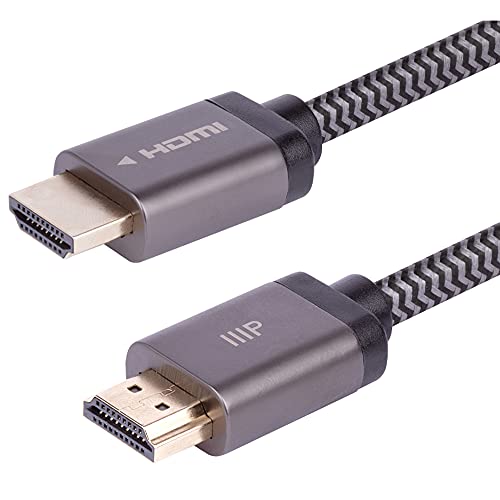
Monoprice 8K Certified Ultra High Speed HDMI 2.1 Cable, Braided, 3 Feet
Short cables are easy to overlook, but a three-foot braided cable is the right tool for a desk or a compact media unit where devices sit close together. This Monoprice model pairs the full 48 gigabit Ultra High Speed rating with a braided nylon jacket and a CL2 in-wall rating, so it handles both a tidy desktop link and a run inside a wall. The listing states support for 8K at 60 hertz, 4K at 120 hertz, HDR, variable refresh rate, and eARC.
The braided jacket is the practical advantage here. On a desk, a cable gets moved, unplugged, and re-routed more often than one behind a television, and braided nylon resists the scuffs and kinks that wear down smooth plastic jackets. The short length also keeps weight off the ports, which matters for a monitor whose HDMI socket sits high on the back of the display. Measure first, though: three feet will not span a media unit to a wall-mounted television.
Amazon Basics Nylon-Braided HDMI 2.0 Cable, 10 Feet, 4K at 60Hz
Ten feet is the length for a setup where the television hangs on the wall and the media unit sits below it, or where a streaming device lives on a shelf a little way from the screen. This Amazon Basics cable covers that gap with a nylon-braided jacket that stands up to being pulled through a cable channel or draped behind furniture. It is rated High Speed at 18 gigabits per second with 4K at 60 hertz support, matching the needs of most televisions, streaming sticks, and Blu-ray players.
The braid is the reason to choose this cable over a smooth-plastic cable of the same length, since a ten-foot run gets handled more and the braid resists tangles and abrasion. Like the three-pack, it is rated for 4K at 60 hertz rather than the faster 120 hertz standard, so it belongs on a television or streaming setup rather than on a console that outputs 4K at 120 hertz.
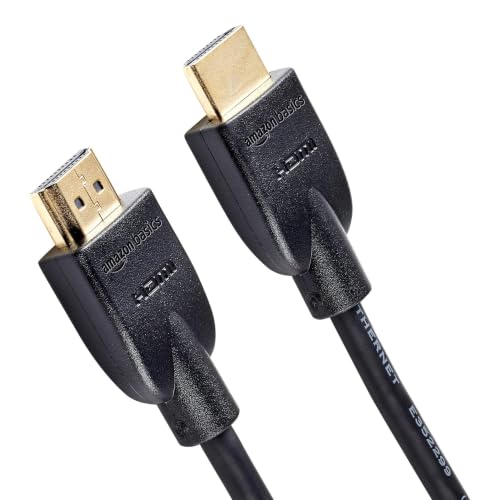
Amazon Basics HDMI 2.0 Cable with Ethernet, 25 Feet, 4K at 60Hz
Some setups simply need distance. A projector on a back shelf, a television across a large living room from the media unit, or a PC in one corner feeding a screen in another all call for a long cable, and this 25-foot Amazon Basics model is built for that job. It is rated High Speed at 18 gigabits per second with 4K at 60 hertz support, and it carries an Ethernet channel, so connected devices can share a network connection through the cable itself.
A cable this long is thicker and stiffer than a six-foot cable, which is a consequence of the heavier shielding and copper needed to carry a clean signal over 25 feet. Plan the route with that in mind, and leave a little slack at each end so the connectors are not pulled at an angle. The listing notes that the cable supports up to 4K at 60 hertz, so this cable suits a 4K television or projector rather than a high-refresh gaming setup.
Frequently Asked Questions
Do I need an Ultra High Speed cable for a 4K television?
It depends on what the television and its connected devices can output. A television that displays 4K at 60 hertz works fully with a High Speed cable rated at 18 gigabits per second. An Ultra High Speed cable rated at 48 gigabits per second becomes necessary only when a device outputs 4K at 120 hertz or 8K, which is mainly a concern for current-generation consoles and high-refresh monitors.
How long can an HDMI cable be before the signal drops?
Passive copper HDMI cables generally hold a clean 4K signal up to about 25 feet, which is the longest length in this guide. Beyond that distance, signal quality can fall off, and a fiber optic cable or an active cable is the usual answer. Shorter is always safer for signal quality.
Does a braided HDMI cable perform better than a smooth one?
The braid changes the jacket, not the signal. A braided nylon jacket resists scuffs, tangles, and kinks better than smooth plastic, which helps a cable that is handled often. The picture and sound quality depend on the speed rating and the build of the conductors inside, so choose the braid for durability and the rating for performance.
Can one HDMI cable carry both video and internet?
Yes, when the cable includes an Ethernet channel, as the 25-foot cable in this guide does. The Ethernet channel lets two connected devices share a network connection through the HDMI link. Both devices need to support HDMI Ethernet Channel for the feature to work, and most setups use a separate network cable instead.
Product and ASIN Reference
| Product | ASIN |
|---|---|
| Amazon Basics HDMI Cable, 3-Pack, 6 Feet, 4K at 60Hz | B01H7M6YKI |
| Monoprice Ultra 8K High Speed HDMI Cable, 48Gbps, 6 Feet | B07WNM2NJ5 |
| Monoprice 8K Certified Ultra High Speed HDMI 2.1 Cable, Braided, 3 Feet | B091JL2GMQ |
| Amazon Basics Nylon-Braided HDMI 2.0 Cable, 10 Feet, 4K at 60Hz | B075ZWY1SK |
| Amazon Basics HDMI 2.0 Cable with Ethernet, 25 Feet, 4K at 60Hz | B014I8TC4E |






Write Your Review
No reviews yet. Be the first to share your experience!