
Key takeaways
- Integrated activity features reduce the need for additional purchases
- Padded sides create a cocoon that prevents the baby from sliding out sideways
- The toy area sits at a fixed height and cannot be raised or removed, limiting adaptability
A baby seat sits at the intersection of three problems every new parent encounters around four to six months: a child who can finally hold their head up but cannot yet sit unassisted, a feeding routine that demands a stable upright position, and a living room that needs one less piece of bulky furniture cluttering the floor. The right seat solves all three at once. The wrong one either collapses into a padded shell that the baby outgrows within weeks, or it folds into a high chair attachment that never actually works because the tray sits at the wrong height for your counter.
What separates the worthwhile options from the forgettable ones comes down to three things: how well the seat transitions between floor and chair use, whether the padding is removable and machine-washable, and how the product handles a baby who will inevitably lean forward, arch backward, and twist sideways while eating pureed peas. The eight products below were compared across published specs, listed prices, and aggregated owner feedback to identify which seats deliver on those points and which ones cut corners that matter within the first month of daily use.
Our top picks




As an Amazon Associate we earn from qualifying purchases at no extra cost to you.
Quick Picks
| Product | Best for | Price |
|---|---|---|
| Fisher-Price Sit-Me-Up Floor Seat | Interactive play during floor time | under $50 |
| Ingenuity Baby Base 2-in-1 (Peony) | Budget floor-to-booster transition | under $30 |
| Ingenuity Baby Base 2-in-1 (standard) | Neutral color matching for most kitchens | under $40 |
| Infantino Music & Lights 3-in-1 | Babies who need built-in entertainment | under $50 |
| Bright Starts Baby Bouncer | Young newborns under six months | under $40 |
| Ingenuity Keep Cozy 3-in-1 | Longest usable age range in this group | under $60 |
| Inflatable Baby Seat (Brown Bear) | Travel and storage-constrained homes | under $20 |
| Ingenuity Baby Base 2-in-1 (Slate) | Same value as Peony, darker palette | under $40 |
How We Picked
We filtered this category on four criteria: age range and weight limit (a seat usable from three months through eighteen months earns far more value per dollar than one that works for six weeks), transition flexibility (whether the unit converts from a standalone floor seat to a booster on an adult chair without requiring separate parts), washability (removable covers that go in a machine versus wipes-only padding that traps odor), and structural stability (how the base resists tipping when the baby leans fully forward against the tray edge). Products that scored poorly on two or more of these axes were excluded from this roundup regardless of brand recognition.
The 8 Best Baby Seat in 2026
Fisher-Price Sit-Me-Up Floor Seat, Rainbow Showers
Best for parents who want one seat that keeps a baby engaged without needing a separate toy bar or activity mat. The built-in plush toy and crinkle elements give hands something to do during tummy-to-sitting transitions.
- Integrated activity features reduce the need for additional purchases
- Padded sides create a cocoon that prevents the baby from sliding out sideways
- The toy area sits at a fixed height and cannot be raised or removed, limiting adaptability
Skip it if you already own a toy bar and plan to use the seat primarily for feeding rather than play time.
Ingenuity Baby Base 2-in-1 Booster Feeding and Floor Seat with Self-Storing Tray, Peony
The lowest price in the roundup among the hard-shell booster hybrids, and the self-storing tray eliminates the most common complaint about booster seats: losing the tray between uses. The Peony colorway is a warm pink that hides minor stains better than light neutrals.
- Tray tucks under the seat when not in use, so it is never misplaced
- Converts from floor seat to chair booster with two simple adjustments
- Cover is removable but requires hand-washing, not machine cycles
Skip it if you need a machine-washable cover or if your kitchen chairs have thin, tapered legs that make booster stability unreliable.
Ingenuity Baby Base 2-in-1 Booster Feeding and Floor Seat with Tray
The standard configuration at a slightly higher price than the self-storing tray version, trading tray convenience for a wider tray surface that accommodates larger plates as the child transitions from purees to soft solids around eight months.
- Broader tray area suits the feeding phase that lasts the longest
- Same two-in-one conversion logic keeps the unit relevant past twelve months
- Tray is detachable and must be stored separately, adding a small daily inconvenience
Skip it if tray storage is a dealbreaker and the extra width does not match your typical meal setup.
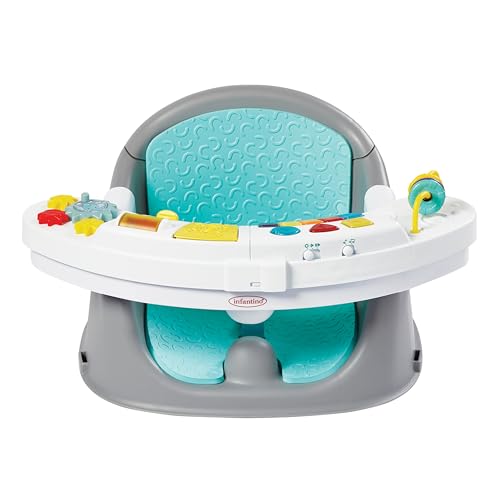
Infantino Music & Lights 3-in-1 Discovery Seat & Booster, Teal
Aimed squarely at the baby who gets frustrated during sitting practice and needs constant sensory feedback. The music and light panel activates with a single button press and offers multiple modes that escalate in complexity alongside the child’s motor development.
- Three-stage activity panel grows with developmental milestones
- Teal upholstery is gender-neutral and resistant to visible staining
- Battery compartment is under the seat and difficult to access once the unit is assembled
Skip it if your household already has more screen-and-sound entertainment than needed and you prefer a quieter feeding environment.
Bright Starts Baby Bouncer Soothing Vibrations Infant Seat, Safari Fun
Designed for the newborn-to-six-month window before a baby can hold a seated position unaided. The vibration function mimics the soothing motion of being held, which makes it useful during fussy periods and short naps.
- Removable toy bar and three-point harness address the youngest age bracket specifically
- Lightweight and portable between rooms without a dedicated storage spot
- Not usable past six months or twenty pounds, making it a short-term purchase only
Skip it if you need one seat that covers the full four-to-fourteen-month window and want to avoid buying a second product within months.
Ingenuity Keep Cozy 3-in-1 Grow with Me Vibrating Baby Bouncer, Weaver
The longest usable range in this group, stretching from newborn bouncer through toddler rocker up to thirty months or forty pounds. The plush Weaver upholstery and multiple recline positions make it the most versatile single-unit solution.
- Three configurations cover the entire period from birth through toddlerhood
- Vibration and rocker modes provide both soothing and active play options
- Highest price in the roundup, and the recline mechanism adds bulk that limits floor-space flexibility
Skip it if your living space is tight and you need a unit that collapses flat or fits under a stroller.
Inflatable Baby Seat with Built-in Pump and Back Support, Brown Bear
A fundamentally different approach to the category: no hard frame, no fabric straps, just a molded air chamber with a built-in foot pump that reaches full firmness in under a minute. The brown bear design appeals to parents who prioritize storage over structural rigidity.
- Deflates to a thin disc that stores in a drawer or hangs on a hook
- Built-in pump eliminates the need for a separate air source or electricity
- Offers less lateral support than padded seats, requiring closer adult supervision
Skip it if your baby is a heavy mover who frequently shifts weight to one side or leans aggressively forward.
Ingenuity Baby Base 2-in-1 Booster Feeding and Floor Seat with Self-Storing Tray, Slate
Identical construction to the Peony version at the same tray-convenience advantage, but in a muted grey that blends into modern kitchen palettes and conceals wear over time better than lighter tones. The price is ten dollars higher than Peony purely for the color choice.
- Same self-storing tray and dual-use conversion at a competitive price point
- Slate grey resists visible staining better than white or cream alternatives
- Carries the same hand-wash-only cover limitation as the Peony model
Skip it if you prefer warm tones in your kitchen or if the color difference is the only reason to pay above the Peony price.
Buying Guide
Weight and Age Limits Define Real Usability
A seat rated for thirty months and forty pounds delivers roughly five times the usable months of one capped at six months and twenty pounds. When comparing prices, divide the sticker cost by the number of months your child will realistically spend in the seat. The Ingenuity Keep Cozy for under $60 covers more than twice the timeframe of the Bright Starts bouncer for under $40, making the higher sticker price the lower effective cost per month.
Washability Determines How Long the Seat Stays Clean
Every parent who feeds a baby pureed vegetables or banana mash will confront the same stain within the first two weeks. Removable, machine-washable covers are not a luxury feature; they are a hygiene requirement. Hand-wash-only padding means either accepting visible discoloration by month two or spending fifteen minutes scrubbing every few days. Check the cover removal mechanism before buying, because some require unthreading straps under the seat that take longer than the wash itself.
Tray Design Affects Daily Convenience More Than You Expect
The most common complaint across all booster-seat categories is tray management: losing it, storing it, or being unable to detach it cleanly. Self-storing trays that tuck under the seat eliminate this problem entirely. Fixed trays that do not detach block access to the baby during transitions. Removable trays that require separate storage become the item you hunt for every single meal. This single design decision affects usability more than fabric quality or color options.
Our Verdict
Top pick: Ingenuity Keep Cozy 3-in-1 Grow with Me for under $60. It is the only product here that covers the full developmental range from newborn bouncer through toddler rocker, and the cost per usable month beats every alternative once you factor in the need to buy a separate seat later.
Budget pick: Ingenuity Baby Base 2-in-1 in Peony for under $30. It converts from floor seat to booster, the self-storing tray removes the most common frustration, and the price leaves room in the budget for a separate newborn bouncer if needed during the first four months.
Condition-based winner: If your home has limited floor space and you need the seat to disappear entirely when not in use, the Inflatable Baby Seat for under $20 is the only option that stores flat in a drawer or hangs on a hook. It sacrifices structural support for spatial freedom, and for parents in apartments or small kitchens, that tradeoff is worth it.
FAQ
Can a baby seat replace a high chair entirely?
Not completely. A seat with a booster function can attach to an adult dining chair, but it will never offer the same stability, leg support, or tray depth as a dedicated high chair. Most parents use a seat for the first six to ten months of eating and then transition to a high chair or kitchen booster that the child can climb into independently.
At what age should I introduce a floor seat?
Once the baby can hold their head steady without support, which is typically around four months. Using a seat earlier than that risks poor postural development because the baby’s spine and core muscles are not ready for an upright position without adequate head control.
Are vibrating seats safe for daily use?
Yes, within the manufacturer’s weight and age guidelines. Vibrations in baby seats operate at very low frequencies that cannot cause internal harm. The concern is habit formation rather than safety, meaning the baby may begin to require motion to settle. Limiting vibration use to specific times such as after meals or during short rest periods helps prevent that dependency.
How long will a baby use a floor seat before needing something else?
Most babies use a dedicated floor seat between four and eight months, after which they can sit unassisted and prefer a stable high chair or booster with a tray for self-feeding. The 2-in-1 booster models in this roundup extend that window to twelve months or beyond because they attach to a dining chair, which is where the child eats by that age.

Write Your Review
No reviews yet. Be the first to share your experience!