
Key takeaways
- Compare the best budget shoe organizers, from over-door pockets and bar racks to underbed bags and clear stackable boxes, with sizing and capacity notes.
Disclosure: As an Amazon Associate, I earn from qualifying purchases.
Shoes multiply quietly. A pair by the front door becomes six, the closet floor disappears under sneakers and boots, and the pair you want is always at the bottom of the pile. The good news is that shoe storage is one of the cheapest organization problems to fix. You do not need a custom closet system, just the right style of organizer for your space and your shoes.
The five budget shoe organizers below cover the main approaches: two over-the-door designs that use space you are probably wasting, a small freestanding rack for entryways, clear stackable boxes that keep every pair visible and dust-free, and an underbed set that hides off-season shoes completely. Each pick lists real capacity limits, materials, and the trade-offs product pages tend to gloss over.
How to Choose a Budget Shoe Organizer
Start by measuring the space, not by counting your shoes. An over-the-door organizer needs a door that closes with roughly an inch and a half of clearance at the top for the hooks, plus room for shoes on the back face. A freestanding rack needs a flat footprint, usually in an entryway, mudroom, or closet. Underbed storage only works if your bed frame gives you at least six inches of clearance underneath, and many platform beds give you less. Measure first, because the cheapest organizer is the one that fits the first time.
Next, match the style to your footwear. Pocket organizers suit flats, sandals, and low sneakers. Bar racks and open shelves handle chunky trainers and ankle boots better. Tall boots defeat almost every budget organizer; they do better standing in a closet corner with boot shapers, or lying in a long underbed box. If most of your collection is heels, look for pockets or angled shelves that keep heels from punching through fabric.
Read capacity claims with suspicion. When a listing says an organizer holds 24 pairs, that count assumes slim shoes, often one shoe per pocket, with heels and sandals in mind. A pair of men’s size 12 running shoes takes roughly twice the room of ballet flats, and boots may not fit at all. Treat the headline number as a best case and expect about two thirds of it with a mixed real-world collection.
Finally, think about doors and materials. Over-door hooks are bare metal on many budget models, and they can scuff paint, dent soft wood trim, and rattle every time the door swings. Felt pads or a strip of tape on the contact points prevent most of that damage. Fabric shelves and pockets are light and cheap, but they sag under heavy shoes over time, especially in humid closets. Metal frames and rigid plastic boxes hold their shape far longer.
GORILLA GRIP Over the Door Shoe Organizer

The GORILLA GRIP organizer is the classic hanging pocket design, upgraded with heavier fabric and reinforced stitching. Its 24 mesh pockets hang from four metal hooks, and the mesh fronts let you see every pair at a glance and let air circulate, which helps with odor.
Specs
- Type: Over-the-door hanging pocket organizer
- Pockets: 24 large breathable mesh pockets
- Overall size: 64 x 19 inches
- Pocket depth: expands to about 4.25 inches
- Load capacity: rated up to 40 lb total
- Material: non-woven fabric with mesh fronts and metal hooks
In practice, plan on one shoe per pocket for sneakers, which means about 12 pairs, or a full pair per pocket for sandals and flats. Bulky high-tops and boots strain the seams and are better kept elsewhere. The reinforced stitching matters because pocket organizers usually fail at the top row of seams first.
Pros:
– Uses dead space behind a door, no floor footprint
– Mesh pockets are visible and breathable
– Reinforced stitching and a higher load rating than basic pocket organizers
– Folds flat for moving or storage
Cons:
– Hooks can scuff door paint and trim without padding
– Pocket depth is too shallow for boots and chunky shoes
– Swings and rattles on doors that get slammed
Who it suits: Renters and dorm residents with lots of flats, sandals, and low sneakers, plus a spare closet door.
Whitmor 36 Pair Over the Door Shoe Rack
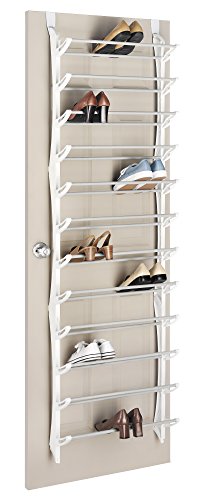
Whitmor takes the opposite approach to pockets: open bars. This rack hangs over the door on resin side frames with coated steel bars, and each bar flips up so lower tiers are easy to reach. The open design means even wide trainers sit flat instead of being squeezed into a pocket.
Specs
- Type: Over-the-door bar rack
- Capacity: up to 36 pairs on angled bars
- Assembled size: 7.5 x 22.6 x 74.5 inches
- Material: resin side frames with non-slip coated steel bars
- Features: fold-up bars, non-slip door pads, tool-free assembly
- Model: 6486-1746-WHT
The 36-pair figure assumes average shoes placed heel to toe; expect closer to 24 to 30 pairs with larger men’s sizes. At over six feet tall assembled, it needs a full-height door and swing clearance so the bottom tier does not catch on flooring. The non-slip pads help keep it quiet and protect the door face.
Pros:
– Biggest capacity of any pick here
– Open bars fit chunky sneakers better than pockets
– Flip-up bars make lower rows easy to reach
– Door pads reduce scratching and noise
Cons:
– Very tall; measure your door before ordering
– Heels can slip between bars if placed carelessly
– Assembly is tool-free but fiddly with many bars to seat
Who it suits: Serious shoe collectors with a spare full-size door who want maximum capacity without spending on furniture.
Simple Houseware 3-Tier Stackable Shoe Rack

Not everyone has a free door. This compact freestanding rack from Simple Houseware puts three metal shelves in a footprint about the size of a doormat, and additional units stack on top when the collection grows. It is the most conventional option here, and the easiest to move around.
Specs
- Type: Freestanding 3-tier rack, stackable
- Capacity: about 9 pairs, plus floor space beneath the bottom shelf
- Assembled size: 26 x 10.6 x 19.1 inches
- Material: metal frame with bronze finish
- Shelf load: up to 30 lb per shelf
- Model: BO-26B-B
Nine pairs is modest, and tier spacing suits shoes and low sneakers rather than high-tops or boots, which need the floor space underneath or the top shelf. The flat metal shelves are a real advantage over fabric racks: they do not sag, they wipe clean after muddy soles, and they support heavier footwear without bowing.
Pros:
– Stable on the floor, nothing hangs on a door
– Metal shelves do not sag and clean easily
– Stackable, so capacity can grow with a second unit
– Compact footprint suits entryways and small closets
Cons:
– Only about 9 pairs per unit
– Tier height limits boots and high-tops
– Bronze finish shows dust and scuffs over time
Who it suits: Small households that need a tidy entryway landing zone for everyday shoes, with the option to stack later.
Kuject X-Large Clear Shoe Storage Boxes, 12 Pack

Kuject’s boxes are the pick for people who like to see the whole collection. Each box has clear panels on the front and sides with a sturdier plastic frame, and the boxes interlock into a stack or a side-by-side wall. Because every pair lives in its own box, dust stays off and shoes stop crushing each other.
Specs
- Type: Clear stackable shoe boxes, pack of 12
- Box size: about 13.2 x 10.1 x 6.4 inches each
- Fit: men’s shoes up to size 11, women’s up to size 12
- Material: ABS plastic frame with transparent panels
- Features: stackable, rear ventilation holes, dustproof enclosure
- Model: BS001Lhei
Be honest about sizing before ordering: men’s size 12 and up, and most boots, do not fit the X-Large boxes, and forcing the lid flexes the panels. Assembly is the other trade-off: twelve flat-packed boxes take a while to click together, and panels can crack if you lean on a stack or overfill a box. Treated gently, though, this is the neatest-looking budget system here.
Pros:
– Every pair visible without opening anything
– Protects shoes from dust and crushing
– Stacks vertically or side by side to fit odd spaces
– Ventilation holes reduce trapped moisture and odor
Cons:
– Too small for men’s sizes above 11 and most boots
– Twelve boxes take real time to assemble
– Panels can crack if stacks are overloaded
Who it suits: Sneaker owners with small to average shoe sizes who want a display-style, dust-free setup in a closet.
Woffit Under Bed Shoe Storage Organizer, Set of 2

The Woffit set moves the overflow completely out of sight. Two fabric boxes slide under the bed, each divided into 12 cells with adjustable dividers, holding up to 24 pairs of off-season shoes. A clear window on top lets you check the contents without unzipping the whole box.
Specs
- Type: Underbed fabric shoe organizer, set of 2
- Capacity: 12 pairs per box, 24 pairs total
- Box size: 32 x 25 x 6 inches each
- Material: thick breathable nonwoven fabric
- Features: adjustable dividers, zippered clear window, reinforced handles
- Fit: shoes up to about US size 12
Measure your under-bed clearance before buying: at six inches tall, these boxes will not slide under low platform frames, and forcing them tears the fabric. The cells suit shoes, sandals, and soft sneakers; rigid boots hold their shape poorly in fabric cells and can crease. The reinforced handles are genuinely useful, because a full box is awkward to drag out by its edges.
Pros:
– Hides two dozen pairs in otherwise wasted space
– Adjustable dividers adapt to different shoe sizes
– Clear window shows contents without opening
– Boxes fold flat when not in use
Cons:
– Needs a full six inches of under-bed clearance
– Fabric cells are a poor match for structured boots
– Retrieving a pair means pulling the whole box out
Who it suits: Anyone rotating seasonal footwear, or small-apartment dwellers whose closet is already full.
Comparison Table
| Product | Type | Realistic capacity | Size | Best for |
|---|---|---|---|---|
| GORILLA GRIP Over the Door Organizer | Hanging pockets | About 12 pairs of shoes | 64 x 19 in | Renters, flats and sandals |
| Whitmor 36 Pair Over the Door Rack | Hanging bar rack | About 24 to 30 pairs | 7.5 x 22.6 x 74.5 in | Maximum door capacity |
| Simple Houseware 3-Tier Rack | Freestanding shelves | About 9 pairs | 26 x 10.6 x 19.1 in | Entryways, everyday shoes |
| Kuject X-Large Shoe Boxes, 12 Pack | Clear stackable boxes | 12 pairs | 13.2 x 10.1 x 6.4 in per box | Visible, dust-free storage |
| Woffit Under Bed Organizer, Set of 2 | Underbed fabric boxes | Up to 24 pairs | 32 x 25 x 6 in per box | Off-season overflow |
FAQ
How many pairs does an over-the-door organizer really hold?
Count one shoe per pocket for sneakers, so a 24-pocket organizer holds about 12 pairs. Slim flats and sandals can double up and reach the headline number, but chunky shoes and boots will not fit at all.
Will an over-the-door shoe organizer damage my door?
It can. Bare metal hooks rub paint and can dent soft trim as the door swings. Stick felt pads or tape where the hooks contact the door, keep the load within the stated limit, and the risk drops to almost nothing.
What is the best budget organizer for boots?
None of the hanging pocket designs, honestly. Ankle boots fit the Whitmor’s open bars or the Simple Houseware top shelf, and tall boots do best standing upright in a closet or lying in a long underbed box.
How do I stop fabric shoe shelves from sagging?
Spread weight evenly instead of loading the middle, keep the heaviest shoes on the lowest tier or the floor beneath, and avoid fabric shelves for wet or muddy footwear. If sagging has started, a thin board cut to size under the fabric restores a flat surface.
Conclusion
For most people, the GORILLA GRIP pocket organizer is the easiest win: it costs little, needs no floor space, and tames the everyday pile behind a closet door. Choose the Whitmor bar rack when capacity matters most and you have a full-height door to spare. The Simple Houseware rack is the better everyday answer for entryways, the Kuject boxes reward sneaker owners who want everything visible and dust-free, and the Woffit set quietly absorbs the seasonal overflow under the bed. Measure your door, floor space, and under-bed clearance first, count your pairs honestly, and any of these five will leave your floors clearer.

Write Your Review
No reviews yet. Be the first to share your experience!