
Key takeaways
- Compare the best office chairs for long hours, with adjustable lumbar support, breathable mesh and deep recline ranges for full workdays at a home desk.
- Top Pick: Steelcase Leap Office Chair
- Runner-up: Herman Miller Sayl Task Chair
- Also consider: Nouhaus Ergo3D Ergonomic Office Chair
If you sit for eight or more hours a day, the best office chair for long hours is one that adjusts to your body instead of forcing your body to adjust to it: the Steelcase Leap leads this roundup for its shape-changing back and two-part lumbar control, with the Herman Miller Sayl, Nouhaus Ergo3D, Duramont Ergonomic and Furmax Mid Back Mesh covering the premium, mid-range and budget tiers below.
A chair that feels fine for twenty minutes can become a problem by hour six. Fixed lumbar bumps land in the wrong place, shallow seats cut off circulation, and armrests that sit too low leave your shoulders hunched. The five chairs below were picked on published specifications that matter over a full workday: lumbar adjustment, seat depth, armrest range, recline control and rated capacity.
As an Amazon Associate, we earn from qualifying purchases.
Table of Contents
- Quick Answer
- Steelcase Leap Office Chair
- Herman Miller Sayl Task Chair
- Nouhaus Ergo3D Ergonomic Office Chair
- Duramont Ergonomic Office Chair
- Furmax Mid Back Mesh Office Chair
- How to Choose
- Who Should Skip
- FAQ
- Final Verdict
- Product and ASIN Reference
Quick Answer
For long hours, pick the Steelcase Leap if it fits your budget: its LiveBack backrest changes shape as you shift position, and the lumbar support adjusts for both height and firmness. The Herman Miller Sayl suits smaller, design-led spaces, the Nouhaus Ergo3D and Duramont bring most of the same adjustments to the mid-range tier, and the Furmax Mid Back Mesh is the budget pick for lighter daily use.
Steelcase Leap Office Chair

The Leap is built around one idea: your back changes shape every time you move, so the backrest should too. Steelcase calls this LiveBack technology. The back flexes to follow your spine as you sit upright, lean in or recline, which keeps support in contact with your back instead of leaving a gap at the lumbar curve during long sessions.
The lumbar system adjusts two ways. A height control moves the support up or down to meet your lower back, and a separate firmness dial changes how strongly it presses. The seat uses the Natural Glide System, sliding forward as you recline so your eyes and hands stay in position relative to the desk. Armrests adjust in four directions, the seat depth adjusts for leg length, and an upper back force control sets how much resistance the recline gives. The rated capacity is 400 pounds, the highest in this roundup, and the black frame with Onyx fabric suits most home offices.
Specs
- Model: Leap (Black Frame, Onyx fabric)
- Back: LiveBack flexible backrest
- Lumbar: adjustable height and firmness
- Arms: 4D adjustable (height, width, depth, pivot)
- Seat: adjustable depth with Natural Glide System
- Recline: variable stop tilt lock, adjustable upper back force
- Capacity: 400 lb
Herman Miller Sayl Task Chair

The Sayl takes the opposite approach to the Leap: instead of a padded back, it uses a frameless suspension back inspired by suspension bridges. The 3D Intelligent back is a flexible elastomer sheet held in tension by a Y-shaped tower, so it bends and supports different zones of your back at different strengths while letting air pass through freely. There is no foam to compress and no upholstery to trap heat over a long day.
This listed configuration includes a tilt limiter, which lets you set how far back the chair can recline, and it comes with stationary arms and a fixed seat depth, so it gives up some fine-tuning in exchange for a lighter, smaller footprint. The rated capacity is 350 pounds, and the Fog base with Studio White frame gives it a bright look that works well in smaller home offices and shared spaces. Herman Miller publishes a 12-year warranty for the Sayl line, the longest coverage in this roundup.
Specs
- Model: Sayl Task Chair (Fog base, Studio White frame)
- Back: 3D Intelligent frameless suspension back with Y-Tower
- Lumbar: passive support from back tension zones
- Arms: stationary (this configuration)
- Seat: fixed depth (this configuration)
- Recline: tilt limiter fitted
- Capacity: 350 lb
- Casters: standard carpet casters
Nouhaus Ergo3D Ergonomic Office Chair

The Ergo3D packs the adjustment list of a premium chair into the mid-range tier. Its lumbar support is a dynamic unit that moves in three dimensions, flexing with your lower back as you change posture rather than holding one fixed curve. The armrests adjust in four directions, the headrest adjusts for height and angle, and the back reclines to 135 degrees with a tilt lock.
The back is a full mesh panel and the seat is a cushion, a combination that balances airflow with thigh support. Nouhaus fits blade-style wheels, which roll quietly and glide over both hard floors and low carpet without the rattle of standard casters. The rated capacity is 275 pounds, lower than the premium picks above, so larger users should look at the Leap or the Duramont instead. For average-sized users who want a headrest and 4D arms without moving up a tier, this is the most complete package here.
Specs
- Model: Ergo3D (Black)
- Back: ElastoMesh mesh back
- Lumbar: 3D dynamic lumbar support
- Arms: 4D adjustable
- Headrest: adjustable height and angle
- Recline: up to 135 degrees with tilt lock
- Wheels: blade wheels
- Capacity: 275 lb
Duramont Ergonomic Office Chair
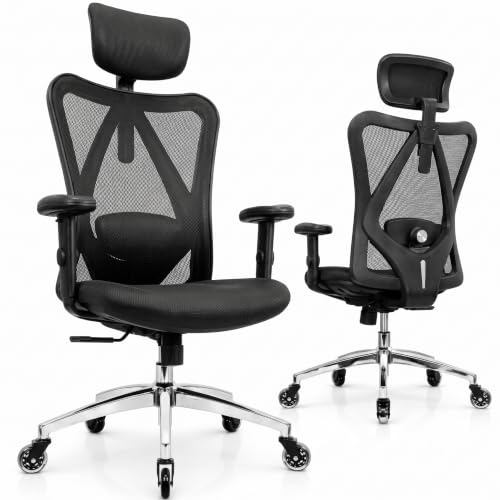
The Duramont is a high-back mesh chair designed around adjustability at every contact point. The lumbar support moves up and down and in and out, so you can set both its position and how firmly it meets your back. The headrest and armrests adjust as well, and the thick padded seat is wider than most mid-range chairs, which helps on long days when you shift position often.
A detail that stands out in the published specifications is the caster set: the Duramont ships with rollerblade-style wheels, which roll smoothly on hardwood and are gentle on floor surfaces. The mesh back keeps air moving, the recline function includes a tilt lock for holding a working angle, and the rated capacity is 330 pounds, the strongest figure in the mid-range tier. If you are a larger user who wants full adjustment without moving to the premium tier, this is the natural pick.
Specs
- Model: Duramont Ergonomic Office Chair (Black)
- Back: high-back breathable mesh
- Lumbar: adjustable height and depth
- Arms: adjustable padded armrests
- Headrest: adjustable
- Seat: thick padded cushion
- Wheels: rollerblade-style casters
- Capacity: 330 lb
Furmax Mid Back Mesh Office Chair
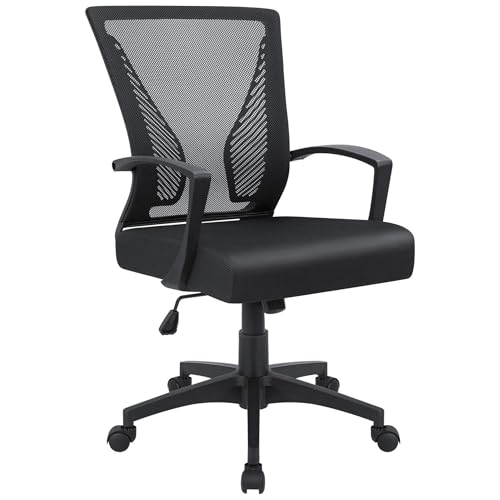
The Furmax is the budget-tier entry, and it keeps the specification list simple. A mid-back mesh panel provides airflow and a built-in lumbar curve, the seat is a padded foam cushion, and the armrests are fixed padded rails. Height adjusts with a pneumatic lift, and a rocking function lets you lean back and move during calls or reading.
What it does not have matters for long hours: the lumbar support is a fixed shape rather than an adjustable unit, the back stops at mid height so there is no head or upper-back support, and the armrests cannot be moved out of the way. The rated capacity is 265 pounds. It suits shorter sitting days, guest desks, and anyone furnishing a first home office on a budget tier who plans to upgrade later. If your workday regularly runs past six hours of sitting, one of the adjustable chairs above is a better match.
Specs
- Model: Furmax Mid Back Mesh Office Chair (Black)
- Back: mid-back breathable mesh
- Lumbar: built-in fixed lumbar support
- Arms: fixed padded armrests
- Seat: padded foam cushion
- Function: pneumatic height adjustment, rocking function
- Capacity: 265 lb
How to Choose
Start with lumbar adjustment. For long hours, a support that moves up and down is the minimum; one that also adjusts for firmness or depth, like the Leap and Duramont, fits more body shapes. Check seat depth next. If the seat is too deep, the front edge presses behind your knees; too shallow and your thighs lose support. Adjustable depth solves this, while fixed-depth chairs like the Sayl suit average leg lengths best.
Armrests should meet your elbows without lifting your shoulders. Four-direction arms, as on the Leap and Ergo3D, give the most control; fixed arms are acceptable if their height happens to match your desk setup. Match capacity to the user with headroom to spare, and consider the back material: mesh backs like the Ergo3D, Duramont and Furmax stay cooler, while the Sayl suspension back and the Leap fabric back offer more shaped support. Finally, check the recline. A tilt lock or limiter lets you hold a slightly reclined working posture, which reduces disc pressure compared with sitting bolt upright all day.
Who Should Skip
Skip this category entirely if you work at a standing desk most of the day; a drafting stool or perch seat fits that setup better. Skip the Furmax if you are tall, since a mid-back chair leaves your upper back and head unsupported, and skip the Ergo3D if you are near or above its 275-pound rating. The Sayl configuration listed here has stationary arms and a fixed seat depth, so skip it if you know you need arm height adjustment to keep your shoulders relaxed. And if your floor is thick carpet, note that blade and rollerblade wheels are tuned for hard floors and low pile; standard casters may roll more freely on deep pile.
FAQ
How many hours a day can you sit in these chairs?
Comfort over long hours depends on fit and movement, not a fixed hour rating. A chair with adjustable lumbar support, seat depth and armrests can be set up for full workdays, but no chair removes the need to stand and move regularly. Use the adjustments: small changes in recline and posture through the day reduce stiffness more than any single feature.
Is a mesh back better than a padded back for long hours?
Mesh backs breathe better and suit warm rooms, and they hold their shape because there is no foam to compress. Padded backs and suspension backs can offer more shaped lumbar contact. For long hours, the quality of the lumbar adjustment matters more than the back material itself.
What capacity should I look for?
Choose a chair rated comfortably above the user’s weight so the lift cylinder, base and tilt mechanism are not working at their limit all day. In this roundup the ratings run from 265 pounds for the Furmax to 400 pounds for the Steelcase Leap.
Do I need a headrest for office work?
A headrest only makes contact when you lean back, so it helps most during calls, reading and short breaks in the chair. The Ergo3D and Duramont include adjustable headrests. For upright typing, lumbar and armrest fit matter far more.
Final Verdict
The Steelcase Leap is the strongest all-round chair for long hours, with the most complete adjustment set and the highest capacity. The Herman Miller Sayl is the premium alternative for smaller spaces and warm rooms. In the mid-range tier, the Nouhaus Ergo3D adds a headrest and 4D arms, while the Duramont offers the firmest capacity and the most adjustable lumbar in its tier. The Furmax covers the budget tier for lighter use. Match the chair to your body size, your desk hours and the adjustments you will actually use.







Write Your Review
No reviews yet. Be the first to share your experience!