
Key takeaways
- Ten Anker power banks compared from listing specs: 10,000mAh slim and MagSafe-style models, 20,000mAh cable-built-in picks and 300W Prime laptop chargers.
If you want one Anker power bank for everyday use, the 20,000mAh 45W model with two built-in USB-C cables is the most flexible pick on this list: it covers a phone several times over and has USB-C and USB-A ports for everything else. For a pocket-size option, the 10,000mAh Nano with its retractable cable is the easiest to carry. For a laptop on the road, the Anker Prime 26,250mAh at 300W is the one built for it. Details come from listing titles and published specifications.
Pick by the way you travel
Our top picks



As an Amazon Associate we earn from qualifying purchases at no extra cost to you.
- Commuter, phone only: Nano 10,000mAh 45W, or the PowerIQ 10,000mAh
- iPhone owners who like magnets: MagGo 10,000mAh Qi2 15W
- Weekend trips: Zolo 20,000mAh (30W or 45W) or the 20,000mAh Travel Essential
- Phone plus tablet: 20,000mAh 45W with dual cables
- Laptop and flights: Laptop Power Bank 25,000mAh 165W or Prime 26,250mAh 300W
Comparison table
| Model | Key point from title | Best for |
|---|---|---|
| PowerIQ 10,000mAh | 5V/3A, USB-C, compact | Light phone top-ups |
| Nano 10,000mAh 45W | Retractable USB-C cable | Pocket carry |
| MagGo 10,000mAh | Qi2 15W, MagSafe-compatible | Wireless iPhone use |
| Zolo 20,000mAh 30W | Built-in USB-C | Budget two-day trips |
| Zolo 20,000mAh 45W | Built-in USB-C, 45W | Faster Zolo variant |
| 20,000mAh 45W dual cables | USB-C and USB-A, two cables | Sharing devices |
| Travel Essential 20,000mAh | 3 ports, 87W max | Phone plus laptop |
| Laptop Power Bank 25,000mAh | 165W total, retractable cables | Frequent flyers |
| Prime 26,250mAh 300W | Two-way charging, app control | Power users |
| Prime 26,250mAh with Base | Charging base, up to 6 devices | Desk plus travel |
The small ones: 10,000mAh
Anker PowerIQ 10,000mAh Portable Charger
A basic 10,000mAh USB-C pack with PowerIQ and a listed 5V/3A output, which is fine for phones but slow for tablets. Expect around two phone charges at best, going by the capacity maths further down. The listing stresses an ultra-compact, travel-ready design. There is no built-in cable, so you carry your own.
Pros
- Smallest-cost 10,000mAh option
- Compact body
Cons
- 5V/3A is slow by current standards
- No cable included in the design
Who it’s for: A glove-box or bag backup for one phone.
Anker Nano Power Bank 45W 10,000mAh
The Nano combines 10,000mAh with 45W output and a built-in retractable USB-C cable. 45W puts small laptops and tablets in reach as well as phones. Retractable cables are neat but are a single point of failure.
Pros
- One cable already attached
- 45W for tablets
Cons
- USB-C connector only on that cable
- 10,000mAh limits laptop charging
Who it’s for: Commuters who hate carrying cables.
Anker MagGo 10,000mAh Qi2 Power Bank
The MagGo is Qi2-certified at 15W and MagSafe-compatible, so it attaches to compatible iPhone 13 to 16 models. It is described as slim. Wireless charging is slower than a wire and generates more heat, a trade-off for convenience. It also needs the phone and case to line up, so a very thick case or a loose fit can interrupt charging. Check your phone model for magnet support.
Pros
- Snaps on, no cable
- Slim, ergonomic body
Cons
- 15W wireless only
- Cost per mAh is higher
Who it’s for: iPhone users who value a clean grip.
The mid-size: 20,000mAh
Anker Zolo 20,000mAh 30W
The Zolo pairs 20,000mAh with a built-in USB-C cable and 30W output. It lists support for iPhone 17, 16 and 15 series and Galaxy phones. 30W suits phones and some tablets but not most laptops.
Pros
- Large capacity with cable included
- Affordable for its size
Cons
- 30W cannot run a laptop well
- Heavier than 10,000mAh packs
Who it’s for: Weekend travellers with phones only.
Anker Zolo 20,000mAh 45W
The same 20,000mAh and built-in USB-C cable concept, now listed at 45W. The title is short, and the listing image matches the 30W Zolo, so treat it as a variant and compare both listings before buying.
Pros
- 45W is more flexible than 30W
- Cable built in
Cons
- Thin listing title
- Easy to confuse with the 30W version
Who it’s for: Shoppers who want more speed than the 30W Zolo.
Anker 20,000mAh 45W with Dual Built-in USB-C Cables
Two integrated USB-C cables plus USB-C and USB-A ports, at 45W. It can charge several devices at once and works for iPhone 17 and 16, Galaxy and MacBook models according to the title. Cables built in mean fewer things to forget.
Pros
- Two cables plus two ports
- USB-A for older gear
Cons
- Bulkier
- Cable damage means a lost feature
Who it’s for: Two-device travellers.
Anker Power Bank 20,000mAh Travel Essential (87W Max)
A three-port model with 87W max output and one built-in USB-C cable. It targets MacBook, iPhone 16 and 15, Samsung and Switch users. It is the lowest-cost model here with an 87W ceiling, enough to help a lightweight laptop. Check how the 87W is split when all ports are in use.
Pros
- 87W max for small laptops
- Works with Switch
Cons
- Power may drop when ports are shared
- Not the lightest
Who it’s for: Phone and MacBook Air-style travellers.
The laptop tier: 25,000mAh and up
Anker Laptop Power Bank 25,000mAh 165W
Three USB-C ports at up to 100W each, with 165W total and built-in retractable cables. It is labelled flight-ready. The 165W total means two laptops would split the power.
Pros
- Three USB-C ports
- Retractable cables
Cons
- Costly
- Total output is shared
Who it’s for: Frequent flyers with a laptop.
Anker Prime Power Bank 26,250mAh 300W
The Prime offers 300W across three ports, two-way charging, a TSA-approved label and app control. The listing says “Base Not Included”. It is aimed at MacBook and iPhone 17 and 16 users who want one device to do everything.
Pros
- Highest power on the list
- App control
Cons
- High cost
- Base sold separately
Who it’s for: Creators and remote workers.
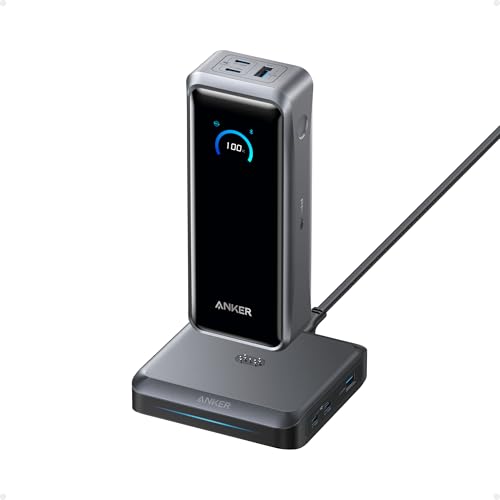
Anker Prime Power Bank 26,250mAh with Fast Charging Base
The same Prime power bank packaged with a charging base, so it can power up to six devices in total. It targets creators and lists flight-safe, two-way charging and app control. Pay for the base only if you want a desk dock.
Pros
- Base makes a desk hub
- Up to six devices
Cons
- Most expensive item
- Base adds bulk
Who it’s for: Users who want a charging station and a travel pack in one.
How we picked these
We chose Anker power banks from Amazon listing titles, published specifications, manufacturer documentation and buyer reviews, and kept every item whose title names a capacity and a charging output. Nobody on the team used or measured these units. Where listing titles were thin or looked alike, as with the two Zolo versions, we flagged it rather than guessing at differences.
Reading the specs before you buy
Turn mAh into charges
The number on the box is the rating at the internal cell voltage, usually about 3.7V. Multiply by 3.7 and divide by 1,000 to get watt-hours: 10,000mAh is about 37Wh, 20,000mAh is about 74Wh, and 26,250mAh is about 97Wh. A typical phone battery is 15 to 20Wh, and after conversion losses, a 20,000mAh unit yields roughly two to four phone charges. Laptops hold 40 to 70Wh, so a 26,250mAh pack gives about one laptop charge.
Worked example: a three-day trip
Suppose you carry an iPhone with a battery of about 15Wh, a tablet at about 30Wh and a pair of earbuds. Over three days you might drain the phone once a day (45Wh), the tablet once (30Wh) and the earbuds a few times (under 5Wh): roughly 80Wh. Because only 60 to 70 percent of a bank’s rated energy reaches your devices, you need about 115 to 130Wh of rated capacity. A single 20,000mAh unit (about 74Wh) falls short, so either carry two 20,000mAh packs or recharge the bank from a wall socket overnight. Add a laptop and the maths points to a 25,000mAh pack plus a wall top-up.
Output and cables
A charger with 300W on the label cannot push that into a phone; each device takes what it asks for, and when several ports are in use the total is shared between them. Check what your device needs: phones 20 to 30W, tablets 30 to 45W, laptops 60 to 100W. A built-in cable avoids loose parts, but a second USB-C port gives you a backup.
Flying with a battery
Carry power banks in your cabin bag, never in checked luggage. Many airlines treat anything over 100Wh as needing approval, and the Prime at about 97Wh sits just under that figure. Rules vary by country and airline, so check yours.
Quick checklist
- Count the devices you charge together
- Add up their watt needs
- Choose a bank whose total output exceeds that figure
- Check capacity in Wh against your airline limit
Mistakes buyers make
People often buy the biggest capacity and then carry weight they do not use; a 26,250mAh pack is a noticeable load in a small bag, while a 10,000mAh Nano slips into a pocket. Others assume a 300W label speeds up a phone, when the phone sets the limit. A third mistake is forgetting that the bank itself needs recharging: a large unit can take many hours from a modest wall adapter, so plan to plug it in the night before a trip, not the morning of. Another error is picking a magnetic model and then using a thick case that weakens the grip. Skipping the cable is another trap, since only some models here carry one. Do not charge a bank on a soft surface such as a bed, and stop using any unit that swells or gets unusually hot.
Verdict
The 20,000mAh 45W unit with dual cables is the best all-rounder, the Nano 10,000mAh is the best pocket pick, and the Prime 26,250mAh is the choice for laptop-heavy travel. If you only ever charge one phone, the PowerIQ 10,000mAh does the job for the least money, and the MagGo is the pick for iPhone owners who prefer going cable-free. Whatever you choose, confirm the exact model on the listing, because Anker titles for similar products can differ only in a single number.
Common questions
Which Anker power bank is best for an iPhone?
For a phone alone, the 10,000mAh models are the sensible size: the Nano (45W, built-in retractable cable), the PowerIQ 10,000mAh and the MagGo (Qi2, 15W, magnetic). The MagGo suits iPhone 13 to 16 owners who want to snap a charger on the back. The 20,000mAh Zolo and Travel Essential models give several full refills if you are away from outlets for days. Larger Prime units are overkill unless you also carry a laptop.
Can I take an Anker power bank on a plane?
Generally yes, in carry-on only, never checked luggage. Many airlines limit batteries to 100 watt-hours without special approval, and power banks usually cannot be used for charging on some carriers during certain phases of flight. The 26,250mAh Prime listings say TSA-approved or flight-safe, but airline rules differ, so read the rules of your specific carrier and check the capacity printed on the unit.
What do the watt numbers like 45W or 300W mean?
They describe the fastest rate the bank can charge a device. A 20W to 30W output is enough for most phones. A 45W or 87W port can charge tablets and some lightweight laptops. The 300W Prime listings are aimed at larger laptops and several devices at once. A higher number only helps if your device and cable can accept it, so check what your charger-ready device supports.
How many phone charges does a 20,000mAh bank give?
Roughly two to four, depending on your phone. The capacity printed on a power bank is measured at the internal cell voltage, not the 5V your phone sees, and conversion losses mean you usually get around 60 to 70 percent of it. A phone battery of 4,000 to 5,000mAh therefore gets about two to three full charges from a 20,000mAh unit. These are rough estimates, not guarantees.
Are the built-in cable models better than ones with ports only?
They are more convenient, because you cannot forget the cable, but they have a trade-off. If the built-in cable is damaged or the wrong connector for a future phone, you may need an extra cable anyway. Models with both a built-in cable and ports, like the dual-cable 45W unit, give the most flexibility. Choose cable-free versions if you share the bank among several devices with different connectors.
Related guides
- How To Check Amazon Price History Before Buying
- How Amazon Lightning Deals Work
- 27 Inch Monitor Under 200






Write Your Review
No reviews yet. Be the first to share your experience!