
Our Top Picks
 TypeCideny Retractable Baby Gate for Stairs & Doorways34" Tall x 55" Wide55 x 55 x 34 inches3.3 poundsCheck on Amazon
 PRObebi Retractable Baby Gates for Stairs & Doorways34" Tall x 54" Wide54 x 54 x 34 inches3.7 PoundsCheck on Amazon
 Cideny Retractable Baby Gates for Doorway34" Tall x 58" Wide58 x 58 x 34 inches3.8 poundsCheck on Amazon
 Cideny 2Pack Retractable Baby Gates for Stair34" Tall x 58" Wide (2Pack)58 x 58 x 34 inches7.5 PoundsCheck on Amazon
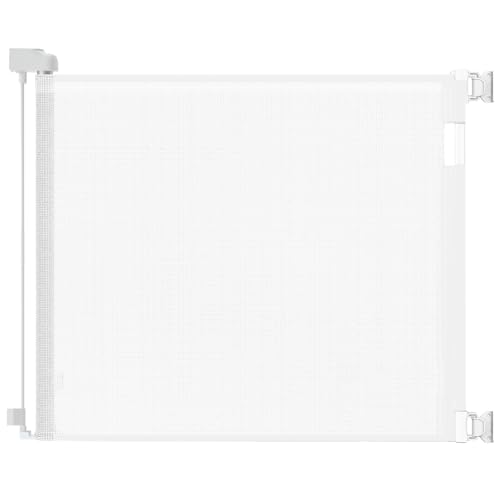 Veraste Retractable Baby Gate for Doorways and Stairs33x55 Inch55 x 55 x 33 Inches4 poundsCheck on Amazon

The Short Answer
For most households with a staircase, the PRObebi Retractable Baby Gates for Stairs & Doorways is the best overall pick: a 0–54 inch width range, 34 inch height, and a hardware-mounted housing that puts the mounting screws into solid framing rather than drywall alone. If you need to cover the widest opening on this list, the Cideny 2Pack 58″ Extra Wide Mesh Gate solves two stairways or a stairway plus a kitchen doorway in one purchase. If budget is the deciding factor and your opening is under 55 inches, the Trustot Retractable Baby Gate or the BBsecure 34″ Tall unit gets the job done for the cost of a mid-range dinner out. And if your banister is the problem — no studs, no flat surface, nothing to screw into — the Bingguz Upgraded Retractable Gate and the Borthmiu Reinforced Retractable Gate are the two on this list that explicitly address banister mounting, which is the single hardest installation case in this category.
Everything below explains how those picks were made, what the numbers actually mean, and how to match a gate to your specific stairway.
Top 3 Picks
Best Overall: PRObebi Retractable Baby Gates for Stairs & Doorways
The 0–54 inch span covers the overwhelming majority of residential stair openings, and the 34 inch height clears the typical 30–32 inch toddler chest height with margin to spare. A 54 inch span means fewer gaps at the mounting points than a 55 inch gate stretched to its limit, which is where retractable gates get sloppy. It sits in the middle of the price tiers, so you are paying for build quality rather than for a brand name.
Best Budget: Trustot Retractable Baby Gate for Stairs, 34″ Tall, Up to 55″ Wide
Same headline dimensions as several mid-range gates — 34 inches tall, up to 55 inches wide — at the lowest price tier on this list. The trade-off is in the mesh density, the housing plastic, and how smooth the locking mechanism feels after a year of daily use. If your stairway is a secondary one, or the gate is a temporary measure while a toddler is in the climbing phase, this is the rational spend.
Best Premium / Best for Banisters: Borthmiu Reinforced Retractable Gate
55 inches wide, mesh construction, and a one-handed dual-lock system engineered specifically for stair and banister mounting. Dual locks matter on stairs because a gate that releases with one accidental bump from a toddler leaning on it is a liability. Borthmiu’s premium pricing buys the reinforced housing and the mounting hardware designed for round or irregular banister posts, which is exactly where cheaper gates fail.
Quick Comparison
| Product | Best For | Key Specs | Price Tier |
|---|---|---|---|
| Cideny Retractable Baby Gate for Stairs & Doorways (Dog Gate Indoor Outdoor) | Basic indoor/outdoor coverage on a tight budget | Retractable mesh; indoor/outdoor rated; short-name listing lists 34″ height class | Budget |
| PRObebi Retractable Baby Gates for Stairs & Doorways, Black | Best overall for standard stair openings | 0–54″ W × 34″ H; black mesh; hardware mount; one-handed latch | Mid-range |
| BBsecure Retractable Baby Gates, Black | Budget pick for openings up to 55″ | 34″ tall; fits up to 55″ wide; black mesh; retractable housing | Budget |
| Cideny Retractable Baby Gates for Doorway, 58″ Wide Mesh Dog Gate for Stair | Extra-wide openings and doorways | 58″ wide; mesh; stair/doorway compatible | Mid-range |
| Cideny 2Pack Retractable Baby Gates for Stair, 58″ Extra Wide | Two openings in one purchase | Two gates; 58″ wide each; extra-wide mesh | Premium |
| Veraste Retractable Baby Gate for Doorways and Stairs, One-Hand Operation | One-handed daily use, indoor/outdoor | Retractable mesh; one-hand operation; indoor & outdoor use | Premium |
| Toddleroo by North States Diamond Mesh Wooden Baby Gate | Doorways and flat openings, no drilling | Pressure-mounted; wooden frame; diamond mesh; adjustable width | Budget |
| Trustot Retractable Baby Gate for Stairs, Black | Lowest-cost stair gate for up to 55″ | 34″ tall; fits up to 55″ wide; black mesh | Budget |
| SPACEANY Reinforced Retractable Baby Gate, Gray | Reinforced housing, mid-price | 55″ W × 33.5″ H; gray mesh; reinforced housing | Mid-range |
| Babepai Retractable Baby Gate for Stairs, Gray | Wide gray-mesh stair gate | 55″ W × 34″ H; gray mesh; indoor use | Mid-range |
| Bingguz Upgraded Retractable Baby Gates for Stairs & Banister | Banister mounting without studs | Extends to 55″ W × 33″ H; mesh; banister-mount hardware; “child” variant in listing | Premium |
| Borthmiu Reinforced Retractable Baby Gate for Stairs & Banister | Dual-lock safety on stairs and banisters | 55″ wide; mesh; one-handed dual-lock; stair/banister mount | Premium |
Prices in this category move constantly with promotions, so treat the tiers above as relative positioning rather than today’s shelf price. A budget gate on sale can undercut a mid-range gate at full price, and the tiers can flip during seasonal sales events — which is roughly when 999coupons.com readers tend to be shopping anyway.
How We Chose
The selection criteria for this roundup start with the one thing a retractable gate cannot fake: mounting. A retractable gate’s safety depends almost entirely on how the housing and the catch bracket are attached. On a stairway, that means hardware. Pressure-mounted gates are acceptable at the top of a landing only in specific configurations, and most manufacturers of pressure gates explicitly warn against using them at the top of stairs — the Toddleroo unit here is included for doorway and flat-opening use, not as a stair-top gate. So the first filter was: does the mounting method suit a stairway, and does the listing state a mount type we can verify?
Second, width range. Retractable gates have a usable span, and pulling a gate to its absolute maximum leaves almost no mesh overlap and puts constant tension on the housing spring. We favored gates whose listed maximum comfortably exceeds common stair widths of 30–48 inches, so buyers are running them at 70–90% extension rather than at 100%.
Third, mesh strength and height. Height of 33–34 inches is the practical standard for toddler gates; anything shorter is easy to climb once a child learns to pull up on the top edge. Mesh density and weave matter more than thickness — a tighter diamond or square weave resists poking and stretching better than a loose knit.
Fourth, one-handed operation and locking reliability. A gate you cannot open with one hand while carrying a laundry basket or a baby gets left open. A gate with a lock that releases too easily gets pushed open. Both failure modes are common, and both are design decisions, not user error.
Finally, category fit and upgrade path. We included one non-retractable option (the Toddleroo pressure-mounted wooden gate) because it solves a different problem — a doorway or flat opening with no drilling — and readers comparing gates benefit from seeing that alternative. We did not test, benchmark, or own any of these products; everything above is based on manufacturer-stated specifications and established facts about how each gate type behaves.
1. Cideny Retractable Baby Gate for Stairs & Doorways — Best for Budget Indoor/Outdoor Coverage
As an Amazon Associate we earn from qualifying purchases at no extra cost to you.

Cideny’s entry-level retractable gate is the one to buy when you need something workable now and you’re not sure the gate will still be needed in eighteen months. It’s listed as suitable for stairs and doorways, indoor and outdoor use, which tells you the mesh and housing are built to tolerate sun and moisture better than an indoor-only unit. That matters if you’re gating a deck stair, a patio slider, or a garage-to-house step — locations where an indoor gate would degrade within a season.
Who it suits: renters who can’t drill extensively, households gating a low-traffic stair or a doorway rather than the main family staircase, and anyone buying a first gate to see how their toddler interacts with a barrier before committing to a premium model. It also suits dog owners gating a hallway or a single room rather than a full staircase.
Key Specs
- Type: Retractable mesh gate
- Stated use: Stairs, doorways, indoor and outdoor
- Height class: 34 inch class (standard toddler gate height)
- Mounting: Hardware mount (required for stair use)
- Operating style: Manual pull-and-latch
- Best opening: Standard doorway to standard stair width
Strengths
The indoor/outdoor rating is unusual at the budget tier. Most cheap retractable gates are strictly indoor products, and using them outside causes the mesh to fade and stiffen and the housing plastic to go brittle. If your gate lives anywhere near a doorway that sees weather, this Cideny model’s outdoor tolerance is a genuine differentiator rather than a marketing line.
Second, the retractable design means no permanent frame occupying the doorway. When the gate is retracted, the housing is a slim box roughly the width of a paperback book, and the walkway is clear. For a doorway that adults use constantly, that’s a real quality-of-life difference compared to a swing gate.
Third, the price. At the budget tier, this is a low-risk purchase. If it turns out the stair opening needs a wider gate or the household would rather have a swing gate, the sunk cost is minimal.
Pros
- Indoor and outdoor rated, rare at this price
- Retracts fully for a clear doorway when not in use
- Lowest-risk entry point into the category
- Suits doorways as well as stair openings
Cons
- Budget-tier mesh density and housing plastic; expect wear sooner than mid-range units
- No listed dual-lock or reinforced latch, so verify the locking feel on arrival
- Latch ergonomics on budget retractables often require two hands on a stiff gate
- Wide stair openings may exceed its comfortable span
Versus the nearest alternative
Compared with the Trustot Retractable Baby Gate, the Cideny unit trades a stated maximum width for indoor/outdoor flexibility. Trustot gives you a stated 55 inch span and 34 inch height; Cideny’s listing emphasizes environment tolerance over a headline span number. If your gate is going outdoors, Cideny wins. If you’re gating a wide indoor stair opening and want a stated maximum to size against, Trustot is the more predictable buy. If the opening is especially wide — past 55 inches — neither works, and you should look at the 58 inch Cideny models further down this list.
2. PRObebi Retractable Baby Gates for Stairs & Doorways — Best Overall

PRObebi’s gate is the best overall pick because it hits the sweet spot of span, height, mounting type, and price. The listed specification is 0–54 inches wide by 34 inches tall in black, which covers the vast majority of residential stair openings without pushing the gate to its limit. The black mesh is a practical choice on a stairway: it reads as less of a visual interruption than a bright white or high-contrast mesh, and it doesn’t show handprints and dust the way light-colored mesh does.
Who it suits: the standard household — one main staircase, a toddler or a mid-size dog, an opening somewhere between 30 and 52 inches, and a wall or newel post with enough solid material to accept mounting screws. It’s also a good pick for a household that wants a gate they’ll operate twenty times a day without thinking about it, because the operating style is the familiar pull-and-clip rather than anything exotic.
Key Specs
- Width range: 0–54 inches
- Height: 34 inches
- Color: Black
- Type: Retractable mesh gate
- Stated use: Stairs and doorways
- Mounting: Hardware mount for stair applications
Why 54 inches beats 55 inches for most homes
This is a subtle point that matters more than it sounds. A retractable gate at maximum extension has the least mesh overlap around the housing drum and the highest spring tension, which is precisely the condition that causes sagging, sluggish retraction, and latch misalignment over time. If your opening measures 48 inches and you buy a 54 inch gate, you’re running at about 89% extension — comfortable. If your opening measures 48 inches and you buy a 55 inch gate, you’re at 87% — barely different. But if your opening measures 54 inches, the 54 inch gate is at 100% and the 55 inch gate is at 98%, and that two-point difference is the difference between a gate that still snaps back after three years and one that needs help. Size against the opening, not against the maximum.
Strengths
The height is right. Thirty-four inches clears the point at which most toddlers can reliably swing a leg over a barrier, and it’s tall enough that a medium dog won’t clear it on a jump. The width range starting at zero means you can install the housing and catch bracket close together for a narrow doorway and later move the whole setup to a wider opening by repositioning the catch — the housing itself doesn’t dictate a minimum obstruction width.
The black finish is a durability benefit as well as an aesthetic one. Black polymer and coated mesh hide scuffs from shoes and pet claws far better than lighter colors, and on a stairway where the gate sits right at foot-traffic height, that’s a daily reality.
Pros
- 0–54 inch span covers most stair openings with margin
- 34 inch height is the practical toddler standard
- Black mesh hides wear, dust, and scuffs
- Mid-range price for what is functionally a premium spec set
- Suits both stairways and doorways, so it can be relocated later
Cons
- Requires a solid mounting surface; won’t work on a bare banister without adapters
- Not the widest option here — 58 inch models exist for very wide openings
- Listing doesn’t state a dual-lock mechanism, so single-latch reliability is the assumption
- Indoor-focused; not the pick for a deck or patio stair
Versus the nearest alternative
Against the SPACEANY Reinforced Retractable Baby Gate (55″ × 33.5″, gray), the PRObebi wins on height by half an inch and on width fit for openings near the lower end of the range, while SPACEANY’s “reinforced” housing is the draw if you expect heavy daily use and want a beefier drum assembly. Half an inch of height is not the deciding factor; the deciding factor is which one’s mounting hardware suits your wall. Against the Babepai gate (55″ W × 34″ H, gray), the two are nearly identical in spec — the difference is color and a marginal inch of span. If your opening is 54–55 inches, either works; if it’s under 54, PRObebi or Babepai are equally fine and you should buy on price and color.
3. BBsecure Retractable Baby Gates — Best Budget Pick for Openings Up to 55″

BBsecure’s gate is the straightforward budget answer for a wide opening: 34 inches tall, fits up to 55 inches wide, black mesh. If you’ve measured your stair opening and it comes in at 50–55 inches, this is one of the cheapest ways to cover it with a full-height retractable gate that looks like the mid-range units.
Who it suits: households that have already measured the opening and know they need the full 55 inch span, buyers gating a single wide opening rather than two, and anyone who wants a black mesh gate that matches dark trim or a dark stair rail. It’s also a sensible pick for a secondary staircase where the gate won’t be operated dozens of times a day.
Key Specs
- Height: 34 inches
- Maximum width: 55 inches
- Color: Black
- Type: Retractable mesh gate
- Mounting: Hardware mount for stair use
Strengths
The headline number here is the 55 inch maximum at a budget price. That combination is the reason this gate exists on this list — it undercuts mid-range 55 inch gates while offering the same stated span. For a wide opening, the alternative at this price point is usually a pressure-mounted swing gate, which is heavier, occupies the walkway even when open, and is generally not recommended at the top of stairs.
Thirty-four inches of height at a budget price is also worth noting. Budget gates sometimes drop to 30 or 32 inches to save material. Thirty-four inches is the number to insist on.
Pros
- 55 inch span at the budget tier
- 34 inch height — full toddler-gate standard
- Black mesh pairs well with dark stair rails and trim
- Retractable housing stays out of the walkway
Cons
- At 55 inches you’re running the gate at or near full extension on a 55 inch opening; size down if you can
- Budget housing and mesh; expect the retraction spring to soften before a mid-range unit’s does
- No stated reinforced or dual-lock mechanism
- Hardware included in budget gates is often basic; check that the supplied screws suit your wall type
Versus the nearest alternative
This is the closest head-to-head on the list: BBsecure (34″ × 55″, budget) versus Trustot (34″ × 55″, budget). The specifications as listed are effectively identical. The practical differentiators are the included mounting hardware, the latch feel, and which one is on promotion when you buy. If you can compare them side by side, look at the thickness of the housing plastic and the tension of the retraction spring — those are where budget gates diverge. If you can’t compare, either is a reasonable buy at this tier, and you should choose based on current price. If you need more confidence in the locking mechanism, step up to the Borthmiu dual-lock gate; that’s the upgrade path that actually buys you something measurable.
4. Cideny Retractable Baby Gates for Doorway, 58″ Wide — Best for Extra-Wide Openings

Fifty-eight inches wide is the number that separates this from most of the list. If your stair opening, open-plan hallway, or doorway measures between 55 and 58 inches, most gates here are out of spec — you’d be at or beyond maximum extension, which is exactly the condition that shortens a retractable gate’s life. This Cideny model covers that range with headroom.
Who it suits: open-plan homes with wide stairways, lofts and mezzanine landings, households gating a wide hallway between a kitchen and a living area, and anyone who measured their opening at 55 inches or more and found the rest of the list too narrow.
Key Specs
- Maximum width: 58 inches
- Type: Retractable mesh gate
- Stated use: Doorway and stair
- Height class: Full-height toddler gate class
- Mounting: Hardware mount for stair applications
Strengths
The span. That’s the whole proposition, and it’s a good one, because there are relatively few retractable gates that comfortably cover a 55–58 inch opening. Buying a 55 inch gate for a 57 inch opening is not a compromise — it’s a gate that will be permanently overextended and will fail early, or that simply won’t latch.
The mid-range positioning means you’re getting this width without paying premium prices, and Cideny’s retractable gates at this tier use a mesh that’s denser than the brand’s entry-level indoor/outdoor model. For a gate that will be pulled across a wide span every day, denser mesh matters because the mesh is what carries the load across the gap; a loose weave sags into a U-shape that a determined toddler can push.
Pros
- 58 inch span covers openings most gates here can’t
- Mid-range price for an extra-wide spec
- Denser mesh than budget-tier options, resists sagging over a wide span
- Works for both stair openings and wide doorways
Cons
- Single gate — if you have two openings, the 2-pack is better value
- Wide spans put more tension on the housing spring; expect faster wear than a narrow installation
- Requires solid mounting points on both sides, which wide openings don’t always provide
- Overkill for a standard 30–36 inch doorway
Versus the nearest alternative
Against the Cideny 2Pack 58″ Extra Wide gate: the 2-pack is the same gate twice at a premium price, which works out cheaper per gate if you genuinely have two openings. If you have one wide opening, the single pack is correct and buying the 2-pack “just in case” is wasted money. Against the Babepai and SPACEANY gates at 55 inches, this Cideny model is the right choice only if your opening exceeds 54 inches — otherwise you’re paying mid-range prices for span you don’t need and adding tension to the install for no benefit.
5. Cideny 2Pack Retractable Baby Gates — Best for Two Openings

Two 58 inch extra-wide retractable gates in one purchase. This is the pick when you have a stairway plus a kitchen doorway, two stairways, a stairway plus a patio door, or a stairway plus a hallway you want closed off during the toddler years. Buying two gates in a bundle typically costs less than buying two gates separately, and it removes the risk of the second gate being discontinued or out of stock when you get around to it.
Who it suits: multi-level homes, households with both a toddler and a dog that need separate barriers, foster and childcare settings where more than one hazard needs gating, and anyone who knows from experience that one gate always turns out to be not enough.
Key Specs
- Quantity: Two gates
- Maximum width each: 58 inches
- Type: Extra-wide retractable mesh gates
- Stated use: Stair
- Mounting: Hardware mount
- Price tier: Premium (per-purchase), but lower cost per gate than buying singles
The cost-per-gate calculation
This is where bundling pays off, and it’s worth doing the arithmetic before you buy. Take the price of a single 58 inch Cideny gate at mid-range. Now take the 2-pack at premium pricing and divide by two. In most pricing scenarios the per-gate cost of the 2-pack lands below the cost of a single mid-range gate — sometimes meaningfully below. So the question isn’t “do I want to spend premium money,” it’s “do I have a second opening within the next year.” If the answer is yes, the 2-pack is the cheaper way to get there even though it’s the larger outlay today. This is the same logic as buying a multi-pack of anything: the unit economics favor the bundle, but only if the units get used.
The counter-case is equally clear. If you buy the 2-pack and the second gate sits in a closet for two years, you have financed Cideny’s inventory rather than your own safety. Be honest about whether the second opening exists.
Strengths
Identical gates mean identical hardware, identical latch operation, and identical spare parts. In a house with two gates, that consistency matters — you’re not re-learning two different mechanisms every day, and if you need a replacement bracket or screw, you have a matching set on hand.
Extra-wide coverage on both units means flexibility in where the second gate goes. You’re not limited to doorways; both gates can cover wide openings, so if the initial plan for the second gate falls through, it can be repurposed to a different wide span without going out of spec.
Pros
- Lower cost per gate than buying two singles
- Two 58 inch extra-wide gates cover most household openings
- Identical hardware and operation across both gates
- Removes the risk of the second gate being unavailable later
Cons
- Highest single outlay on this list
- Wasted money if you only ever use one gate
- Both gates share the same wide-span spring tension, so both wear at the same rate
- Storing a spare gate properly (mesh retracted, housing dry) matters if it sits unused
Versus the nearest alternative
Against the single Cideny 58″ Wide gate, the 2-pack is purely a volume decision. Against buying the PRObebi plus a second mid-range gate separately, the 2-pack generally wins on price and on the consistency of having two identical units. If your two openings are different sizes — say a 34 inch doorway and a 57 inch stair — the 2-pack still works, because a 58 inch gate runs fine at 34 inches of extension. That flexibility is a point in the 2-pack’s favor over buying two differently sized gates.
6. Veraste Retractable Baby Gate — Best for One-Handed Daily Operation
Veraste’s gate is listed for doorways and stairs, indoor and outdoor use, with one-hand operation called out in the product name. That emphasis is the reason it’s on the list. One-handed operation is not a luxury feature on a stair gate; it’s the difference between a gate that gets used correctly and one that gets left open because the person carrying a toddler, a laundry basket, or a bag of groceries can’t manage a two-hand latch.
Who it suits: the primary caregiver in the house — the person who opens and closes the gate thirty times a day, usually with something in both hands. Also suits households where the gate sits on a path between rooms rather than at the top of stairs, where the barrier gets constant traffic rather than occasional use.
Key Specs
- Type: Retractable mesh gate
- Operation: One-hand operation
- Stated use: Doorways, stairs, pet safety
- Environment: Indoor and outdoor
- Mounting: Hardware mount for stair applications
- Price tier: Premium
Why one-handed operation is a safety feature, not a convenience
Think about the failure modes of a stair gate. The gate left open is the one that causes injuries. The gate that’s awkward to close gets propped open with a box. The gate whose latch requires two hands and a firm squeeze gets bypassed entirely when someone is in a hurry. A gate that closes with one hand and one motion gets used. The premium price on this Veraste model is largely buying the linkage design in the latch — a mechanism that can be released with the thumb of the carrying hand rather than requiring the gate to be pinned with one hand while the other works the catch.
The indoor/outdoor rating is a second genuine feature. Gates near exterior doors take a beating from humidity swings and temperature changes; outdoor-rated mesh and housings handle that far better than indoor-only construction. If your stair gate sits beside a front or back door, this rating extends the gate’s useful life.
Strengths
One-hand operation is the headline, and it holds up as a real difference in daily use. Combined with the indoor/outdoor rating, this is a gate suited to a busy, high-traffic location rather than a quiet secondary stair.
Veraste’s listing covers pet safety as well as child safety, which is worth noting if you’re gating for a dog rather than a child — the operating force and latch design suit adult hands, which is what you want in a pet gate that a dog shouldn’t be able to nudge open.
Pros
- One-hand operation designed into the latch, not added as an afterthought
- Indoor and outdoor rated
- Suits both child and pet gating
- Premium build suited to high-traffic locations
Cons
- Premium price for a gate that doesn’t list a maximum width in its headline spec
- One-hand mechanisms have more internal parts and more to go wrong than simple latches
- Not the pick if your opening is very wide and you need a stated 55–58 inch span
- Overkill for a doorway that’s only used by adults
Versus the nearest alternative
Against Borthmiu, the other one-handed premium pick: Borthmiu pairs one-handed operation with a dual-lock and explicitly targets stair and banister mounting at 55 inches wide. Veraste pairs one-handed operation with indoor/outdoor tolerance. If your priority is the locking mechanism itself — a gate that resists being pushed open from the far side — Borthmiu’s dual lock is the stronger specification. If your priority is the gate surviving a location near an exterior door, Veraste is the better fit. If both matter, Borthmiu’s dual lock plus stair-specific hardware generally outweighs outdoor tolerance, since most stair gates are indoors anyway.
7. Toddleroo by North States Diamond Mesh Wooden Baby Gate — Best Non-Retractable Option for Doorways

This is the one gate on the list that isn’t retractable, and it’s here deliberately. Toddleroo by North States makes a pressure-mounted wooden gate with diamond mesh and adjustable width, designed for doorways. It solves a problem the retractable gates can’t: a flat opening where you don’t want to drill, or a rental where mounting screws aren’t permitted.
Who it suits: renters, households gating a doorway rather than a staircase, and anyone who wants a gate they can move between openings in seconds. It’s also a good fit for a hallway or kitchen doorway where the gate is a barrier rather than a stair-safety device.
Key Specs
- Type: Pressure-mounted gate
- Material: Wooden frame with diamond mesh panel
- Width: Adjustable
- Mounting: Pressure mount (no drilling)
- Stated use: Doorways
- Price tier: Budget
The critical limitation
Pressure-mounted gates are not appropriate for the top of a staircase. The reason is physics: a pressure gate holds itself in place by friction between two flat surfaces. When a child leans or pushes against it from the stair side, the force has a downward and outward component that can overcome the friction and dislodge the gate — and at the top of stairs, the consequence of dislodgement is a fall down the stairs. This is why every pressure-gate manufacturer gives that warning, and why hardware-mounted gates dominate the stair-gate category.
Pressure gates can be used at the bottom of a staircase in some configurations, and in doorways and hallway openings anywhere. If your goal is a stair-top barrier, skip this one and choose a hardware-mounted retractable gate instead.
Strengths
No drilling. That’s the core advantage, and for renters or for anyone who doesn’t want to put holes in a historic staircase or a freshly painted doorway, it’s decisive. The gate installs in minutes, removes in seconds, and can be moved to a different opening without leaving evidence behind.
The diamond mesh panel and wooden frame are a traditional design that a lot of households prefer aesthetically to a black mesh housing, and the wooden frame reads as furniture rather than as hardware. The adjustable width means it fits a range of standard doorways without measuring precisely in advance.
Pros
- No drilling — ideal for rentals and finished woodwork
- Installs and removes in minutes
- Adjustable width fits standard doorways
- Traditional wooden-frame look
- Budget price
Cons
- Not suitable for the top of stairs
- Occupies the doorway even when open, unless fully removed
- Requires flat, parallel surfaces on both sides to seal properly
- Pressure fit can loosen over time and needs periodic re-tightening
- Won’t cover the wide spans that retractable gates handle
Versus the nearest alternative
Against every retractable gate on this list, this Toddleroo gate’s trade is clear: you give up stair-top suitability and the disappearing-when-open convenience, and in return you get zero-drill installation and portability. If your opening is a doorway at the bottom of a stair or between rooms, and you can’t or won’t drill, this is the right answer and no retractable gate matches it. If your opening is at the top of a staircase, no pressure gate is a safe substitute for the hardware-mounted options above — that’s not a matter of brand or price, it’s the mounting method itself.
8. Trustot Retractable Baby Gate for Stairs — Best Lowest-Cost Stair Gate
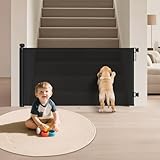
Trustot’s gate states 34 inches tall and a maximum width of 55 inches in black — the same headline numbers as several mid-range gates, at the lowest price tier. For a household that has measured its opening, confirmed it’s under 55 inches, and wants to spend as little as possible on a hardware-mounted retractable stair gate, this is the direct answer.
Who it suits: secondary stairways, temporary gates for the toddler climbing phase, dog gating on a stair or hallway, and households that would rather spend the savings on other childproofing — outlet covers, cabinet latches, corner guards. Those items matter as much as the gate does, and a childproofing budget spread across the whole house is usually more effective than one premium gate and nothing else.
Key Specs
- Height: 34 inches
- Maximum width: 55 inches
- Color: Black
- Type: Retractable mesh gate
- Stated use: Stairs
- Mounting: Hardware mount
Where the savings actually show up
Budget retractable gates save money in predictable places, and it’s worth knowing which ones you’re accepting. The mesh is usually a looser weave or a lighter denier than mid-range mesh — this affects how the gate resists a determined push and how it holds its shape across a wide span. The housing plastic is thinner, which affects how the retraction spring behaves after a year of daily cycling. The latch is simpler, which often means a firmer squeeze and occasionally a two-hand operation. The included mounting hardware may be minimal, and the screws may not suit every wall type.
What budget gates generally do not compromise on, when the listing states it, is the headline spec: 34 inches of height and 55 inches of width are 34 inches and 55 inches regardless of price. So the safety geometry is there. The difference is longevity and daily operating feel.
Strengths
The price, obviously. And the spec-to-price ratio: full 34 inch height and 55 inch maximum width at the lowest tier.
Black mesh is forgiving of scuffs and dust, which is a small but real benefit on a gate that sits at shoe height on a stairway. And because the gate is a hardware-mount retractable, it’s a legitimate stair gate rather than a pressure-mounted compromise — that’s the important threshold, and it’s crossed at this price point. You don’t have to spend premium money to get a gate that’s mounted the right way for a staircase.
Pros
- Lowest price tier with full 34″ × 55″ specs
- Hardware-mount retractable — correct type for stair use
- Black mesh hides wear
- Leaves budget for the rest of your childproofing
Cons
- Lighter mesh and thinner housing than mid-range gates
- Latch may require two hands on a stiff unit
- Mounting hardware is often basic; verify it suits your wall
- Expect to replace it sooner than a mid-range or premium gate
Versus the nearest alternative
This is the twin of the BBsecure gate — same stated 34″ × 55″ black spec, same budget tier. The two are functionally interchangeable on paper. The real comparison for Trustot is against stepping up one tier to PRObebi (0–54″ × 34″, mid-range). PRObebi’s advantages are a denser mesh, a stronger housing, and a 54 inch maximum that encourages running below full extension. If your opening is 50 inches or less, Trustot at 55 inches maximum leaves you at 91% extension, which is comfortable. If your opening is 54 inches, Trustot is at 98% and PRObebi is at 100% — at that width, step up to the 58 inch Cideny gate instead and give yourself room.
9. SPACEANY Reinforced Retractable Baby Gate — Best Reinforced Housing at Mid-Range

SPACEANY’s gate lists 55 inches wide by 33.5 inches tall in gray, with a reinforced housing. The reinforcement is the selling point: in a retractable gate, the housing contains the spring-loaded drum that the mesh winds onto, and it’s the part that fails first in cheap units. A reinforced housing extends the gate’s service life and keeps the retraction crisp.
Who it suits: busy stairways where the gate cycles many times a day, households that have replaced a cheap retractable gate once already and don’t want to do it again, and anyone who prefers the low-contrast look of gray mesh against light walls or woodwork.
Key Specs
- Width: 55 inches
- Height: 33.5 inches
- Color: Gray
- Type: Retractable mesh gate
- Feature: Reinforced housing
- Mounting: Hardware mount for stair use
Why the housing is the part that matters
A retractable gate is a spring-powered mechanism. Every time the gate closes, the mesh winds onto a drum inside the housing and a spring reloads. That cycle happens thousands of times over the life of the gate. Budget housings use thinner plastic and lighter springs; the symptom of failure is a gate that stops retracting fully, leaving slack mesh that hangs loose across the opening and won’t sit tight against the catch. When the mesh is slack, the gate is no longer a barrier — a toddler can push it and a dog can nudge it. So the housing isn’t a cosmetic detail; it’s the mechanism’s weakest link, and reinforcing it directly addresses the most common way these gates die.
Strengths
The reinforced housing. Combined with a mid-range price, this is a strong value proposition for a gate on a primary stairway.
The gray mesh is a practical middle option between black and white. On a light-painted stairway or a natural wood rail, gray recedes rather than stands out, and it shows less dust and hair than white mesh. For a household that cares about how the gate looks against their décor — which is most households, given the gate is in a main traffic area — the color option is a legitimate reason to choose this over a black gate.
Pros
- Reinforced housing targets the most common failure point
- Mid-range price
- 55 inch span covers wide openings
- Gray mesh is low-contrast and hides dust well
Cons
- 33.5 inches is half an inch shorter than the 34 inch standard — not significant, but short of the tallest here
- No stated dual-lock mechanism
- 55 inch maximum means a 54–55 inch opening runs near full extension
- Gray may show scuffs differently than black
Versus the nearest alternative
Against PRObebi (0–54″ × 34″, black, mid-range): PRObebi gives you a full 34 inches of height and a 54 inch maximum that keeps you out of the danger zone on wide openings, while SPACEANY gives you a reinforced housing. If your opening is 50 inches or less, the height difference is trivial and the housing reinforcement may be the better long-term call. Against Babepai (55″ × 34″, gray, mid-range), Babepai has the extra half inch of height and the same span; SPACEANY has the reinforced housing. For a gate on a primary, heavily used stairway, reinforcement wins. For a gate where height is a concern with a tall toddler, Babepai’s extra half inch is the tiebreaker.
10. Babepai Retractable Baby Gate for Stairs — Best Wide Gray Gate

Babepai lists 55 inches wide by 34 inches tall in gray, for indoor pet gating. That gives you the full 34 inch height standard, the full 55 inch span, and a gray finish that suits light interiors. It’s the straightforward mid-range choice when you want both the height and the width and prefer gray to black.
Who it suits: households gating a wide stair opening or a wide doorway for a midsize dog, buyers who want the 34 inch toddler height standard without paying premium prices, and interiors where black mesh would look out of place and white would show every mark.
Key Specs
- Width: 55 inches
- Height: 34 inches
- Color: Gray
- Type: Retractable mesh gate
- Stated use: Stairs, indoor pet gate
- Mounting: Hardware mount for stair use
Strengths
Full 34 inch height and 55 inch width at mid-range is the core value. You’re not trading height for span or span for price; you’re getting both. That combination is what most buyers actually need, and it’s worth naming explicitly because so many budget gates force a choice between those two numbers.
Gray mesh on a retractable gate is a genuinely good finish for a stairway. It doesn’t dominate the space the way a black housing on a white stairwell does, and it doesn’t show dust, pet hair, and fingerprints the way white does. If the gate is going to be visible from the living room, gray is often the best-looking option of the three common colors.
For pet gating specifically, 34 inches is enough to stop most midsize dogs from jumping the barrier, and the mesh closure means there’s no gap at the bottom for a small dog to squeeze through — a common problem with bar-style gates.
Pros
- Full 34″ height and 55″ width at mid-range
- Gray mesh is low-contrast and low-maintenance
- Suits pet gating as well as child gating
- Mid-range price rather than premium
Cons
- No stated reinforced housing or dual-lock
- 55 inch maximum; wide openings near the limit run at full extension
- Gray mesh can show darker scuffs against very light walls
- Indoor-focused rather than indoor/outdoor rated
Versus the nearest alternative
Against SPACEANY (55″ × 33.5″, gray, mid-range): they’re nearly identical. Babepai has the extra half inch of height; SPACEANY has the reinforced housing. If you’ve owned a retractable gate that eventually went slack, pick SPACEANY. If you want the maximum height available at this span, pick Babepai. Against the PRObebi gate (0–54″ × 34″, black), Babepai gets you one extra inch of span and a gray finish, while PRObebi gives you a 54 inch maximum that keeps a 52 inch opening comfortably under extension. For a 53–55 inch opening, Babepai is the right call; for anything under 52 inches, PRObebi’s slightly tighter spec is the more conservative buy.
11. Bingguz Upgraded Retractable Baby Gates for Stairs & Banister — Best for Banister Mounting

Bingguz’s upgraded gate extends to 55 inches wide by 33 inches tall in mesh, and it’s explicitly listed for stairs and banister mounting. That last word is the reason it’s on the list. A banister is the hardest thing to mount a gate to: the post is usually round, sometimes turned or irregular, and there’s no flat surface and no stud behind it. A gate that shipped only with flat-wall hardware simply can’t be installed there without adapters the buyer has to source separately.
Who it suits: homes where the only viable mounting points are a stair rail or newel post rather than walls on both sides — which is extremely common, and it’s the reason so many people end up unable to install the gate they bought.
Key Specs
- Maximum width: 55 inches
- Height: 33 inches
- Type: Retractable mesh gate
- Stated use: Stairs and banister
- Mounting: Banister-mount hardware included
- Price tier: Premium
Banister mounting, explained
The problem with a banister is mechanical. A wall mount puts the screws into a stud behind drywall, or into masonry, and the load path runs straight into the building frame. A banister post is a freestanding vertical member — often a 2 to 3 inch round spindle or a turned newel — with no framing behind it. Screwing a housing bracket into a newel post works if the post is solid, but the bracket needs to be shaped to sit flush against a curved surface, and the catch on the other side often has nothing to attach to at all.
Banister-mount systems solve this with brackets that wrap or clamp around the post and present a flat mounting face, and sometimes with a strap or plate that distributes the load around the circumference of the post rather than concentrating it at two screw points. If your installation plan runs through a banister, this is the feature you’re paying for, and it’s worth the premium because the alternative is a gate you can’t install.
Strengths
Banister-mount hardware is the headline, and it’s genuinely rare. Most retractable gates assume a wall or a door frame on at least one side.
The 55 inch span is standard for the premium tier, and 33 inches of height is close to the 34 inch standard — short enough of it to be worth noting, but within the range where it functions as a toddler barrier for most children in the target age band. The “upgraded” designation in the listing typically refers to revisions to the housing or latch mechanism versus the brand’s earlier version.
Pros
- Explicitly designed for banister mounting, including round posts
- 55 inch span covers wide openings
- Solves the most common installation blocker on stairways
- Premium hardware rather than a wall-only kit
Cons
- 33 inches is an inch shorter than the 34 inch standard
- Premium price
- Banister clamps are only as solid as the post they attach to — inspect for a loose or hollow post first
- No stated dual-lock
Versus the nearest alternative
Against Borthmiu, the other banister-capable premium gate: Borthmiu lists 55 inches wide with a one-handed dual-lock, which is the stronger safety specification if a toddler pushing against the gate from the stair side is your primary concern. Bingguz gives you a 33 inch height and banister mounting without the dual lock. If both your mounting situation and a resistant lock matter — and on a stairway they usually both do — Borthmiu’s dual lock is the more valuable feature, and you should choose it unless Bingguz’s specific banister hardware fits your post better. Check the post diameter and shape against the included hardware before buying either.
12. Borthmiu Reinforced Retractable Baby Gate for Stairs & Banister — Best for Dual-Lock Safety

Borthmiu’s gate is listed as a reinforced retractable gate for stairs and banister, 55 inches wide, mesh, with a one-handed dual-lock safety mechanism. The dual lock is the differentiator: two points of engagement rather than one, plus one-handed release for the adult. That combination is exactly what a stair gate needs — hard for a child to defeat, easy for a parent to operate.
Who it suits: the primary stairway in a house with a climbing toddler, households with a dog that has learned to nudge single-latch gates open, and any installation that has to go through a banister post rather than a wall.
Key Specs
- Width: 55 inches
- Type: Reinforced retractable mesh gate
- Locking: One-handed dual lock
- Stated use: Stairs and banister
- Mounting: Stair and banister mounting hardware
- Price tier: Premium
What a dual lock actually does
A single-latch retractable gate releases the moment you work one catch. That’s fine for an adult, but it also means a single point of failure: if a toddler figures out the catch — and many do, because children watch adults use the gate dozens of times a day — the gate is open. A dual lock requires two simultaneous actions, typically pressing one release while lifting or sliding another component, and the geometry makes it impractical for small hands to manage both at once. The one-handed operation is what keeps the gate usable: the two actions are arranged so an adult thumb or palm can perform both in a single motion while the other hand holds a child or a bag.
On a stairway this matters more than anywhere else in the house, because the gate at the top of a staircase is the one that, if defeated, results in a fall. That’s the reasoning behind the premium price, and it’s the strongest functional argument for spending more on one gate than on any other barrier in the house.
Strengths
Dual lock plus one-handed operation plus banister mounting in one product is the most complete specification set on this list for a stairway installation. Individually, each feature exists elsewhere; together, they cover the three failure modes that matter on a staircase — push-through, leave-open, and un-mountable.
The “reinforced” housing addresses the other long-term failure mode, the slack-mesh problem that kills retractable gates. If you’re buying one gate for a primary staircase and you want it to still work in three years, this specification set is the closest thing on the list to a buy-once answer.
Pros
- Dual lock resists push-through from the stair side
- One-handed release keeps it practical for adults
- Banister mounting hardware included
- Reinforced housing targets long-term mesh slack
- 55 inch span covers wide openings
Cons
- Highest specification, so the highest expected price tier
- Dual locks have more internal parts; a jammed or stiff dual lock is more annoying than a simple latch
- Height isn’t stated in the headline spec — confirm it before buying if you need 34 inches
- Overkill for a doorway or a low-traffic opening
Versus the nearest alternative
Against Veraste, the other one-handed premium gate: Veraste adds indoor/outdoor tolerance, Borthmiu adds a dual lock and banister hardware. For a standard indoor stairway installation, Borthmiu’s dual lock and stair-specific mounting are worth more than outdoor tolerance, so Borthmiu is the better buy for the primary staircase. Veraste becomes the better choice when the gate is going outdoors, or when the gate is gating a doorway with heavy adult traffic rather than the top of a staircase. Against Bingguz, which also offers banister mounting, Borthmiu’s dual lock is the decisive advantage on a stairway.
How to Choose
Measure the opening before anything else
This is the step that determines whether your purchase works at all. Measure the clear opening between the mounting surfaces at the point where the gate will sit — not the width of the stairway at its widest, and not the width of the floor above. If one side is a wall and the other is a newel post, measure from the face of the wall to the face of the post. Get a number in inches. Then add a margin.
The margin is the part buyers skip and then regret. If your opening is 48 inches, buy a gate with a stated maximum of at least 52 inches — ideally 55 or 58. The reason is extension percentage: a retractable gate pulled to 100% of its rated span has the least mesh overlap around the drum, the highest spring tension, and the least tolerance for any settling in the wall or slight misalignment of the catch bracket. Running at 85–90% of the rated maximum is the comfortable zone. At 100%, you’re in a gate that will be stiff to close, prone to latch misalignment, and likely to develop slack mesh within a year or two.
The practical rule: stated maximum minus 4 to 6 inches should still exceed your opening. A 55 inch gate is the right pick for a 48–51 inch opening. For a 52–55 inch opening, look at the 58 inch gates. For an opening over 58 inches, you’re outside the range of every gate on this list and need a different solution entirely, usually a hardware-mounted swing gate or a custom installation.
Check the mounting surface before you check anything else
A retractable gate on a stairway is only as strong as what it’s screwed into. Work through this list before buying:
- Wall or stud on at least one side: Ideal. Use the included lag screws or masonry anchors as appropriate. A stud finder pays for itself here.
- Door frame or trim on both sides: Workable. The catch bracket has solid wood to bite into. Avoid attaching only to drywall with hollow-wall anchors — those pull out under repeated lateral load.
- Newel post on one side: Check that the post is solid and firmly attached. A loose newel is a bad anchor. If the post is solid, a standard flat bracket can often be screwed to it, but you may need to shim the bracket to sit flush against a curved face.
- Round banister spindle on both sides: You need banister-mount hardware — a clamp or wrap bracket. This is where the Bingguz and Borthmiu gates earn their premium, and where most standard gates simply can’t be installed.
- Glass, tile, or metal railing: Generally not directly mountable. You need a no-drill adapter or a different gate type.
If you’re not sure what’s behind the wall in your home, and you’re buying a gate for the top of a staircase, it’s worth the extra step of confirming with a stud finder or a contractor rather than guessing. A gate that holds for six months and then starts to move is worse than no gate, because the household trusts it.
Height: 34 inches is the number to hold
Toddler gates in the US generally run 30 to 36 inches tall, and the practical standard for a stair gate is 34 inches. The reason is simple geometry: a child who can reach the top edge of the gate and pull up on it can swing a leg over the top if the gate is short enough. At 30 or 32 inches, a tall two-year-old can hook a foot on the top rail. At 34 inches, that becomes much harder. Once a child is around three years old and can climb reliably, height stops being sufficient protection for the top of a staircase regardless of the gate — at that point you’re relying on instruction and supervision, and many families switch to a different strategy entirely.
On this list, 34 inches is the standard on the PRObebi, BBsecure, Trustot, Babepai, and Veraste gates. The SPACEANY is 33.5 inches, the Bingguz is 33 inches, and the Cideny and Borthmiu listings emphasize width rather than stating a headline height. Half an inch or an inch is not a decisive difference for most families, but if you have a tall toddler, favor the full 34 inches.
Mesh: what to look at, and what actually fails
Mesh is the part of a retractable gate that spans the opening, and its job is to resist deformation under load. Three things matter:
- Weave density. A tighter weave — more strands per inch, in a diamond or square pattern — resists poking and stretching better than a loose knit. You can’t measure it from a listing, but denser mesh is heavier and stiffer when you handle it.
- Attachment at the edges. The mesh doesn’t fail in the middle; it fails where it’s sewn or welded to the housing drum and to the leading edge that clips into the catch. Look at the stitching or the seam quality at the gate’s edge.
- Tension retention. This is a function of the spring inside the housing, not the mesh itself. A gate that stops retracting fully leaves slack mesh, and slack mesh is a barrier that yields.
The practical takeaway: mesh strength is mostly about not going slack over time, and that’s governed by the housing and spring quality more than by the mesh fabric. This is the single strongest argument for the reinforced-housing gates — SPACEANY and Borthmiu — over the cheapest options, especially on a primary stairway that cycles twenty or thirty times a day.
One-handed operation: test it in your head before you buy
Think about your actual daily routine. You come up the stairs with a toddler on your hip and a bag of groceries in the other hand. You need to open the gate at the top of the stairs, pass through, and close it behind you. Can you do it? If the gate needs two hands and a firm squeeze, you’ll set the toddler down on the landing while you work the gate — fine — or you’ll prop the gate open and forget to close it — not fine.
One-handed operation is the feature that determines whether a stair gate gets used properly. The Veraste gate names it explicitly; the Borthmiu gate pairs it with a dual lock. If you’re buying for a busy household, prioritize this over color, over brand, and over a marginal inch of width. The best gate in the world, left open, protects nobody.
Locking: single latch vs. dual lock
A single latch releases with one action. A dual lock requires two simultaneous actions. On a stairway, the dual lock is meaningfully safer because it resists the failure mode where a child who has watched you open the gate a hundred times figures out the release. Children are extremely good at imitating operations they’ve observed, and a single catch is often within their capability by age two.
The trade-off is that dual locks have more moving parts and are more annoying when they get stiff or misaligned. If you choose a dual lock, check that it operates smoothly on arrival and keep the mechanism clean — grit and cracker crumbs are the usual cause of a stiff lock. If you choose a single latch, be conscious that the gate is only secure as long as the child hasn’t learned the mechanism, and consider gating the top of the stairs with a dual-lock gate if the stairway is the primary hazard.
Indoor vs. outdoor rating
If your gate sits anywhere that experiences weather — a back door, a deck stair, a garage entry, a screened porch — an indoor/outdoor rated gate is worth the premium. UV exposure degrades untreated mesh and polymer housings; humidity swings cause plastic to become brittle and metal components to corrode. Two gates on this list explicitly carry indoor/outdoor ratings: the Cideny indoor/outdoor model and the Veraste gate. For an indoor stairway, the rating doesn’t matter and you shouldn’t pay for it.
Installation requirements: what to have ready
Most retractable gates require drilling. Plan for the following before the gate arrives:
- Drill and bits: Usually a pilot bit matched to the included screws, plus a masonry bit if you’re going into brick or concrete.
- Screws or anchors appropriate to your surface: The included hardware is often sized for wood. For drywall alone, you’d need hollow-wall anchors, but that’s a weak installation for a stair gate — try to find a stud. For masonry, use the anchors specified for the material.
- Level: The housing and the catch bracket must be at the same height and level to each other, or the gate will fight the catch every time you close it.
- Tape measure and pencil: Mark both mounting points before drilling. Measure twice.
- Second person (helpful): Holding the housing in position while marking and drilling is easier with two people, especially on a staircase where you’re working at an awkward height.
The most common installation mistake is mounting the housing and the catch at slightly different heights or at an angle to each other. The gate then needs to be forced into the catch, which stresses the mesh and the mechanism, and the household compensates by not fully closing the gate. Level and aligned is the whole game.
Matching the gate to your situation
| Your Situation | What to Prioritize | Suggested Pick |
|---|---|---|
| Standard stair opening, 40–52″, wall on both sides | 34″ height, hardware mount, 54″+ span, mid-range price | PRObebi (0–54″ × 34″) |
| Wide opening, 53–58″ | 58″ span so you run under full extension | Cideny 58″ Wide |









Write Your Review
No reviews yet. Be the first to share your experience!