
Key takeaways
- Compare the best juicers for celery and leafy greens, from a celery-specific Omega to a wide-chute Kuvings, with specs, cleaning notes, and buying tips.
Celery is one of the hardest everyday ingredients to juice well. Its long, stringy fibers wrap around cheap augers, clog fine screens, and leave wet pulp in fast centrifugal machines, so a juicer that handles apples easily can still struggle through one bunch of stalks. Leafy greens create the opposite problem: kale, spinach, and wheatgrass are light and flimsy, and spinning blades blow them through the chamber before much juice comes out.
The machines that do both jobs well share one design: a slow masticating auger that crushes and presses fibrous produce at low speed instead of shredding it at high speed. This guide compares five slow juicers for a celery and greens routine, from a model built only for celery to a wide-chute machine that takes whole stalks with almost no prep, plus a budget option.
As an Amazon Associate, we earn from qualifying purchases.
Quick Answer
For celery above everything else, the Omega MM900HDS is the specialist pick because it ships with a dedicated celery end cap that squeezes stalks longer. For the least prep, the Kuvings REVO830 cuts long stalks automatically through its narrow chute. The Omega NC900HDC suits mixed greens and wheatgrass, the Hurom H400 cleans up fastest, and the AMZCHEF ZM1501 covers daily celery juice on a budget.
Table of Contents
- Omega MM900HDS
- Kuvings REVO830
- Omega NC900HDC
- Hurom H400
- AMZCHEF ZM1501
- How to Choose
- Who Should Skip
- FAQ
- Conclusion
1. Omega MM900HDS Celery Juicer

The MM900HDS is the rare juicer designed around a single ingredient. Omega builds it on a horizontal masticating platform running at 80 RPM, then adds a dedicated adjustable end cap made specifically for celery. That cap holds stalks under pressure longer than a standard cap, which is exactly what fibrous celery needs, and Omega states plainly that the celery cap is not meant for other produce. A second adjustable end cap in the box handles everything else, so the machine still works as a general juicer for greens, carrots, and fruit.
Triple-stage extraction presses produce in stages rather than tearing it once. The feed chute is larger than older Omega designs and pairs with an extra-large feed tray, and automatic pulp ejection keeps a batch moving. Most removable parts are top-rack dishwasher safe, a genuine advantage when the juicer gets washed every morning. Fifteen-year coverage on parts and performance is the longest backing in this roundup.
Specs
- Type: Horizontal masticating (cold press)
- Speed: 80 RPM
- Power: 200 watts
- End caps: Two adjustable caps, one celery-specific and one for general produce
- Dimensions: 6.5 x 14.5 x 15.5 inches
- Weight: 14 pounds
- Care: Most removable parts top-rack dishwasher safe
- Coverage: 15 years on parts and performance
- Tier: Mid-range
2. Kuvings REVO830 Whole Slow Juicer

The REVO830 attacks celery from the prep side. Its vertical body carries two feed chutes: an extra-wide 88 mm chute for whole apples and round produce, and a 48 mm chute sized for long ingredients. Inside that narrow chute, a bladeless auto-cutting screw slices celery stalks, carrots, and kale stems as they drop, so the fibers that tangle lesser machines are chopped before they reach the pressing zone. If your main complaint is cutting stalks into small pieces, this machine removes that step.
Power is the other headline: a maximum of 240 watts, the strongest in this group, in a build of Ultem, Ecozen, and stainless steel. The listed recommended uses explicitly include celery alongside apples, beetroot, carrots, and nuts, and smoothie and sorbet attachments come in the box. The trade-offs are size and care: at 18 pounds it is the heaviest pick here, and parts are hand wash only. Auger speed and warranty term are not stated consistently across published sources, so both appear as not stated below.
Specs
- Type: Vertical masticating (cold press) with auto-cut screw
- Speed: Not stated
- Power: 240 watts maximum
- Feed chutes: Dual, 88 mm wide chute and 48 mm long-produce chute
- Dimensions: 10 x 19 x 8 inches
- Weight: 18 pounds
- Care: Hand wash only
- Attachments: Smoothie and sorbet included
- Coverage: Not stated
- Tier: Premium
3. Omega NC900HDC Juicer and Nutrition System

The NC900HDC is the generalist of the group and the strongest pick when greens share the stage with celery. Its horizontal dual-stage system runs at 80 RPM and was built for leafy greens and wheatgrass as much as for stalks: the slow auger grips flimsy leaves instead of flinging them, and the adjustable end cap changes back-pressure for softer or harder produce. Celery follows the same path as kale and spinach, so a mixed green recipe needs no change of method.
What separates the NC900HDC is everything it does after juicing. Its nutrition system attachments extrude pasta, grind coffee and spices, mince herbs and garlic, and make nut butter, baby food, and frozen desserts. It is also lighter than the MM900HDS at 13 pounds, with the same compact footprint. The compromise is cleaning: the product information lists hand wash only, and the two-stage path has more parts to rinse than a vertical machine. Fifteen-year coverage matches the best in the group.
Specs
- Type: Horizontal masticating (cold press), dual-stage
- Speed: 80 RPM
- Power: 150 watts
- End cap: Adjustable for different produce types
- Dimensions: 6.5 x 14.5 x 15.5 inches
- Weight: 13 pounds
- Care: Hand wash only
- Extras: Pasta, grinding, mincing, and nut butter functions
- Coverage: 15 years on parts and performance
- Tier: Mid-range
4. Hurom H400 Easy Clean Slow Juicer

The H400 is built for people who juice often but dislike scrubbing screens. Traditional slow juicers push juice through a fine mesh strainer that traps celery fiber and needs a brush after every session. The H400 removes the strainer entirely: its two-piece chamber separates juice from pulp without a screen, so cleanup is mostly a rinse under the tap. For a daily celery habit, that decides whether the machine gets used or stored away.
The self-feeding hopper is the second convenience. It accepts a loaded batch and feeds the auger on its own, so you can fill it with celery stalks, cucumber, and greens and step away instead of pushing pieces down a chute one at a time. The chamber holds 550 milliliters, the auger turns at 90 RPM per Hurom’s published comparison, and the motor is rated at 150 watts. The tall, narrow body suits tight counters. Two published figures conflict across sources, the item weight and the voltage, so both are marked not stated here.
Specs
- Type: Vertical masticating (cold press), strainer-free chamber
- Speed: 90 RPM
- Power: 150 watts
- Chamber capacity: 550 milliliters
- Feeding: Self-feeding hopper for batch loading
- Dimensions: 10.3 x 6.6 x 18.5 inches
- Weight: Not stated
- Voltage: Not stated
- Materials: ABS, Tritan, and Ultem; BPA free
- Tier: Premium
5. AMZCHEF ZM1501 Cold Press Juicer
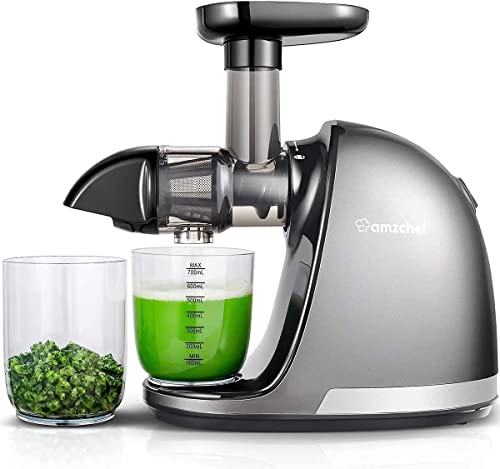
The ZM1501 brings slow juicing down to a budget tier without giving up the features celery needs. Its seven-spiral auger turns produce slowly, and the brand’s own listing calls out celery, ginger, and other fibrous vegetables by name. A reverse function backs the auger out when fiber stalls it, the most common frustration with stringy stalks, and a protection chip guards the motor. At 150 watts it matches the NC900HDC above, in a lighter 7.59-pound body.
The narrow feed chute is the honest trade-off: celery stalks fit, but apples and large fruit need cutting first, and the listing frames the small chute as a safety and flavor choice that lets you remove seeds before juicing. Parts are hand wash only and clean with the included brush. The motor carries a two-year guarantee per the listing, far shorter than the Omega coverage but typical for this tier. For a first celery juicer, it covers the daily routine at the lowest commitment here.
Specs
- Type: Vertical masticating (cold press)
- Speed: Not stated
- Power: 150 watts
- Auger: Seven-spiral masticating design with reverse function
- Dimensions: 12 x 7.75 x 16.14 inches
- Weight: 7.59 pounds
- Care: Hand wash only; cleaning brush included
- Extras: Recipe collection included
- Coverage: Two-year motor guarantee per listing
- Tier: Budget
How to Choose
Start with the extraction style. Celery and leafy greens both reward slow masticating pressure and punish high-speed centrifugal blades, which is why every machine here is a cold press model. Horizontal machines, like the two Omegas, give fibrous stalks a long pressing path and handle wheatgrass and greens best. Vertical machines save counter space and, in designs like the REVO830 and H400, reduce prep or cleanup.
Next, match the machine to your prep tolerance. If you juice celery daily and hate chopping, an auto-cutting chute or a self-feeding hopper saves real minutes every morning; if you juice twice a week, a standard chute costs little. Then look at pressure control: an adjustable or dedicated celery cap changes how dry the pulp gets, and dry pulp signals good extraction.
Cleaning decides long-term use more than any other factor. Count the parts, check whether a mesh strainer needs brushing, and confirm whether pieces are dishwasher safe or hand wash only. Finally, weigh coverage and footprint: long backing suits a machine run daily for years, while a compact budget model can be smarter for a trial routine.
Who Should Skip
Skip this category if you mostly juice soft fruit: centrifugal machines are faster for oranges, apples, and melons, and slow augers offer little advantage there. Skip the celery-specific Omega if you rarely juice celery on its own, since its cap only earns its place in a straight celery routine. Skip the large premium models if counter space is tight or you will not juice several times a week. If you want the fiber left in, a blender is the right tool.
FAQ
Why do celery and leafy greens need a slow juicer?
Celery fibers are long and stringy, so they wrap around fast spinning parts and clog fine screens, while leafy greens are so light that centrifugal force throws them into the pulp bin almost untouched. A slow auger crushes and squeezes both gradually, pulling more juice from stalks and leaves and leaving drier pulp.
How should celery be prepared before juicing?
Wash the stalks, trim the base and dry ends, and cut them into short sections unless your machine has an auto-cutting chute or a self-feeding hopper. Feeding a few pieces at a time, alternating with a harder ingredient like carrot, helps the auger keep its grip. Long whole stalks are the most common cause of fiber wrapping.
How long does fresh celery juice keep?
Slow juicers limit heat and oxidation, so the juice holds up better than centrifugal juice. Omega states its celery juicer can produce juice that stores for up to 72 hours refrigerated in a sealed container. Flavor and color are still best on day one, so smaller, frequent batches beat one large batch.
Are these juicers hard to clean?
It depends on the design. Models with a fine mesh strainer need a brush over the screen after each session to clear celery fiber. Strainer-free designs like the Hurom H400 mostly rinse clean, and some Omega parts are top-rack dishwasher safe. Rinsing parts right after juicing cuts cleanup time everywhere.
Conclusion
Celery and greens expose weak juicers quickly, so the right pick depends on which part of the routine matters most. Choose the Omega MM900HDS for straight daily celery juice, the Kuvings REVO830 for big batches with almost no chopping, the Omega NC900HDC for mixed greens and extra kitchen tasks, the Hurom H400 for fastest cleanup, or the AMZCHEF ZM1501 to start on a budget. Any of the five handles fibrous stalks and flimsy leaves well.
Product and ASIN Reference
| Product | ASIN |
|---|---|
| Omega MM900HDS Celery Juicer | B07XPPNFQQ |
| Kuvings REVO830 Whole Slow Juicer | B0BZRH41TH |
| Omega NC900HDC Juicer and Nutrition System | B00CIU92S6 |
| Hurom H400 Easy Clean Slow Juicer | B0BN28HV73 |
| AMZCHEF ZM1501 Cold Press Juicer | B09ZVF4JKC |

Write Your Review
No reviews yet. Be the first to share your experience!