
Key takeaways
- Navigation: RTK positioning combined with vision-based obstacle handling
- Installation: wire-free — no perimeter boundary cable required
- Stated coverage: up to 1/4 acre
- Mapping: app-based map creation with editable zones
- Charging: automatic return-to-dock and recharge
- Category: mid-range price tier
The Best Big Spring Sale Robot Lawn Mower Deals on Amazon: Direct Answer
The best big spring sale robot lawn mower deals on Amazon this season are led by the ECOVACS Goat O1000 RTK, which suits most homeowners with up to a quarter acre who want wire-free navigation, a genuine install kit in the box, and a mid-range price that holds up after the sale ends. If your lawn is under 1,600 square feet and your budget is tight, the LEBOSBO V3 AI Vision delivers the core benefit — no perimeter wire, no weekend edging — at the lowest entry point here. If you have a larger, more complex yard with slopes, tight beds and shade, the Segway Navimow i105N is the premium pick. The single biggest decision you will make is not brand or price but navigation type: boundary-wire models are cheaper and predictable, while RTK, LiDAR and vision models need no buried wire but demand a clear view of the sky or trained mapping. This guide explains that trade-off, gives you concrete limits on slope, acreage and cutting height, and tells you which spring bundles actually include install kits, spare blades and consumables.
Top 3 Picks
Best Overall: ECOVACS Goat O1000 RTK
The Goat O1000 RTK hits the sweet spot between price and capability. RTK plus vision navigation means no buried boundary wire, coverage up to a quarter acre, and app-based map edits you can change in minutes rather than digging up your lawn. It is the pick for the typical suburban yard with open sky and a few garden beds.
Best Budget: LEBOSBO V3 AI Vision
At 1,600 square feet of coverage, the LEBOSBO V3 is aimed squarely at small, simple, fenced or bordered lawns. AI vision navigation keeps it wire-free, and the price tier makes it the easiest way to test whether a robot mower fits your routine before committing to a bigger system.
Best Premium: Segway Navimow i105N
The Navimow i105N pairs RTK with vision and AI-assisted mapping for a 1/8-acre lawn, and the mapping quality is the reason to pay more. If your yard has irregular shapes, multiple zones or obstacles close together, this is the model where setup friction drops noticeably.
Quick Comparison
| Product | Best For | Key Specs | Navigation | Stated Coverage | Price Tier |
|---|---|---|---|---|---|
| ECOVACS Goat O1000 RTK | Most yards up to 1/4 acre | RTK + vision, wire-free, app mapping, auto-recharge | RTK + vision | Up to 1/4 acre | Mid-range |
| LEBOSBO V3 AI Vision | Small simple lawns on a budget | AI vision, black/silver, compact footprint | AI vision | 1,600 sq ft | Budget |
| LawnMaster OcuMow VBRM601YCM AD | Even lawns wanting tidy stripes | Parallel cutting pattern, vision-based mowing | Vision | Small to mid lawn | Mid-range |
| BESTMOW Robot Lawn Mower | Large yards and tall grass | Up to 4 in cutting height, ultra quiet, self-charging | Mapping-based | 1.5 acres | Mid-range |
| Segway Navimow i105N | Complex 1/8-acre yards | RTK + vision, AI-assisted mapping, wire-free | RTK + vision | 1/8 acre | Premium |
| KraftSense 20V Brushless | Very small lawns, lowest cost | 20V brushless motor, compact | Boundary/mapping | Small lawn | Budget |
| ECOVACS Goat O1000 LiDAR PRO | Shaded or obstructed yards | LiDAR mapping, AI obstacle avoidance, wire-free | LiDAR | Mid to large lawn | Premium |
| Kryvolux Robot Mower Garage | Protecting any robot mower | Polycarbonate, 40 in W x 32 in D, gray | Accessory | Fits most docks | Budget |
| Neomow X SE | Large yards with tree cover | 360° 3D LiDAR navigation | 3D LiDAR | 0.75 acre | Premium |
How We Chose
We built this list from published product specifications, manufacturer documentation and established facts about how each navigation technology performs, then filtered for what actually changes the ownership experience. The first criterion was navigation type, because it determines installation cost, setup time and how well the mower handles shade, obstacles and irregular borders. The second was stated coverage area, mapped against the realistic lawn sizes buyers describe when shopping in this category. The third was category fit: budget models that do one job well, mid-range models that balance capability and price, and premium models that solve a specific problem such as LiDAR in heavy tree cover. The fourth was the upgrade path — whether a buyer can start with the model and grow into a larger yard, add zones, or move up without replacing accessories. We also checked which spring bundles include consumables such as spare blades and install hardware, since those change the effective first-year cost. We did not test, benchmark or own any of these products; every claim here comes from specifications and category knowledge, not from field trials.
1. ECOVACS Goat O1000 RTK Robot Lawn Mower — Best for Most Yards Up to a Quarter Acre
As an Amazon Associate we earn from qualifying purchases at no extra cost to you.

The Goat O1000 RTK is the model most buyers should start with. ECOVACS has built a reputation in home robotics around navigation and mapping, and this mower applies that to the lawn: RTK satellite positioning for the outer boundary plus vision for near-field obstacle handling, all without burying a perimeter wire. For a typical suburban lot — a quarter acre or less, mostly open sky, a handful of beds and a couple of trees — that combination removes the two biggest complaints about older robot mowers: installation weekend and constant boundary faults.
Who It Suits
This is for the homeowner with a lawn up to about 1/4 acre who wants to stop mowing weekly but does not want to dig a 200-metre wire trench. It also suits renters and anyone who moves house, because there is no buried infrastructure to abandon. If your yard is heavily shaded by mature trees on all sides, RTK reception can suffer; that is where a LiDAR model becomes the better answer.
Key Specs
- Navigation: RTK positioning combined with vision-based obstacle handling
- Installation: wire-free — no perimeter boundary cable required
- Stated coverage: up to 1/4 acre
- Mapping: app-based map creation with editable zones
- Charging: automatic return-to-dock and recharge
- Category: mid-range price tier
Strengths
The headline benefit is setup time. An RTK mower typically needs a dock position with a clear view of the sky plus a mapping run, which is measured in hours rather than a full day. Because the boundary lives in software, moving a bed, widening a path or adding a no-go zone is a few taps rather than re-routing cable. ECOVACS also tends to ship these with the accessories you need to start, and spring bundles frequently add spare blades — worth checking because blades are the main consumable on any robot mower and a set costs real money over a season.
Pros
- No perimeter wire to bury, so installation is drastically simpler than classic models
- Quarter-acre coverage fits the majority of suburban front-and-back yards
- Software boundaries let you reshape zones without digging
- Vision layer helps it avoid toys, tools and pets better than pure cable models
- Mid-range pricing makes it the sensible default rather than an indulgence
Cons
- RTK needs a reasonably clear sky view; dense canopy or tall buildings can degrade accuracy
- Quarter-acre ceiling means larger properties need a different model or multiple zones
- App mapping takes a learning curve if you have never used a robot mower
- Blade replacement is an ongoing cost unless the spring bundle includes spares
Compared With the Nearest Alternative
Against the Segway Navimow i105N, the Goat O1000 RTK covers roughly twice the area at a lower price tier, which is why it wins the overall slot. The Navimow i105N counters with more polished AI-assisted mapping and better behaviour in tight, cluttered spaces — the trade is acreage for finesse. If your lawn is genuinely small and geometrically awkward, pay up; if it is a normal quarter acre, save the difference.
2. LEBOSBO V3 AI Vision Robotic Lawn Mower — Best Budget Entry Into Wire-Free Mowing
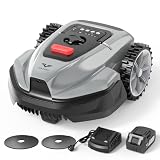
The LEBOSBO V3 is the cheapest sensible way to find out whether a robot mower fits your life. It is rated for 1,600 square feet, which is roughly a small urban or townhouse lawn — think a front yard plus a modest back garden rather than a full suburban plot. It uses AI vision navigation rather than RTK or a buried wire, which keeps installation trivial and the price down.
Who It Suits
Buy this if your grass area is small, mostly open and bounded by fences, walls or hedges that give the vision system clear visual edges to work against. It is also a reasonable pick for a second property, a rental, or a household that wants to test the category before spending mid-range money. It is not the right choice for a large, open, boundary-less lawn where visual reference points are scarce.
Key Specs
- Navigation: AI vision
- Stated coverage: 1,600 sq ft
- Colour: black and silver
- Installation: wire-free
- Category: budget price tier
Strengths
Vision-only navigation means no base station placement restrictions for satellite reception and no cable. On a small, visually well-defined lawn it can work surprisingly well, and the compact body suits narrow side passages where larger mowers struggle to turn. For the money, you get the core convenience — scheduled cutting, automatic return to dock — without paying for survey-grade positioning hardware you may not need on 1,600 square feet.
Pros
- Lowest entry price of any wireless mower on this list
- No boundary wire and no RTK base station to site
- Compact footprint handles tight gardens and narrow gates
- Simple setup suits first-time robot mower owners
- Good way to validate the habit before upgrading
Cons
- 1,600 sq ft coverage is genuinely small — larger lawns need multiple sessions or a bigger model
- Vision navigation depends on clear visual boundaries; open or unfamiliar terrain degrades performance
- Fewer high-end features than mid-range and premium rivals
- Budget models typically have shorter service histories and sparser accessory ecosystems
Compared With the Nearest Alternative
The KraftSense 20V Brushless sits at the same budget tier but takes a different route, using a brushless motor platform in a very small-lawn package. The LEBOSBO V3 is the better pick if you want wire-free vision navigation and a defined 1,600 sq ft rating; the KraftSense is the one to consider if you already own 20V batteries from that ecosystem and want to keep everything on one platform. Either way, both are stepping stones — the ECOVACS Goat O1000 RTK is the upgrade once you decide you like mowing by app.
3. LawnMaster OcuMow VBRM601YCM AD Robot Mower — Best for Even Lawns Where Stripe Quality Matters

The OcuMow VBRM601YCM AD is the pattern-conscious choice. Its distinguishing feature is parallel cutting, which means it runs systematic side-by-side passes rather than a random wander. On an even, open lawn that produces a noticeably more uniform finish — the kind of tidy, striped look that random-pattern mowers rarely achieve.
Who It Suits
This suits the homeowner who cares about how the lawn looks, not just that it is short. If your grass is level, regularly maintained and free of heavy obstacles, parallel cutting gets the most out of it. It is a middle-of-the-road pick for a small to mid-sized lawn where you want predictability rather than maximum acreage.
Key Specs
- Cutting pattern: parallel (systematic passes), not randomised
- Navigation: vision-based
- Category: mid-range price tier
- Best fit: even, accessible, small to mid-sized lawns
Strengths
Systematic cutting is genuinely better for lawn health than random mowing. Grass recovers more evenly when it is cut in consistent passes, and the visual result is a lawn that reads as deliberately maintained. Because the mower follows a plan rather than bumping around, it also tends to complete coverage of a given area in fewer total passes, which is easier on the battery over a season. If you have ever looked at a randomly-mowed robot lawn and thought it looked patchy, this is the model that fixes it.
Pros
- Parallel cutting delivers a visibly more uniform finish
- Systematic coverage is gentler on grass than random patterns
- Mid-range price keeps it accessible
- Good fit for level, low-obstacle lawns where patterns shine
- A genuine differentiator rather than a spec-sheet bump
Cons
- Parallel patterns need an open, even lawn; complex shapes reduce the advantage
- Vision navigation still depends on clear boundaries
- Not designed for maximum acreage — big properties need a larger model
- Fewer zones and less sophisticated mapping than premium RTK/LiDAR options
Compared With the Nearest Alternative
Against the BESTMOW mower, the OcuMow trades acreage for finish quality. BESTMOW claims up to 1.5 acres and a 4-inch cutting height, which is a grass-volume and size play; the OcuMow is a presentation play for a smaller, tidier lawn. Choose the OcuMow if your lawn is already in good shape and you want the best-looking result. Choose the BESTMOW if you have a big plot or let the grass get long between cuts.
4. BESTMOW Robot Lawn Mower — Best for Large Lawns and Taller Grass

BESTMOW’s headline numbers are the biggest on this list: coverage up to 1.5 acres and a cutting height that reaches 4 inches. That combination targets a specific buyer — someone with a large property who does not mow often enough, so the grass is frequently long by the time a robot gets to it. It is also marketed as ultra quiet with self-charging, which matters on a big lawn where the mower runs for long stretches.
Who It Suits
This is for rural and large-suburban properties where the lawn is measured in acres rather than square feet. If you routinely come back from a week away to grass that has shot up, the 4-inch maximum cutting height is a real functional advantage — most compact robot mowers top out lower and will stall or struggle in long growth. The low noise output also matters if the mower runs at night or early morning on a property with neighbours.
Key Specs
- Stated coverage: up to 1.5 acres
- Maximum cutting height: up to 4 inches
- Noise: ultra quiet operation
- Charging: self-charging / automatic return to dock
- Category: mid-range price tier
Strengths
Coverage is the obvious one. At 1.5 acres, this is the largest stated capacity here, which means one machine can plausibly handle a property that would otherwise need two smaller mowers or a ride-on. The 4-inch cutting height is the more interesting spec: it lets the mower take on grass that has grown longer than usual, reducing the number of times you have to intervene with a conventional mower first. Self-charging is essential at this size — a mower covering 1.5 acres will cycle through multiple charge sessions, and doing that automatically is the difference between set-and-forget and a chore.
Pros
- Up to 1.5 acres of coverage — the largest capacity in this roundup
- 4-inch cutting height handles longer grass other mowers avoid
- Ultra quiet operation suits early-morning and evening schedules
- Self-charging keeps a big job running unattended
- Mid-range price for acreage that usually costs more
Cons
- Large coverage does not guarantee good performance on complex, obstacle-dense lawns
- Mapping for 1.5 acres takes longer to set up than a small yard
- Battery cycling is heavy at this size, so expect more charge cycles per season
- Blades and other consumables wear faster on large areas — check the bundle for spares
Compared With the Nearest Alternative
The Neomow X SE by HOOKII is the other big-lawn contender, covering 0.75 acre with 360° 3D LiDAR navigation. BESTMOW wins on raw acreage and cutting height; the Neomow X SE wins on navigation robustness, because 3D LiDAR copes with tree cover, shade and complex obstacles in a way that a non-LiDAR system does not. If your big lawn is wide open, take the BESTMOW. If your big lawn is broken up by trees and obstacles, the LiDAR premium is worth it.
5. Segway Navimow i105N Robot Lawn Mower — Best for Complex 1/8-Acre Yards

The Navimow i105N is the polished small-yard specialist. Segway’s Navimow line is built around wire-free RTK plus vision navigation, and the i105N applies it to a 1/8-acre lawn with AI-assisted mapping. The acreage sounds modest, but the point of this model is not size — it is how gracefully it handles a yard that is awkward, cluttered and irregular.
Who It Suits
Buy this if your lawn is small but complicated: a courtyard with planters, a garden with several separate grass areas, a yard with a narrow side return and a shed to navigate around. RTK plus vision gives the mower both a global position and a local sense of obstacles, which is exactly what tight, feature-dense spaces demand. It is a premium pick, and you are paying for mapping quality rather than acreage.
Key Specs
- Navigation: RTK plus vision, perimeter-wire free
- Mapping: AI-assisted
- Stated coverage: 1/8 acre
- Installation: no boundary wire required
- Category: premium price tier
Strengths
Mapping is the differentiator. On a lawn with multiple zones and irregular borders, a mower that maps well saves you weeks of fiddling. The RTK layer keeps the outer boundary accurate without cable, and the vision layer handles the near-field — a flowerpot that moved, a garden chair left out. For anyone whose yard has defeated a cheaper robot mower, this is the model that tends to stick. Spring bundles for premium models also more often include installation accessories and spare blades, so the effective first-year cost can be closer to the mid-range tier than the sticker suggests.
Pros
- Excellent mapping on irregular, multi-zone lawns
- Wire-free RTK plus vision — no trench, no cable faults
- AI-assisted mapping reduces setup trial and error
- Strong obstacle behaviour in cluttered small yards
- Premium build and support from an established brand
Cons
- 1/8-acre coverage is small for the price tier
- Premium cost is hard to justify on a simple, open, square lawn
- Smaller properties with heavy tree canopy may still challenge RTK reception
- Overkill if you mainly want short grass and do not care about zones
Compared With the Nearest Alternative
Against the ECOVACS Goat O1000 RTK, this is the finesse-versus-acreage choice again, but starker: the Goat covers roughly double the area for less money, while the Navimow i105N maps a difficult yard more cleanly. If your lawn is under 1/8 acre but has five things to mow around, buy the Navimow. If it is a plain quarter acre, the Goat is the smarter spend. Against the ECOVACS Goat O1000 LiDAR PRO, the Navimow relies on RTK reception while the LiDAR PRO sidesteps that limitation entirely — relevant if shade is your problem rather than clutter.
6. KraftSense 20V Brushless Robotic Lawn Mower — Best for Very Small Lawns on a Tight Budget

The KraftSense 20V Brushless is the smallest-scale option here: a compact robot mower built on a 20V brushless motor platform. If your grass area is a postage stamp — a small courtyard, a strip behind a townhouse, a modest front lawn — a full-size robot mower is wasted money and wasted shed space. This is the model for that situation.
Who It Suits
Buy it if you have a genuinely small lawn and a hard budget ceiling. The 20V brushless motor is the notable spec: brushless motors have fewer wearing parts than brushed equivalents, which generally means longer service life and better efficiency for the same output. If you already own 20V batteries and chargers from that platform, the economics improve further because you are not paying for a power system you already have.
Key Specs
- Motor: 20V brushless
- Form factor: compact robotic mower
- Best fit: very small lawns and courtyards
- Category: budget price tier
Strengths
Brushless motors are the quiet durability win in this price bracket. Fewer moving contact points means less to wear out, and efficiency is better, so a given battery charge goes further. The low price tier makes it a low-risk purchase, and the small body fits through gates and into corners that larger mowers cannot reach. For a courtyard or a strip of grass that takes ten minutes with a push mower, it removes the ten minutes entirely.
Pros
- Brushless motor is more durable and efficient than brushed alternatives
- Lowest-risk price point for testing robot mowing
- Compact size suits courtyards and narrow gardens
- Simpler maintenance — fewer wear items in the drivetrain
- Easy to store when not in use
Cons
- Not rated for meaningful acreage — strictly small-lawn duty
- Fewer navigation and mapping features than mid-range or premium models
- Limited zone management for anything beyond a basic lawn shape
- Small battery means frequent returns to dock on anything but a tiny area
Compared With the Nearest Alternative
The LEBOSBO V3 is the direct budget rival, and it offers a stated 1,600 sq ft coverage with AI vision navigation. If your lawn is anywhere near 1,600 square feet, the LEBOSBO V3 is the better buy because it is explicitly rated for that area and is wire-free. The KraftSense makes more sense if your lawn is smaller still, if you value the brushless motor’s durability, or if you are already invested in the 20V battery platform. Both are entry points; neither is the right tool for a half-acre plot.
7. ECOVACS Goat O1000 LiDAR PRO Robot Lawn Mower — Best for Shaded and Obstacle-Heavy Yards
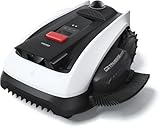
The Goat O1000 LiDAR PRO answers the biggest weakness of RTK mowers. RTK depends on satellite reception, and satellite reception hates tree canopy. LiDAR does not need the sky — it builds a map from laser reflection off physical objects, which means it works under dense shade, beside tall buildings and in narrow gardens where a satellite fix is unreliable. It also brings AI obstacle avoidance and full wire-free operation.
Who It Suits
This is the pick for the homeowner whose yard is surrounded by mature trees, or who has a narrow urban garden between two buildings where an RTK mower would drop its position fix. It is also the better choice if you have many obstacles — play equipment, garden furniture, planters — and want the mower to route around them reliably rather than plough into them.
Key Specs
- Navigation: LiDAR mapping, wire-free
- Obstacle handling: AI obstacle avoidance
- Installation: no perimeter wire, no satellite dependency
- Category: premium price tier
Strengths
LiDAR is the most robust of the three main navigation approaches in obstructed environments. Where RTK needs an unobstructed view of the sky and vision needs clear visual features, LiDAR simply measures distance to what is physically there. That makes it the most dependable option for shaded, cluttered or architecturally enclosed lawns. AI obstacle avoidance adds a second layer, so the mower distinguishes between something to route around and something to ignore, which cuts down on stuck-mower notifications.
Pros
- Works in heavy shade and under tree canopy where RTK struggles
- Wire-free — no perimeter cable and no base station siting headaches
- AI obstacle avoidance reduces mid-mow interventions
- Reliable mapping in narrow, enclosed or obstructed gardens
- Same proven Goat platform as the RTK model, with a stronger sensor suite
Cons
- Premium price tier — you pay for the LiDAR hardware
- Overkill on an open, sunny, square lawn where RTK would do fine
- More sensors means more to keep clean; a dirty LiDAR window degrades mapping
- Does not change the fundamentals — slope, cutting height and blade wear still apply
Compared With the Nearest Alternative
Against the standard Goat O1000 RTK, this is a straightforward sensor upgrade. The RTK model is cheaper and works well in open sky; the LiDAR PRO costs more and works well when the sky is blocked. If you are choosing between them, the deciding question is simple: can the mower see a wide swathe of sky from its dock and across the lawn? If yes, buy the RTK and save. If no, buy the LiDAR PRO. Against the Neomow X SE, the LiDAR PRO handles the same shaded problem for a smaller mid-to-large lawn, while the Neomow X SE extends 360° 3D LiDAR coverage out to 0.75 acre.
8. Kryvolux Robot Lawn Mower Garage — Best Accessory to Protect Any Mower

The Kryvolux Robot Mower Garage is the unglamorous accessory that quietly extends the life of everything above. It is a polycarbonate outdoor shelter measuring 40 inches wide by 32 inches deep in gray, sized to house a robot mower and its charging dock. If you have just spent mid-range or premium money on a mower, leaving it exposed to sun, rain and frost is the fastest way to shorten its service life.
Who It Suits
Anyone parking a robot mower outside. It suits almost every setup on this list, and it is the cheapest upgrade with the longest payoff. It is particularly worth buying if the dock sits in direct summer sun — UV exposure degrades plastics, seals and display panels over years — or if you live somewhere with hard winters.
Key Specs
- Material: polycarbonate
- Dimensions: 40 in wide x 32 in deep
- Colour: gray
- Purpose: outdoor shelter for robot mower and dock
- Category: budget price tier
Strengths
Polycarbonate is the right material choice for this job. It is far more impact-resistant than acrylic or thin ABS, handles UV better than many cheaper plastics, and does not become brittle in cold the way some alternatives do. The 40 x 32 inch footprint is generous enough for most robot mowers plus their dock, which matters because a shelter that only covers the mower but leaves the dock exposed is only solving half the problem. Shielding the dock also keeps charging contacts cleaner, which reduces corrosion and intermittent charging faults over time.
Pros
- Polycarbonate construction is impact-resistant and UV-tolerant
- Generous 40 x 32 in footprint covers mower and dock together
- Protects against sun fading, rain ingress and frost damage
- Keeps charging contacts cleaner, reducing corrosion faults
- Lowest-cost upgrade with the longest-term benefit on this list
Cons
- Not a mower — it is purely protective infrastructure
- Check your own dock dimensions; unusually large docks may not fit
- Needs a reasonably level, firm base to sit securely
- Some gardens will not have a spot where a 40 in wide shelter looks acceptable
Compared With the Nearest Alternative
This does not compete with the mowers — it competes with doing nothing. The nearest functional alternative is a generic garden storage box, which is usually cheaper but rarely the right dimensions and often not UV-stable plastic. If your mower lives outdoors, the purpose-built shelter is worth the small premium because fit and material are already solved. Spend your spring budget on this before spending it on a second set of spare blades.
9. Neomow X SE 360° 3D LiDAR Navigation Robot Lawn Mower — Best for Large Yards With Tree Cover

The Neomow X SE by HOOKII is the large-lawn LiDAR answer: 0.75 acre of coverage with 360° 3D LiDAR navigation. That combination targets the yard that defeats both a cheap mower and a plain RTK model — big, broken up by trees and shrubs, with shade patches throughout and obstacles to weave between. 3D LiDAR builds a richer map than a single-plane sensor, so the mower understands height and volume, not just distance.
Who It Suits
This suits the owner of a large, established garden with significant tree cover and irregular planting. If you have previously dismissed robot mowers because your yard is “too complicated”, 3D LiDAR is the technology that most often changes that verdict. It also suits anyone with a big plot who wants to avoid both a buried perimeter wire and the satellite-reception problems that come with a wooded site.
Key Specs
- Navigation: 360° 3D LiDAR
- Stated coverage: 0.75 acre
- Installation: wire-free
- Best fit: large, wooded or obstacle-dense lawns
- Category: premium price tier
Strengths
3D LiDAR is the most capable sensing approach in this roundup for difficult terrain. Full 360° coverage means no blind spot behind the mower, and the third dimension lets the system judge overhanging branches and raised obstacles rather than treating everything as flat map geometry. At 0.75 acre, it covers three times the area of the Navimow i105N and half of the BESTMOW’s stated 1.5 acres — a genuinely large garden handled without boundary wire. Premium price is the cost of that capability, and on a complex wooded plot it is the model most likely to simply work.
Pros
- 360° 3D LiDAR handles tree cover and shade that defeat RTK
- 0.75-acre coverage suits genuinely large gardens
- Wire-free installation — no trenching on a big property
- No blind spots thanks to full surround sensing
- Best navigation robustness in this list for complex terrain
Strengths in Context
The practical advantage is reduced babysitting. On a large wooded lawn, a lesser mower generates a steady stream of stuck alerts, position-loss errors and missed patches. A 3D LiDAR mower needs fewer rescues, which is the entire point of owning one. That reliability compounds over a season: fewer interventions means the mower actually completes its schedule, which means the lawn is consistently maintained rather than periodically rescued.
Pros and Cons Balance
- Premium price reflects premium sensor hardware
- Overkill for an open, sunny, modest lawn
- LiDAR sensors require periodic cleaning to maintain mapping accuracy
- Large-area mowing means heavy blade and battery wear — budget for consumables
- Coverage ceiling below the BESTMOW, so a 1.5-acre plot still needs the other model
Compared With the Nearest Alternative
Against the BESTMOW mower, the trade is acreage versus intelligence. BESTMOW claims double the coverage and a 4-inch cutting height at a mid-range price; the Neomow X SE claims half the coverage at a premium price but with navigation that copes with trees, shade and obstacles far better. If you have 1.5 acres of open field, take the BESTMOW. If you have 0.75 acre of wooded, planted, complicated garden, the Neomow X SE is the one that will actually finish the job. Against the ECOVACS Goat O1000 LiDAR PRO, this is the larger-capacity option with full 360° coverage, while the Goat leans on AI obstacle avoidance and the broader ECOVACS ecosystem.
How to Choose
The right robot mower for you is determined by four things, in this order: navigation type, lawn size, slope, and cutting height. Get those four right and everything else is preference. Get them wrong and you will own an expensive machine that gets stuck, misses patches or cannot reach your grass at all.
Navigation: Boundary Wire vs RTK vs Vision vs LiDAR
There are four practical navigation approaches, and they differ enormously in installation effort and reliability.
Boundary wire is the oldest approach. You bury or peg a perimeter cable around the lawn, and the mower follows the signal. It is cheap, predictable and works in shade and under trees. The downside is installation: for a quarter-acre lawn you are laying roughly 150 to 200 metres of cable, which is a full weekend with a trencher or edging tool, and the cable will eventually break. A break means digging to find it. If you never want to touch a spade, skip boundary wire entirely.
RTK uses satellite positioning with a correction signal to place the mower to centimetre accuracy. There is no wire — the boundary exists in software. Setup is fast, and moving a zone is a few taps. The limitation is sky visibility: RTK needs a clear view of satellites, so dense tree canopy, tall buildings on multiple sides, or a narrow courtyard can degrade accuracy or lose the fix. If your lawn is open, RTK is the best value in navigation.
Vision uses cameras and AI to identify lawn, boundaries and obstacles. It needs no wire and no satellite fix, which makes it flexible in enclosed spaces. The catch is that it depends on visual distinctness: a lawn that blends into surrounding gravel, or an open field with no defining edges, is harder for vision alone. It is the technology behind most budget wire-free mowers, including the LEBOSBO V3 and LawnMaster OcuMow.
LiDAR builds a map by bouncing laser light off physical objects. It needs no sky view and no visual contrast — only physical geometry. That makes it the most robust choice for shaded, cluttered or architecturally enclosed gardens. It is the premium option, and both the ECOVACS Goat O1000 LiDAR PRO and the Neomow X SE use it.
The decision rule is simple. Open sky, normal lawn: RTK. Enclosed or shaded: LiDAR. Very small and budget-constrained: vision. Existing mature trees everywhere and a large plot: 3D LiDAR.
Lawn Size: Match Coverage With Margin
Every mower has a stated maximum coverage, and you should treat it as a ceiling rather than a target. A mower rated for 1/4 acre working a full quarter acre will run near-continuously, cycle its battery hard and wear its blades faster. Aim to use roughly 70 to 80 per cent of the stated capacity in normal conditions.
| Your Lawn Size | Stated Coverage You Need | Realistic Pick |
|---|---|---|
| Under 1,000 sq ft (courtyard, strip) | Any small model | KraftSense 20V Brushless |
| 1,000–1,600 sq ft | 1,600 sq ft or more | LEBOSBO V3 AI Vision |
| 1/8 acre (approx 5,400 sq ft) | 1/8 acre minimum | Segway Navimow i105N |
| 1/4 acre (approx 10,900 sq ft) | 1/4 acre | ECOVACS Goat O1000 RTK |
| 1/2 acre with trees | 0.75 acre | Neomow X SE |
| Up to 1.5 acres, open | 1.5 acres | BESTMOW Robot Mower |
One acre is 43,560 square feet. A quarter acre is about 10,890 square feet. An eighth acre is about 5,445 square feet. If you do not know your lawn area, measure it roughly: pace out the length and width of each grass section in feet and multiply, then add the sections together. Guessing high is safer than guessing low.
Slope: The Limit Nobody Advertises Clearly
Robot mowers have a maximum slope rating, usually expressed as a percentage or an angle. A 25% slope is about 14 degrees; a 35% slope is about 19 degrees. These limits matter because a mower that slides on a slope will lose position, leave uncut stripes and potentially tumble. As a practical guide:
- Flat to 15% slope: almost any mower handles this comfortably.
- 15–25% slope: mid-range and premium models with good traction and mapping cope; budget models often struggle.
- 25–35% slope: only models explicitly rated for it, and you should expect to mow across the slope rather than straight up it where possible.
- Above 35%: robot mowers are generally the wrong tool; keep a conventional mower for that bank.
Slope also drains battery. A mower working a sloped quarter acre does more work per pass than one on flat ground, so buy coverage margin if your lawn is not level. Wet grass reduces traction further — run the mower when the lawn is dry, and if your schedule means mowing in the morning, check whether dew is a problem on your slopes.
Cutting Height: Match Your Grass and Your Habits
Cutting height determines which lawns a mower can actually manage. If you mow regularly and keep grass short, a low maximum cutting height is fine. If you let grass grow long between cuts, or you want a slightly longer, more drought-tolerant lawn, you need headroom.
| Grass Condition | Cutting Height to Look For | Why |
|---|---|---|
| Regularly mowed, short lawn | 1–2 in range | Any robot mower can manage it |
| Normal weekly growth | 1.5–3 in range | Standard mid-range capability |
| Occasionally neglected, longer grass | Up to 4 in | Needs a high-max model such as BESTMOW |
| Drought-tolerant or ornamental longer grass | 3–4 in | Requires genuine height adjustment, not just low settings |
A rule of thumb for grass health: never remove more than about one third of the blade height in a single cut. A robot mower that runs frequently removes very little each time, which is ideal — but it still needs to be set within its range. If your grass is consistently longer than the mower’s maximum height, the mower will leave it ragged and work the motor hard.
Install Kits, Spare Blades and the Real First-Year Cost
The sale price is not the full cost. Three things sit on top:
- Installation kit. Wire-free models need little — a dock position with power and clear sky. Boundary-wire models need cable, pegs, connectors and possibly a trencher rental. If a bundle includes the install kit, that is genuine value; check specifically rather than assuming.
- Spare blades. Blades are the main consumable. On a quarter-acre lawn cut several times a week, a set of blades typically lasts a season or less depending on grass type and how many stones are in the lawn. A bundle with two or three spare sets is worth real money and saves you a mid-season order.
- Dock protection. A shelter like the Kryvolux garage costs little and extends the life of the mower, the dock and the charging contacts. If your dock is in full sun or exposed to frost, this is not optional maintenance — it is prevention.
The worked comparison is straightforward. A mid-range mower at the lower end of its tier plus a spare blade set and a shelter can cost less over three years than a premium mower with no consumables included, while delivering the same core result on a suitable lawn. Buy the navigation technology your yard actually needs first, then spend the remainder on consumables and protection rather than on extra features you will not use.
Ownership Realities: What Wears First
Robot mowers are low-maintenance, not no-maintenance. Expect these items, roughly in order of how soon they need attention:
- Blades: the fastest-wearing part. Dull blades tear grass rather than cutting it cleanly, which yellows the tips. Replace or sharpen each season, more often on large or sandy lawns.
- Wheels and treads: wear depends on surface. Slopes, gravel edges and concrete transitions accelerate it.
- Charging contacts: corrode if the dock is exposed to rain and dirt. Cleaning them periodically — and shielding the dock — is the cheapest reliability upgrade you can make.
- Battery capacity: degrades over years. A mower working near its maximum coverage cycles its battery far harder than one with headroom.
- Sensors: LiDAR windows and camera lenses need wiping. A dirty LiDAR sensor maps badly, and the symptom looks like a software problem when it is actually grime.
Common mistakes: buying exactly the rated coverage instead of leaving margin; ignoring slope ratings; leaving the dock fully exposed; running the mower on wet grass and blaming it for slipping; and forgetting that grass grows fastest exactly when you least want to think about it — in spring, which is why the spring sale timing is genuinely good.
Frequently Asked Questions
Do robot lawn mowers need a boundary wire?
No — that is the biggest change in this category over recent years. RTK, vision and LiDAR models are all wire-free, and most of the models in this roundup use one of those three approaches. Boundary wire is now the budget-and-simplicity end of the market, not the default. If avoiding installation work is a priority, choose any wire-free model listed above.
How do I know if RTK will work in my garden?
Stand where you plan to put the dock and look up. If you can see a wide, unobstructed arc of sky — say most of the horizon from roughly 30 degrees upwards — RTK should work well. If mature trees or tall buildings block most of that view, expect degraded accuracy, and choose a LiDAR model like the ECOVACS Goat O1000 LiDAR PRO or the Neomow X SE instead.
What slope can a robot mower handle?
Most handle slopes up to around 25%, which is roughly 14 degrees, and mid-range to premium models often manage a little more. Check the specific rating before buying, because budget models are frequently limited to gentler ground. Above about 35% slope, a robot mower is generally not the right tool — keep a conventional mower for banks that steep.
Are spare blades included in spring sale bundles?
Sometimes, and it is worth checking specifically rather than assuming. Blades are the main consumable, and a set typically lasts a season or less on a quarter-acre lawn cut frequently. A bundle that includes two or three spare blade sets has meaningfully more value than one that includes only the mower, and it saves you a mid-season reorder.
How long does a robot mower take to cut a quarter acre?
It varies with model, grass condition and how many obstacles are in the way, but a quarter-acre mower typically covers its area over the course of a day in several passes with charging breaks in between. That is by design — frequent light cuts are healthier for grass than one heavy cut, so the mower working across a day is doing its job properly rather than being slow.
Can a robot mower handle long grass?
Partly. Most cope best with grass kept in a regular cutting rhythm, which is the whole point of a scheduled mower. If grass grows long, a higher maximum cutting height helps a great deal — the BESTMOW’s up to 4-inch height is the standout here. Where grass is extremely long, most owners cut it back once with a conventional mower and then let the robot take over.
Do I need a shelter for the charging dock?
It is strongly advisable if the dock sits in direct sun, rain or frost. UV exposure degrades plastics and displays over years, and exposed charging contacts corrode, which causes intermittent charging faults. A polycarbonate shelter sized to cover both mower and dock — such as the Kryvolux 40 x 32 inch garage — is a small cost against a much larger one.
Is a robot mower worth it for a very small lawn?
It depends on how you value your time. For a courtyard that takes ten minutes with a push mower, the maths is marginal on pure time saved, but a budget model like the KraftSense 20V Brushless or LEBOSBO V3 is cheap enough that convenience and a consistently tidy edge can justify it. For a lawn under 1,000 square feet, buy the cheapest model that fits rather than a mid-range one.
Closing Recommendation by Situation
If you have a normal suburban lawn up to a quarter acre and open sky, buy the ECOVACS Goat O1000 RTK — it is the best balance of navigation, capacity and price, and it makes the biggest single improvement to your weekends. If your budget is tight and your lawn is small, start with the LEBOSBO V3 AI Vision, or the KraftSense 20V Brushless if you are already on that battery platform. If your yard is awkward, small and cluttered, the Segway Navimow i105N earns its premium through mapping quality.
If shade is your obstacle rather than size, choose LiDAR: the ECOVACS Goat O1000 LiDAR PRO for a normal-sized shaded garden, or the Neomow X SE if you have roughly 0.75 acre under tree cover. If you have a genuinely large open plot or let grass grow long, the BESTMOW mower’s 1.5-acre coverage and up-to-4-inch cutting height are the deciding specs. Whichever you choose, budget for spare blades and add the Kryvolux garage to protect the dock — those two small purchases do more for long-term reliability than any feature upgrade.



Write Your Review
No reviews yet. Be the first to share your experience!