
Key takeaways
- Body: 22-inch kettle, porcelain-enameled bowl and lid, black finish
- Cooking area: approximately 360 square inches on the primary grate — roughly six to eight burgers, four to six chicken breasts, or two racks of ribs cut in half
- Grate: plated steel, hinged in sections, so you can replenish charcoal through the opening
- Airflow: one-touch style sweeping damper system below the coals, plus a vented lid above; both adjustable independently
- Ash cleanout: removable ash catcher ring under the bowl
- Mobility: two wheels on one leg pair with a stabilizing leg, plus a lid holder and a tool hook
- Assembly: typically one to two hours for a first-timer with the included hardware and tools; two people make leg alignment easier
- Cover: a kettle-specific 22-inch cover is the correct fit; generic covers sag and pool water
Top 3 Picks
Best overall: the Weber Original Kettle Premium 22-Inch — the most predictable airflow of any grill in this class, a hinged cooking grate you can add charcoal through, and an ash catcher you empty without tipping the whole bowl. It is the right call for a household of 4–6 that grills at least twice a month.
Best budget: the Weber Jumbo Joe 18-Inch — roughly 60% of the cooking area of the 22-inch kettle in a 20-odd pound body, which makes it the only charcoal grill here that works equally well on a balcony, a tailgate and a campsite.
Best premium: the Bestfire 63-Inch Oversized Charcoal BBQ Grill & Smoker — two individually lifting charcoal trays let you run a hot sear zone and a cool hold zone on one body, and the sheer grate length covers a party-size cook without a second grill.
Quick Comparison
| Product | Best for | Body style | Cooking area (class) | Grate material (class) | Ash cleanout | Cover needed | Price tier |
|---|---|---|---|---|---|---|---|
| Weber Original Kettle Premium 22-Inch | All-round family grilling, 4–6 people | Kettle (round bowl, lid with vent) | ~360 sq in primary grate | Plated steel, hinged sections | Removable ash catcher ring | Kettle-specific 22″ cover | Premium |
| Weber Jumbo Joe 18-Inch | 2–4 people, portable and small-space use | Kettle (round bowl, locking lid) | ~240 sq in primary grate | Plated steel, single piece | Tip-out bowl, no catcher | 18″ kettle cover or generic | Budget |
| Royal Gourmet CD1824M 24-Inch | 4–6 people, side-table workspace | Barrel/wagon (rectangular, folding table) | ~490 sq in total | Porcelain-enameled wire | Front pull-out ash tray | Barrel-grill cover, 24″ class | Mid-range |
| SUNLIFER Charcoal Grill Offset Smoker | Beginner low-and-slow and small direct cooks | Offset (main chamber + side firebox) | Main chamber plus firebox zone | Chrome-plated wire | Bottom door cleanout | Offset-specific cover (harder to fit generically) | Budget |
| Bestfire 63″ Oversized Charcoal BBQ Grill & Smoker | Large crowds, dual-zone searing and smoking | Oversized barrel with 2 lifting charcoal trays | Extra-large (party class) | Heavy-gauge wire | Removable ash tray under each tray | Large barrel cover, 63″ class | Premium |
| GREEN PARTY 22″ Kettle Charcoal BBQ Grill with Wheels | 2–6 people, budget kettle with mobility | Kettle (round bowl on wheeled legs) | ~360 sq in class | Chrome-plated wire | Bowl cleanout, basic | 22″ kettle cover | Mid-range |
No dollar figures appear above on purpose. Charcoal grill pricing swings with season, bundle contents and marketplace promotions, so treat the tiers — budget, mid-range, premium — as the stable part and check the live listing for today’s number.
How We Chose
This roundup was built by comparing published product specifications and category norms, not by unboxing anything. Every unit here had to clear four filters. First, airflow architecture: a grill only earns a place if it has a named intake and exhaust system (a vent below the coals, a vent above them, or a damper between chambers), because airflow control is the single biggest determinant of whether a charcoal grill is usable for anything beyond dumping lit coals and hoping. Second, grate construction: plated steel and chrome-plated wire are grouped on one side, porcelain-enameled and heavy-gauge wire on the other, and we say plainly which is which so buyers know what will rust first.
Third, category fit: kettle, barrel/wagon, and offset-smoker bodies cook differently, so we did not rank them against each other on a single axis. Instead each entry is filed under the situation it genuinely serves — a kettle is not a worse offset smoker, it is a different tool. Fourth, upgrade path and ownership cost: we weighed whether a given grill can be expanded (adding a cover, a second grate, a chimney starter, a rotisserie ring, a thermometer) and whether its consumables and cleaning routine are realistic for a casual owner. Grills that demand fussy maintenance to stay functional were marked down, not up.
1. Weber Original Kettle Premium 22-Inch — Best for Family All-Rounder
As an Amazon Associate we earn from qualifying purchases at no extra cost to you.
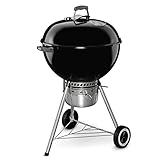
If you want one charcoal grill that behaves itself for six people, three times a month, for a decade, this is the unit the rest of the category is measured against. The Premium designation on the 22-inch Original Kettle centers on two upgrades over the base model: a hinged cooking grate that lets you lift a section and add or rearrange coals mid-cook without pulling the whole grate off, and a removable ash catcher that slides out from under the bowl so you are not lifting a hot kettle over a trash bag. Everything else is the formula Weber has built on for decades — a deep round bowl, a lid with a vent, and a set of dampers that responds predictably.
Key specs at a glance
- Body: 22-inch kettle, porcelain-enameled bowl and lid, black finish
- Cooking area: approximately 360 square inches on the primary grate — roughly six to eight burgers, four to six chicken breasts, or two racks of ribs cut in half
- Grate: plated steel, hinged in sections, so you can replenish charcoal through the opening
- Airflow: one-touch style sweeping damper system below the coals, plus a vented lid above; both adjustable independently
- Ash cleanout: removable ash catcher ring under the bowl
- Mobility: two wheels on one leg pair with a stabilizing leg, plus a lid holder and a tool hook
- Assembly: typically one to two hours for a first-timer with the included hardware and tools; two people make leg alignment easier
- Cover: a kettle-specific 22-inch cover is the correct fit; generic covers sag and pool water
Why it wins the top slot
The appeal is not a single feature, it is the air control. A 22-inch kettle gives you enough distance between the coal bed and the grate to build two zones — coals banked to one side for searing, empty space on the other for holding — and its dampers hold a setting instead of drifting. That is the skill that turns a charcoal grill from a weekend gamble into a repeatable cooking method. The hinged grate matters more than it sounds: on a non-hinged grate, adding coals mid-cook means lifting hot metal with a tool while juggling food, and most people simply under-load the grill rather than deal with it.
The ash catcher is the other practical winner. Barrel grills with pull-out trays still require you to tip a bowl; the kettle catcher lets you lift a ring off and dump it, which means you actually clean after every cook instead of letting ash accumulate and choke the bottom damper. That single habit is why heavily used kettles still run well in year five.
Where it falls short
It is the most expensive unit in this roundup for its cooking area, and it is not portable — you are moving a wide, wheeled kettle, not carrying one. It also does not smoke seriously. You can run a low-and-slow setup with a snake of coals and a water pan, and it works, but a long smoke on a kettle requires babysitting in a way an offset or a dedicated smoker does not.
Pros
- Best-in-class airflow control from two independently adjustable vents
- Hinged grate lets you add charcoal mid-cook without removing food
- Removable ash catcher keeps the bottom vent clear
- Massive accessory ecosystem: covers, chimneys, baskets, rotisserie rings
- Porcelain-enameled bowl resists rust far better than bare steel bodies
Cons
- Highest price tier here for roughly 360 square inches
- Not portable and not a genuine smoker
- Needs a properly fitted cover — a generic tarp will collect water in the bowl
Compared with the nearest alternative
Against the GREEN PARTY 22-inch kettle with wheels, the Weber is the same cooking footprint at a higher tier. GREEN PARTY gives you the round-bowl geometry and wheeled mobility at a mid-range price, but with a chrome-plated single-piece grate, a basic bowl cleanout and lighter-duty hardware. If you grill a few times a season and want the kettle shape cheaply, the GREEN PARTY is defensible. If you grill weekly and want the grill to still hold a stable 225 °F-ish low zone in five years, the Weber’s hinged grate and ash catcher are what you are paying for. Against the Jumbo Joe, this is simply the bigger, less portable version of the same idea — see the next section for the trade you are making.
2. Weber Jumbo Joe 18-Inch — Best for Small Spaces and Portability

The Jumbo Joe is the grill you buy when the constraint is not cooking area but where the grill lives. It is an 18-inch kettle — the round bowl and vented lid you already understand — packed into a body light enough for one person to carry by the lid handle, with a lid that locks down for transport. That combination makes it the only entry in this roundup that plausibly goes from a balcony to a tailgate to a campsite without a trailer.
Key specs at a glance
- Body: 18-inch kettle, porcelain-enameled bowl and lid, black
- Cooking area: approximately 240 square inches — around four burgers comfortably, or a whole spatchcocked chicken with room to move it off the hot zone
- Grate: plated steel, single piece (no hinge)
- Airflow: adjustable bottom damper plus vented lid; the same two-vent logic as its larger sibling in a smaller volume, which means temperature changes happen faster in both directions
- Ash cleanout: tip-out bowl — no separate catcher ring
- Portability: locking lid and carry handle, no wheels
- Assembly: quick — the leg and handle hardware on an 18-inch kettle usually assembles in well under an hour
- Cover: an 18-inch kettle cover, or a generic round cover if you can find one that fits snugly
Why it holds the budget slot
Two things make the Jumbo Joe better than its size suggests. The first is the lid lock: a locking lid turns a kettle from a thing that must live in one spot into a thing that can be moved, and that changes how often you actually grill. The second is that it keeps the kettle’s two-vent airflow logic. Cheaper small grills often have a fiddly or fixed intake, which makes them effectively on/off; the Jumbo Joe’s damper is adjustable and responsive, so you can still bank coals to one side and hold a cooler zone.
The smaller bowl is also an advantage in one specific way: it uses noticeably less charcoal to reach grilling temperature. For a two-person household, that is not a rounding error — it is a meaningful per-cook saving over a 22-inch bowl, which is why the portability downsizing is often a net win rather than a compromise.
Where it falls short
240 square inches is a real ceiling. Four adults eating generously is about the limit for a single load, and a six-person cook means two batches — which is fine if you are organized and miserable if you are not. The single-piece grate means you cannot add coals through a hinge; you either lift the grate or over-load at the start. The tip-out bowl cleanout also scatters ash, so you want to empty it into a bag or bin, not onto a patio, and the lack of a catcher means the bottom damper can get gunked up if you skip cleanouts.
Pros
- Genuinely portable: locking lid, carry handle, no wheels to fight
- Lowest price tier in this roundup
- Uses less charcoal per cook than a 22-inch bowl
- Keeps the two-vent kettle airflow system rather than a fixed intake
- Fast assembly and simple maintenance
Cons
- Approximately 240 square inches caps you at two to four people
- Single-piece grate — no mid-cook charcoal access without lifting it
- Tip-out ash cleanout is messier than a catcher ring
- Smaller bowl means temperature swings faster if you are careless with vents
Compared with the nearest alternative
Against the 22-inch Weber Original Kettle Premium, the Jumbo Joe is the same cooking philosophy at roughly two-thirds the grate area, one-third the accessory depth and a much lower tier. Choose the Jumbo Joe if the grill must move or must fit a small footprint. Choose the 22-inch if it will sit in one place and you regularly cook for four or more. Against the SUNLIFER offset smoker, the decision is about method rather than size: the SUNLIFER gives you an offset chamber for low-and-slow at a budget tier, but it is not a grill you carry anywhere and it needs more attention to hold indirect heat.
3. Royal Gourmet CD1824M 24-Inch Charcoal Grill — Best for Workspace and Mid-Size Crowds

This is the grill for people who are tired of juggling. The CD1824M pairs a rectangular 24-inch barrel body with a folding side table, which sounds like a small thing until you have tried to hold a spatula, a tray of raw meat and a lid at the same time over a round kettle. If your grilling pain point is logistics rather than fire control, this is the pick.
Key specs at a glance
- Body: 24-inch barrel/wagon style, rectangular, with a folding side table
- Cooking area: approximately 490 square inches claimed across the main grate — comfortably a six-person cook of burgers, sausages and vegetables at once
- Grate: porcelain-enameled wire, which resists rust better than plain chrome plating
- Airflow: adjustable vents on the firebox and the lid, giving a hot zone over the coal bed and a cooler zone at the ends of the rectangle
- Ash cleanout: front pull-out ash tray — the cleanest routine in this roundup
- Mobility: wheeled cart-style base with the folding table attached
- Assembly: the longest build here by a clear margin; a cart body, legs, shelf, tray and lid hinge typically run two to three hours, and two people help with the panel alignment
- Cover: a barrel-grill cover sized for a 24-inch cart, ideally one with a table fold allowance
Why the rectangle matters
A rectangular cooking surface changes how you cook. On a round kettle, the hot zone is a bullseye: coals in the middle, cooler ring around the edges. On a 24-inch barrel, the hot zone is a band you can arrange along one long edge, which makes it far easier to run a proper two-zone setup for a large group — searing at one end while finished food rests at the other, all on the same grate. With roughly 490 square inches, that means you are not sequencing batches. Six people eat at the same time instead of the first two eating while the last two wait.
The pull-out ash tray is the second real advantage. Barrel grills with a front tray let you slide it out, dump it, and slide it back without tipping the body. That keeps the bottom vents unobstructed, which is exactly the failure mode that kills cheap barrel grills after a season of neglect. The folding table seals the case for anyone with a small patio: it gives you a prep surface that disappears when the grill is stored.
Where it falls short
Assembly is the price of entry. A cart with a folding shelf has more fasteners and more alignment tolerance than a three-legged kettle, and if you rush the legs, the lid will not sit square. It is also less adaptable than a kettle: the barrel body lends itself to grilling and light smoking, but there is no rotisserie ring ecosystem and no long tradition of third-party accessories built for this exact footprint. Lid-off heat control is also less forgiving — a rectangular lid seals differently, and vent tuning on this shape rewards a bit more practice.
Pros
- Largest cooking area in the mid-range tier at around 490 square inches
- Folding side table provides genuine prep workspace
- Pull-out ash tray makes cleanup the easiest routine here
- Porcelain-enameled grates resist rust better than plated steel
- Rectangular grate makes two-zone cooking easier for large groups
Cons
- Longest assembly time in this roundup — budget a full afternoon
- Not portable and not suitable for balcony-size spaces
- Thinner accessory ecosystem than a kettle
- Rectangular lid tuning takes practice if you are used to a kettle
Compared with the nearest alternative
Against the Weber Original Kettle Premium 22-Inch, this is the workspace-versus-fire-control trade. The Royal Gourmet gives you about a third more grate area plus a table; the Weber gives you better airflow predictability and a decade of spare parts. If your cooks are large and your bottleneck is staging food, take the Royal Gourmet. If your bottleneck is hitting a temperature, take the Weber. Against the Bestfire 63-inch, the Royal Gourmet is the smaller, cheaper, easier-to-store version of the same barrel idea — the Bestfire is what you buy when 490 square inches is not enough.
4. SUNLIFER Charcoal Grill Offset Smoker — Best Budget Entry into Offset Smoking

An offset smoker puts the fire in a separate box beside the cooking chamber, so heat and smoke travel sideways rather than rising straight up. That single design choice makes true low-and-slow cooking possible — and it is genuinely harder to run than a kettle. The SUNLIFER offset is a budget-tier way to find out whether you enjoy that method before spending serious money on it.
Key specs at a glance
- Body: offset configuration — main cooking chamber with an attached side firebox
- Cooking area: main chamber grate plus the smaller firebox grate, which can double as a small direct-grill zone; the main chamber comfortably handles a couple of racks of ribs or a whole chicken
- Grate: chrome-plated wire, the most rust-prone of the materials in this roundup
- Airflow: intake damper on the firebox, exhaust stack damper on the main chamber — the classic offset control pair, and the adjustment you will spend most of your time on
- Ash cleanout: a bottom door in the firebox for raking ash out; expect to use a small shovel or poker
- Temperature monitoring: a lid-mounted dial thermometer on the chamber. Assume it reads at lid height, not at grate level, so treat it as a trend indicator and confirm with a probe thermometer where it matters
- Mobility: wheeled legs; heavier than a kettle of similar grate area because of the extra chamber
- Assembly: offset bolts, the exhaust stack, the firebox and the legs typically take one to two hours and are easier with two people supporting the chamber while the bolts are seated
- Cover: offsets are an irregular shape, so a generic cover rarely fits well — look for one sized for an offset with a firebox, or measure before buying
Why it earns a place
The reason to own an offset is flavor and heat direction. Because the fire is not under the food, drippings do not flare, which means a long cook does not turn into a grease fire. You can hold a low temperature with a small, steady fire in the firebox and let the exhaust damper pull smoke across the meat. On a kettle, replicating that requires a snake of coals, a water pan and constant lid checks; here, the geometry does the work.
The budget framing matters. This is the cheapest and least fussy way to learn whether you have the patience for a four-to-six-hour cook. If you discover you love it, you will upgrade; if you discover you hate tending a fire every 30 to 45 minutes, you have lost less. The firebox grate also gives you a second, smaller direct-cook zone for searing a couple of steaks while the main chamber holds something else.
Where it falls short
Offsets are the most maintenance-heavy design in this roundup. The firebox sees the hottest, dirtiest conditions, chrome-plated wire grates will show rust first if they are not dried and oiled after washing, and thin-gauge bodies lose heat faster than a heavy kettle, so fuel consumption per hour is higher. The lid-mounted thermometer reads at the top of the chamber rather than at grate level, where food actually sits — the difference between the two readings is often tens of degrees, which is exactly the source of most beginner frustration. Budget for a probe thermometer; it is not optional equipment on an offset.
Pros
- Lowest-cost way to try genuine offset smoking
- Separate firebox means drippings do not cause flare-ups over a long cook
- Classic two-damper control: firebox intake and chamber exhaust
- Firebox grate works as a small secondary direct-grill zone
Cons
- Chrome-plated grates are the first thing to rust if not dried and oiled
- Lid thermometer reads at lid height, not grate level — add a probe thermometer
- Needs fuel tending every 30–45 minutes on a long cook
- Thin steel loses heat faster than a heavy kettle, raising fuel use
- Irregular shape makes cover fit awkward
Compared with the nearest alternative
Against the Weber Jumbo Joe 18-Inch, this is method versus convenience. The Jumbo Joe is quicker to light, easier to clean and portable; the SUNLIFER gives you a real low-and-slow chamber at a similar price tier but demands patience and a thermometer. Against the Bestfire 63-inch, the SUNLIFER is the beginner’s offset while the Bestfire is a large-format, dual-tray barrel that covers smoking and high-volume grilling in one body — significantly more capacity, significantly more money, and significantly more grill to store.
5. Bestfire 63-Inch Oversized Charcoal BBQ Grill & Smoker — Best for Large Crowds and Dual-Zone Cooking
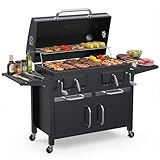
At 63 inches, this is not a family grill; it is an event grill. The defining feature is a pair of individual lifting charcoal trays, which means the coal bed is split into two independently adjustable zones inside one oversized body. You can run one side hot for searing and one side low for holding or smoking, or raise both trays close to the grate for maximum direct heat when you are cooking for twenty.
Key specs at a glance
- Body: oversized barrel-style charcoal grill and smoker, 63 inches, with two lifting charcoal trays
- Cooking area: party class — the grate spans the full length of the body, so multiple full racks of ribs, a large batch of chicken and a tray of vegetables can be worked at once without rotating the way you would on a kettle
- Grate: heavy-gauge wire, the sturdiest of the grates covered here
- Airflow: adjustable vents plus the two lifting trays, which move the coal bed closer to or further from food — a second, mechanical layer of heat control that vent-only grills cannot match
- Ash cleanout: removable ash trays beneath each lifting tray, so you can empty half the grill without disturbing the other half
- Mobility: wheeled, but it is a large, heavy unit — plan its position before assembly, because moving it after is a two-person job
- Assembly: the longest of the group by far; a body this size means many fasteners and a chamber that needs support while bolts are seated. Expect a full afternoon with help
- Cover: needs a cover sized for a 63-inch barrel — a generic kettle cover will not come close
Why the dual lifting trays matter
Heat control on most charcoal grills is one-dimensional: you move coals sideways to create hot and cool zones. Lifting trays add a second dimension. Raising a tray brings the coals closer to the grate, increasing radiant heat without adding fuel; lowering it does the reverse. That means you can sear on one side while holding food at a gentle temperature on the other, using the same amount of charcoal, and then drop both trays for a slow finish. It is the closest thing in this roundup to having a two-zone gas setup, but on charcoal.
The ash trays underneath each lifting tray are the practical counterpart. On a grill this size, ash volume is the real enemy: a single clogged vent can ruin an afternoon of cooking for a crowd. Being able to empty each tray independently means you can clean mid-event without shutting the whole grill down. That is a genuine ownership advantage, not a spec-sheet flourish.
Where it falls short
The honest objection is effort and storage. This grill takes an afternoon to assemble, needs a permanent position, drinks charcoal to fill two trays, and deserves a proper cover that costs more than a generic one. If you cook for four people twice a month, it is the wrong purchase — you will burn fuel heating empty grate. The large lid also retains weight and heat, which is fine with gloves and awkward without them. And unlike the kettle, there is no deep ecosystem of aftermarket parts; you are relying on the manufacturer for replacements.
Pros
- Huge party-size cooking area on a single grate
- Two independently lifting charcoal trays enable true dual-zone heat
- Separate ash trays under each zone allow mid-cook cleanout
- Heaviest-duty grate in this roundup
- Covers smoking and high-volume direct grilling in one unit
Cons
- Highest price tier and the highest cover cost
- Longest assembly of any grill here — a full afternoon with two people
- Needs permanent space; heavy and awkward to reposition
- Burns far more charcoal than needed for small cooks
- Thin third-party accessory support compared with a kettle
Compared with the nearest alternative
Against the Royal Gourmet CD1824M, the Bestfire is the same barrel concept scaled up and given lifting trays. The Royal Gourmet gives roughly 490 square inches, a folding table and easier storage for mid-size crowds; the Bestfire doubles down on capacity and dual-zone control for events. If you routinely cook for six to ten, the Royal Gourmet is the sane purchase. If you host twenty, the Bestfire is the one that stops you cooking in shifts. Against the SUNLIFER offset, the Bestfire trades the offset’s authentic sideways smoke path for far greater capacity and quicker high-heat grilling — it is the better all-rounder, the SUNLIFER is the better dedicated smoker for the money.
6. GREEN PARTY 22-Inch Kettle Charcoal BBQ Grill with Wheels — Best Mid-Range Kettle Alternative

This is the value play on kettle geometry. The GREEN PARTY 22-inch kettle gives you a round bowl, a vented lid and wheeled legs — the same basic architecture as the premium kettles in this roundup — at a mid-range tier. If you want the round-bowl cooking style and mobility without the top-tier outlay, this is where the decision gets interesting.
Key specs at a glance
- Body: 22-inch kettle, round bowl and lid, wheeled legs
- Cooking area: approximately 360 square inches class — same footprint as the 22-inch Weber, so the same practical headcount of four to six
- Grate: chrome-plated wire, single piece
- Airflow: adjustable bottom damper and lid vent — the standard two-vent kettle arrangement
- Ash cleanout: basic bowl cleanout; expect to tip or scoop rather than slide out a catcher
- Mobility: wheels on the leg assembly, plus a handle for rolling
- Assembly: simpler than any cart-style grill here — a kettle leg set and a handle typically come together in under an hour
- Cover: a standard 22-inch kettle cover fits; this is one of the easiest grills here to cover properly
Why it is worth listing
Because cooking area is where cheap grills usually cheat, and this one does not. A 22-inch kettle is a 22-inch kettle: you get the same roughly 360 square inches and therefore the same ability to bank coals to one side and hold a cooler zone. The wheeled legs are a real quality-of-life feature too — rolling a hot kettle away from a wall is much safer than dragging it, and it makes storing the grill against a fence or in a corner practical.
The cover situation is a quiet advantage. Round grills are easy to cover well; rectangular carts and offset smokers are not. A snug 22-inch kettle cover keeps water out of the bowl, keeps the vents from seizing, and is cheap to replace. Over five years, that is a bigger durability factor than most spec sheets admit.
Where it falls short
Everything that is not the bowl is lighter duty. Chrome-plated wire grates rust faster than porcelain enamel or plated steel hinges, and a single-piece grate means no mid-cook coal access without lifting hot metal. The basic ash cleanout is the weakest routine in this roundup: tipping a kettle scatters ash, and if you skip it, the bottom vents clog and your temperature control degrades. Hardware fit and finish will not match premium kettles, and you should expect to replace the grate before you replace the bowl.
Pros
- Full 22-inch kettle cooking area at a mid-range tier
- Wheeled legs make repositioning and storage practical
- Standard 22-inch kettle cover fits easily and cheaply
- Fast, simple assembly
- Keeps the two-vent airflow system that makes kettles versatile
Cons
- Chrome-plated single-piece grate is the first part to rust
- No hinged grate section for adding charcoal mid-cook
- Basic ash cleanout — tipping and scooping, not a slide-out catcher
- Lighter-duty hardware than premium kettles
Compared with the nearest alternative
Against the Weber Original Kettle Premium 22-Inch, this is the same size and airflow concept at a lower tier, minus the hinged grate, the ash catcher and the long-term parts availability. The upgrade path is clear: grill on a GREEN PARTY for a season, and if you find yourself wanting to add coals mid-cook and dreading the ash routine, the premium kettle is the natural next step. Against the Royal Gourmet CD1824M, the choice is shape: the GREEN PARTY is a round kettle with easier covering and simpler assembly; the Royal Gourmet is a wheeled barrel with far more grate area, a folding table and a pull-out ash tray, at the cost of a much longer build.
How to Choose
Charcoal grills look similar in photographs and behave completely differently in use. Work through the five decisions below in order — body style, grate material, ash cleanout, cooking area, then assembly and cover — and the shortlist will narrow itself.
Step 1: Choose airflow architecture before anything else
There are three architectures in this roundup, and they are not interchangeable.
Kettle (round bowl). Coals sit in a bowl below a circular grate; a bottom damper and a lid vent control airflow. The round shape creates a natural hot center and cooler edge, which is ideal for two-zone cooking for two to six people. Kettles are the most forgiving design for beginners because the coal-to-grate distance is consistent and the lid seals well. They are also the easiest to cover and the cheapest to accessorize.
Barrel / wagon (rectangular). Coals sit in a long tray under a rectangular grate; vents on the firebox and lid control airflow. The hot zone becomes a band along one edge, which makes large-group two-zone cooking easier and gives you more usable square inches per dollar. The trade is that rectangular lids seal less predictably than round ones, so vent tuning takes a session or two to learn.
Offset (separate firebox). The fire burns in a box beside the chamber, and heat and smoke travel sideways. This is the only architecture here designed for genuine low-and-slow cooking, and the only one where flare-ups from drippings are structurally avoided. It is also the most demanding: you will tend fuel every 30 to 45 minutes, and you must accept that a lid-mounted thermometer reads at lid height rather than at grate level — a probe thermometer is required equipment, not an upgrade.
A practical rule: if you want one grill that does everything competently, buy a kettle. If you want volume and workspace, buy a barrel. If you specifically want to smoke, buy an offset or a dual-tray barrel.
Step 2: Grate material — what rusts first, and when
Grate material is the single most reliable predictor of what you will replace first. Ranked from most to least rust-resistant in this roundup:
- Heavy-gauge wire (Bestfire class): thickest stock, holds heat well, resists warping, and tolerates the hottest firebox conditions. Expect the longest service life, with replacement availability tied to the manufacturer.
- Porcelain-enameled wire (Royal Gourmet class): a fused glass-like coating on steel. Excellent rust resistance as long as the coating is not chipped. Never scrape it with a metal brush — chipping the enamel is what starts the rust, so use a nylon or brass-bristle brush.
- Plated steel (Weber kettle class on the grates): durable in normal use and the material that most hinged grates are made from, so replacements are widely available. Dry and oil it after washing.
- Chrome-plated wire (GREEN PARTY, SUNLIFER class): the most rust-prone option here. It works fine for years if you dry it thoroughly and wipe it with a thin coat of oil after every wash. Leave it wet in a humid climate and it will pit within a season.
The maintenance routine that matters for all of them: after cooking, burn off residue with the lid on and vents open for 10–15 minutes, brush the grate while it is still warm, then — once cool — wipe with a lightly oiled cloth. Ten seconds of oiling is worth more than any coating.
Step 3: Ash cleanout — the system you will actually use weekly
The grills that fail early are not the ones that rust through; they are the ones whose bottom vents clog. Ash cleanout determines whether you can clear the vents quickly after every cook or whether you postpone it until the grill runs badly.
- Removable catcher ring (Weber kettle Premium class): lift the ring, dump it, done. The easiest per-cook routine, and the reason these grills hold temperature in year five.
- Pull-out ash tray (Royal Gourmet, Bestfire class): slide out, dump, slide back — the cleanest option on a rectangular body, and it keeps the firebox vents clear without tipping the grill.
- Firebox bottom door (SUNLIFER offset class): rake or scoop ash out through a door. Functional but messy, and the firebox is the dirtiest part of the grill.
- Basic bowl tip-out (Jumbo Joe, GREEN PARTY class): cheapest, but you scatter ash, and if your grill sits on a wooden deck you will avoid doing it. That avoidance is what clogs the vents.
If you grill more than twice a month, prioritize a catcher ring or a pull-out tray. It is not a luxury feature; it is the difference between a grill that holds its temperature for years and one that starts running hot-and-cold in eighteen months.
Step 4: Match cooking area to headcount — and to real numbers
Plan 70–90 square inches of grate per person for a mixed meal of burgers, sausages, chicken pieces and vegetables. That gives this simple size map:
- 1–2 people: 150–200 sq in. The 18-inch Jumbo Joe (roughly 240 sq in) gives comfortable margin and is the most portable option.
- 3–4 people: 240–320 sq in. The Jumbo Joe at a push, or a 22-inch kettle (roughly 360 sq in) with room to work in two zones.
- 4–6 people: 320–540 sq in. A 22-inch kettle (~360 sq in) or the Royal Gourmet 24-inch (~490 sq in, claimed) both land here. The kettle wins on airflow finesse; the barrel wins on staging space and a folding table.
- 8–20+ people: 800 sq in and up. The 63-inch Bestfire with its two lifting trays is the unit in this roundup built for that volume.
Also count the cooks where you want indirect space: a whole spatchcocked chicken needs a cool zone as large as the bird, so a grill sitting at exactly your headcount minimum will feel cramped the first time you cook something whole. Size up by one step and you will not regret it; size down and you will cook in batches.
Step 5: Budget assembly time and cover cost honestly
Assembly is real labor and it varies enormously across this list. Kettles — the Jumbo Joe and the GREEN PARTY — typically assemble in under an hour because there is one bowl, a leg set and a handle. The Weber Premium 22-inch runs one to two hours because of the lid holder, tool hook and ash catcher hardware. The SUNLIFER offset takes one to two hours with two people, mostly because the chamber must be supported while the firebox and stack bolts are seated. The two cart and barrel units are the outliers: the Royal Gourmet CD1824M is a two-to-three-hour build with a folding table, and the 63-inch Bestfire is a full afternoon with help. If you are buying a grill the day before a party, choose a kettle.
Covers are a running cost most buyers ignore, and fit matters more than material claims. Round kettles are easy: a dedicated 22-inch or 18-inch kettle cover fits snugly, sheds water, and is inexpensive to replace. Barrel carts need a cover sized to the cart dimensions with allowance for a folded table. Offsets are the awkward case — the firebox makes the footprint irregular, so take two measurements (overall length and depth at the widest point) before buying, and prefer a cover with a drawstring or tie-downs. A loosely fitting cover is worse than none: it pools water in the bowl, and pooled water in a kettle is what rusts the grate over a winter.
A worked example: what a grill actually costs per use
It helps to convert the tiers into a per-cook figure. Take a mid-range kettle and assume a five-year ownership horizon with fortnightly cooking for six months a year — roughly 130 cooks. If the grill and one cover come to a mid-range outlay, and you use a chimney starter’s worth of lump charcoal per cook at a typical bulk price, the fuel cost per session will usually be a small multiple of the amortized hardware cost, and the premium kettle’s higher purchase price spread over 130 cooks typically adds only a modest amount per session. That is the argument for buying the better airflow system if you will actually use it: over five years, the difference between a mid-range kettle and a premium one is a handful of small change per cook, while the difference in temperature stability is something you feel every single time.
Run the same math for a 63-inch party grill and the conclusion flips. If you cook for twenty people six times a year, the hardware cost per cook is high and the charcoal load is heavy. If you cook for twenty people monthly, it becomes the cheapest way to feed that many people well. Frequency, not price, decides which tier is rational.
Common mistakes to avoid
- Under-loading the charcoal to avoid waste. Running a thin coal bed means you cannot build a cool zone, and thin beds cool fast. Load enough to cover the area you are actually cooking over.
- Trusting a lid thermometer. It reads at lid height. Use a probe thermometer at grate level for anything where temperature matters — especially on offsets.
- Scraping enameled grates with a metal brush. Chipped enamel is where rust starts. Use nylon or brass bristles.
- Skipping the ash dump. Clogged bottom vents are the number one cause of “my grill stopped holding temperature.”
- Buying a cover that does not fit. A flapping, pooling cover accelerates rust rather than preventing it.
- Choosing a grill bigger than your typical cook. An oversized grill burns more fuel to reach the same grate temperature, forever.
Frequently Asked Questions
Is a 22-inch kettle big enough for six people?
Yes, with planning. A 22-inch kettle offers roughly 360 square inches, which comfortably covers six people if you are cooking burgers, sausages and chicken pieces in two zones rather than six large steaks at once. If your typical cook includes several large cuts plus sides, step up to the roughly 490 square inches of the Royal Gourmet 24-inch barrel, which lets you work everything at once.
Kettle or barrel — which gives better airflow control?
Kettles generally win. A round bowl with a bottom damper and a sealing lid responds predictably and holds a setting, which is why kettles are the standard recommendation for learning charcoal. Barrel grills offer more grate area and a longer hot band for big-group two-zone cooking, but rectangular lids seal less evenly, so expect a couple of sessions before vent tuning feels intuitive.
How long does a charcoal grill take to assemble?
It varies more than buyers expect. Simple kettles such as the Jumbo Joe and the GREEN PARTY 22-inch typically assemble in under an hour. The Weber Premium 22-inch runs one to two hours once the ash catcher, lid holder and tool hook are fitted. Offsets take one to two hours with two people because the chamber needs support while the firebox is bolted on. Cart and oversized barrel grills are the outliers at two to three hours, and the 63-inch Bestfire realistically takes a full afternoon with help.
Do I really need to buy a cover?
Yes, if the grill lives outdoors. A fitted cover keeps rain out of the bowl, stops the vents from seizing and slows rust on the grate — the part that fails first. The critical point is fit: a 22-inch kettle cover on a 22-inch kettle is easy, but an offset or a large barrel needs a cover sized to its real footprint, and a loose cover that pools water does more harm than good.
What wears out first on a budget charcoal grill?
The cooking grate, nearly always. Chrome-plated wire is the most rust-prone grate material in this roundup, and it will pit before the bowl rusts through. Drying it thoroughly and wiping it with a thin coat of oil after each wash adds years. After the grate, watch the bottom vents — ash accumulation is what degrades temperature control, not structural failure.
Can I smoke on a kettle or do I need an offset?
You can smoke on a kettle using banked coals and a water pan, and it works for shorter cooks like ribs or a whole chicken. What a kettle cannot do easily is a long, unattended burn, because you will be checking and replenishing fuel. If smoking is your main interest rather than an occasional experiment, an offset smoker gives you the sideways heat path that avoids flare-ups and holds a steady low temperature for hours.
How much charcoal does a large grill waste on a small cook?
An oversized grill is penalized twice over: you need more fuel to bring a larger area up to temperature, and more of that heat radiates away unused. A 63-inch grill cooking four burgers will burn a multiple of what an 18-inch kettle needs for the same four burgers. If most of your cooks are small, size down and hold the big grill for events — or accept the fuel cost as the price of not cooking in batches.
Which grill is best for a balcony or small patio?
The Weber Jumbo Joe 18-inch is the strongest fit. It has a locking lid and a carry handle so it can be moved indoors or into a storage closet, uses less charcoal per cook, and its smaller bowl heats up faster. Add a fitted cover and empty the tip-out ash pan into a bag rather than shaking it out, and it behaves well in a confined space. A full cart-style barrel grill is usually too large and too heavy for a balcony.
The Bottom Line by Situation
Cooking for 4–6 people, most weekends, in one fixed spot: the Weber Original Kettle Premium 22-Inch. The hinged grate and ash catcher are ownership features you will notice every single cook, and its airflow is the most predictable here.
Two to four people, limited space, or a grill that has to travel: the Weber Jumbo Joe 18-Inch. Less charcoal per cook, a locking lid, and the same two-vent kettle logic in a body one person can carry.
Big cooks where staging food is the bottleneck: the Royal Gourmet CD1824M 24-Inch. Around 490 square inches, a folding prep table and the easiest ash routine in this roundup — in exchange for a long build.
You want to try real low-and-slow smoking on a budget: the SUNLIFER Offset Smoker, plus a probe thermometer. Budget for fuel tending and grate maintenance; you are paying for method, not convenience.
You host large groups or want dual-zone searing and smoking in one body: the Bestfire 63-Inch. Two lifting charcoal trays and separate ash trays make party-size cooking manageable, provided you have the space and the patience to assemble it.
You want the 22-inch kettle experience for less: the GREEN PARTY 22-Inch Kettle with Wheels. Same cooking footprint, simpler hardware, and a cover that fits properly — just plan to replace the chrome-plated grate first.




Write Your Review
No reviews yet. Be the first to share your experience!