
Key takeaways
- 10 gallons: 83 pounds
- 20 gallons: 167 pounds
- 30 gallons: 250 pounds
- 40 gallons: 334 pounds
- 50 gallons: 417 pounds
The best lawn rollers for most homeowners are water-fill poly-drum rollers in the 18–24-inch range, while steel rollers are the better choice for frequent, heavy-duty leveling and tow-behind models suit large lawns or tractor owners.
Our top picks


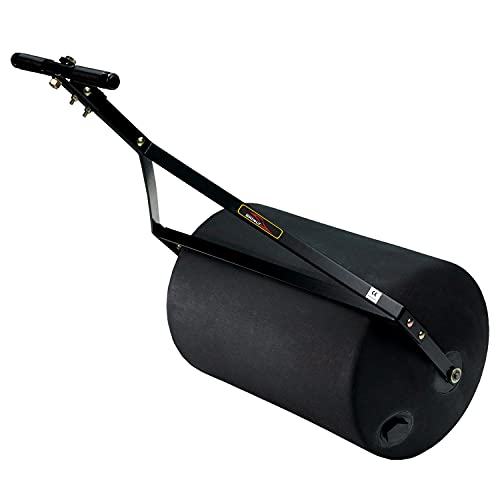

As an Amazon Associate we earn from qualifying purchases at no extra cost to you. Ratings are shown as listed on Amazon.
Best lawn roller choices by situation
| Situation | Best choice | Useful specification | Why it fits |
|---|---|---|---|
| Small residential lawn | Push water-fill poly roller | 18–24 in. wide; 20–35 gal | Easy to store, maneuver, empty, and refill |
| Newly seeded lawn | Light water-fill roller | 10–20 gal; roughly 80–170 lb filled | Provides seed-to-soil contact without excessive compaction |
| Uneven established lawn | Medium poly or steel roller | 24–30 in. wide; 25–45 gal | Enough weight for shallow bumps and frost heave |
| Large property | Tow-behind roller | 36–48 in. wide; 40–60 gal | Covers more ground with less walking and effort |
| Frequent commercial or field use | Steel tow roller | 36–60 in. wide; 500–1,000+ lb filled | Resists impact and repeated loading better than light poly models |
| Limited storage space | Compact poly push roller | 18–20 in. drum; removable handle | Can be drained and stored vertically or on a garage shelf |
Steel versus poly lawn rollers
Steel drums: durable and naturally heavy
Steel rollers are the traditional heavy-duty option. Their drum walls tolerate rough handling, contact with stones, and frequent towing better than most residential plastic drums. A steel drum also has a higher empty weight, which can help when you need meaningful pressure without filling it completely.
The trade-off is ownership. Steel can rust if water remains inside, the paint is chipped, or the roller is stored outdoors. A steel drum may also be difficult to move when empty because its fixed weight remains substantial. On a small lawn, that extra mass can make turning and transporting unnecessarily tiring.
Choose steel when the roller will be used often, transported over uneven ground, or pulled behind a capable garden tractor or utility vehicle. Look for a powder-coated or corrosion-resistant finish, sealed bearings, a grease fitting where applicable, and a drain plug that is easy to reach.
Poly drums: lighter, quieter, and easier to own
Polyethylene drums are common on residential water-fill rollers because the empty roller is easy to lift or roll into storage. Filling the drum with water adds weight only when needed, and draining it reduces stress on the frame and wheels. Poly also will not rust, and it tends to be quieter when it contacts paving or edging.
Plastic is not indestructible. Dragging a poly roller over sharp gravel, leaving it in direct sun for years, or towing it too quickly can damage the drum or frame. A good model should have thick, UV-resistant plastic, a reinforced axle area, a broad scraper bar, and a cap with a reliable gasket.
For most homeowners, poly is the better material because the roller’s weight can be adjusted to match the job rather than staying permanently heavy.
How much water-fill weight do you need?
Water weighs about 8.34 pounds per U.S. gallon. The approximate added weight is therefore:
- 10 gallons: 83 pounds
- 20 gallons: 167 pounds
- 30 gallons: 250 pounds
- 40 gallons: 334 pounds
- 50 gallons: 417 pounds
Add the empty weight of the roller to estimate its operating weight. For example, a 24-inch poly roller weighing 35 pounds empty and holding 25 gallons will weigh about 244 pounds when full: 35 + (25 × 8.34) = 243.5 pounds.
More weight is not automatically better. Heavy rolling can compact soil, restrict air and water movement, and make turf roots struggle. For newly spread seed, start with a partly filled drum, often around 10–20 gallons for a residential push roller. The goal is to press seed into the surface, not squeeze the soil into a hard layer.
For leveling shallow frost heaves or smoothing a prepared seedbed, 20–35 gallons is a practical range for many home lawns. Fill more only if the surface remains uneven after a slow pass and the soil is firm enough to support the load without deep ruts.
Push or tow: which design is right?
Push rollers
Push models are best for small and medium lawns, tight gates, garden paths, and areas where precise control matters. You can change direction quickly and stop immediately around trees, beds, and sprinkler heads. They also tend to cost less and require no compatible vehicle.
The limitation is physical effort. A full 30-gallon push roller may weigh around 285–330 pounds after including the drum and frame. Even with a wide handle, turning that load on turf is demanding. A narrow 18–20-inch model is easier to control, but it requires more passes.
Tow-behind rollers
Tow rollers are preferable for large yards, sports areas, pasture edges, and repeated seasonal use. They attach to a riding mower, lawn tractor, or utility vehicle and cover a wide strip in fewer passes. Some have a seat or operator platform, but a basic roller should still have a rounded or flexible hitch that can turn without twisting the frame.
Check the towing vehicle’s capacity before buying. A full 50-gallon roller can exceed 450 pounds, and rolling resistance rises on slopes, wet soil, and rough ground. Avoid towing a heavy roller with a lightweight riding mower on steep terrain. A tow model also needs adequate clearance at gates and enough turning room at lawn edges.
Decision matrix: match the roller to your lawn
| Budget and use pattern | Recommended design | Target width | Fill strategy |
|---|---|---|---|
| Occasional seeding, low budget | Basic push poly | 18–20 in. | Half-fill or less; drain after use |
| Several lawn projects each year | Reinforced push poly | 20–24 in. | 10–30 gal depending on soil firmness |
| Large lawn, experienced operator | Tow-behind poly or steel | 36–48 in. | 25–50 gal; use only on firm, moderately moist soil |
| Frequent professional-style work | Heavy steel tow model | 48–60 in. | Use manufacturer’s load limit and vehicle rating |
| Small shed or apartment storage | Drainable compact poly | 18–20 in. | Empty after each job; prioritize removable handles |
Features that matter more than maximum capacity
- Wide scraper bar: Prevents wet soil from building up on the drum and changing its balance.
- Rounded drum edges: Reduce gouging when you turn at the end of a pass.
- Secure fill cap: A threaded cap with a gasket is less likely to leak during storage or towing.
- Drain position: A low drain makes it possible to remove nearly all water before freezing weather.
- Axle and frame support: Reinforced brackets matter because the axle carries the full filled weight.
- Hitch design: Tow models should have a pin-compatible hitch and enough articulation for turns.
- Replaceable hardware: Standard bolts, bushings, and bearings are easier to maintain than proprietary parts.
How to use a lawn roller without damaging turf
- Fix major problems first. Fill deep holes and remove large stones. A roller smooths small irregularities; it does not replace grading.
- Choose the right moisture level. Soil should be slightly damp but not sticky. If soil clings to your shoes or the drum, wait.
- Start with a partial fill. Use the least weight that produces the desired result, particularly on established turf.
- Make straight, overlapping passes. Walk or tow at a slow, steady pace. Overlap each pass by several inches to avoid ridges.
- Limit turns on the lawn. Turn on a hard surface or make wide turns so the drum does not twist grass and soil.
- Inspect after one pass. Stop if you see ruts, standing water, flattened crowns, or soil sticking to the drum.
- Drain, rinse, and dry. Empty the drum after use, rinse away soil, and store it under cover.
Durability and maintenance realities
The parts most likely to wear first are axle bushings, wheel or drum bearings, hitch pins, scraper mounts, and fill-cap seals. Check the axle before every major job for side-to-side movement. Replace worn bushings or bearings before the drum begins rubbing against the frame.
Do not leave water inside over winter in a climate where freezing occurs. Ice expansion can split a poly drum, distort a steel drum, or damage the drain fitting. If the roller has a grease fitting, lubricate it according to the manufacturer’s schedule; otherwise, keep the axle clean and inspect it regularly.
Common mistakes include filling the roller completely for every task, rolling saturated soil, towing too fast, and storing a steel model directly on wet ground. These shortcuts can create compaction, ruts, corrosion, or premature axle failure.
Bottom line
Choose a water-fill poly push roller around 18–24 inches wide for ordinary residential seeding and light leveling. Move up to a 24–30-inch model when you need more coverage and adjustable weight. Choose a tow-behind roller for large properties, and choose steel when repeated heavy use and impact resistance matter more than easy storage. The best lawn roller is the one that supplies only the pressure your so




Write Your Review
No reviews yet. Be the first to share your experience!